Jahangirpuri Hanuman Jayanti Violence: Planned Violence, Zero Remorse, and Justification in Name of Jihad

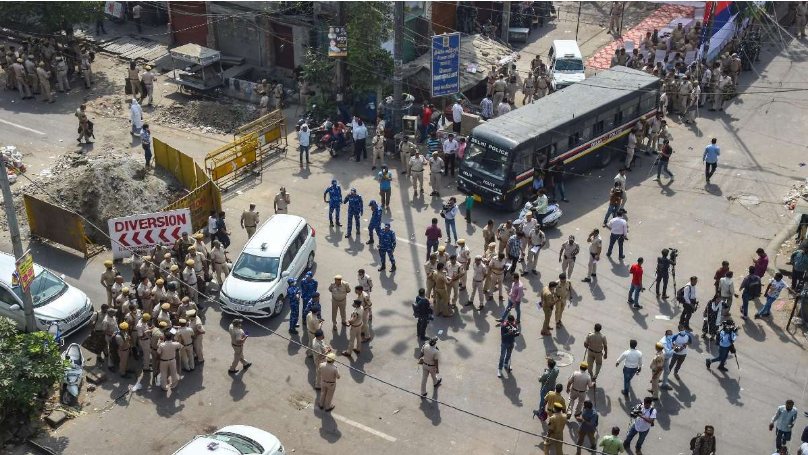
Violent clashes erupt on the occasion of Hanuman Jayanti in Jahangirpuri, Delhi | Image Source: India TV
On April 16, 2022, during the Hanuman Jayanti Shobha Yatra, the religious procession was brutally attacked in Delhi’s Jahangirpuri as it crossed from near a Masjid. Eyewitness accounts and subsequent investigations into the matter have indicated that the attack by the radicalized group on the peaceful protestors had been planned in advance. The violent group was already armed with sticks, swords, bottles, and firearms as they assaulted the devotees, including women and children. As the case unfolded, the incident quickly brought the main accused, Mohammed Ansar, to the limelight, not only for how he planned or orchestrated the entire incident, but prominently because he showed not even an iota of remorse. Shockingly enough, when Ansar was produced before the court, he defended and trivialized the entire incident with a “jhukega nahi” gesture, a reference from the 2021 Telugu film, Pushpa: The Rise. This violent incident and its later defiance only hint at how the “jihadi” mindset, where violence is not seen as wrong, but is justified as necessary, is deeply ingrained in the minds of Islamist radicals.
What Happened on April 16, 2022?
According to reports, the procession was underway in its designated route when it approached a Masjid in C Block. At that point, a large crowd of radicalized Islamist miscreants was already present, carrying lathis, edged weapons, bottles, and firearms. As the procession reached the area, the situation escalated rapidly, with the radicalized group violently attacking the devotees. The scale of preparedness observed at the site immediately confirmed that the violence had been anticipated and organized in advance. Later investigations, too, revealed the same. Reports confirmed that the main accused, Md. Ansar had convened a meeting nearly a week before Hanuman Jayanti, involving around 30 individuals, including some juveniles. During this meeting, plans were allegedly discussed to block and confront the procession.

Md. Ansar, the prime accused in the incident | Image Source: Times of India
Investigations have also revealed that Mohammad Ansar was a habitual offender with a history of arrests and multiple cases. His first recorded arrest dates back to 2009 under the Arms Act for illegal possession of a weapon. In later years, he faced charges related to assault, criminal intimidation, and an incident involving outraging the modesty of a woman. He was also repeatedly detained under preventive provisions and booked under the Gambling Act and Arms Act, with reports linking him to illegal liquor and gambling activities in the area. Such a record indicates familiarity with unlawful activity and suggests that the alleged role in the Jahangirpuri incident was not an isolated departure but part of a longer pattern of jihadi behavior.
No Remorse, But Justification
One of the most significant aspects of the case is not only the alleged planning and execution of violence, but the absence of remorse afterward. Ansar’s courtroom gesture, “jhukega nahi,” mimicking a pop-cultural cinematic expression, was widely circulated as an indication that the act was not seen by him as morally wrong. In studies of radicalization, this stage is critical: When individuals begin to justify violence as legitimate, necessary, or even righteous. In such frameworks, jihadis interpret acts of violence as justified responses rather than criminal offenses.

Jahangirpuri violence accused enters Rohini court in 'Pushpa' style | Image Source: India TV
Such incidents are part of a recurring pattern wherein radicals have often targeted religious processions. In Bengaluru in April 2024, devotees celebrating Ram Navami were attacked and allegedly forced to chant “Allah Hu Akbar" instead of “Jai Shri Ram". When they resisted, the attackers reportedly returned with additional people, escalating the assault. Justifying their act, the violent Islamist group said, “No Jai Shri Ram, only Allah," as they also tried to snatch their saffron flags.

Screengrabs from the viral video of Bengaluru incident | Image Source: the
In another case in Maharashtra’s Amravati, on the occasion of Eid-e-Milad-un-Nabi in October 2022, slogans with violent connotations of “sar tan se juda” were raised. The violent Islamic mob raised the slogan, "Gustakh-e-Nabi ki ek saza, tan se sar juda," meaning “The punishment for insulting the prophet is to be separated from the body,” while the police remained a mute spectator.
The Jahangirpuri violence of April 16, 2022, cannot be viewed merely as a law-and-order breakdown; it reflects a troubling pattern where premeditated attacks are followed by open justification. When such acts are not only carried out but also trivialized and defended, they signal a mindset in which wrongdoing is no longer recognized as such. Addressing this challenge, therefore, requires not only strict enforcement of the law but also a clear recognition of the ideological conditioning that enables individuals to justify violence instead of rejecting it.