Tamil New Year: A Journal of Kallazhagar and the Chithirai Spirit

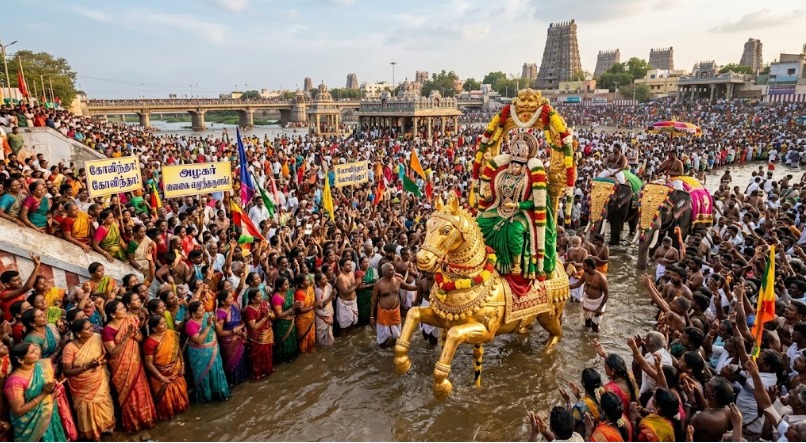
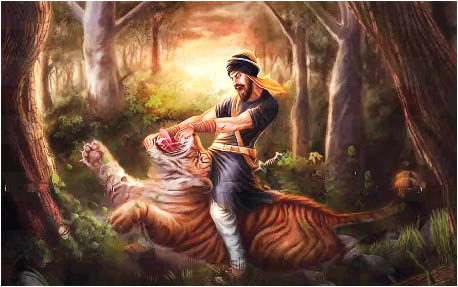
This image is AI-generated
The air in the Alagar Hills carries a scent of crushed jasmine and sun-baked earth as the Tamil month of Chithirai begins. For centuries, this wasn’t just a change in the calendar; it was a period of deep religious tension. The city of Madurai was a landscape of two halves: The Shaivites, who worshipped at the Meenakshi Amman Temple, and the Vaishnavites, who looked toward Alagar Kovil. They were two rivers flowing in the same valley but never meeting—until the 17th-century ruler King Thirumalai Nayak rewrote their destiny, turning a theological divide into a grand family reunion by aligning their festivals.
Something very similar to a Kumbh happens in Madurai every April. The story begins on Puthandu (April 14, 2026), the Tamil New Year. While families across the state look into mirrors at gold and fruits for prosperity, the "Beautiful Thief," Lord Kallazhagar (a form of Vishnu), prepares for a journey. He sheds his princely robes for the attire of a hunter, mounting a golden horse. His mission is one of sibling love: He is traveling to Madurai to witness the wedding of his sister, Goddess Meenakshi, to Lord Sundareswarar (Shiva). This narrative effectively declared that the God of the Vaishnavites was the brother-in-law of the God of the Shaivites, stitching the two faiths into a single tapestry.
As the Chithirai sun blazes, the festival officially commences with the Flag Hoisting (April 19, 2026). Kallazhagar’s procession winds through rural hamlets, stopping at hundreds of roadside shelters. However, a divine interruption occurs at the banks of the Vaigai River. The sage Manduka, cursed to live as a frog, cries out for salvation. Kallazhagar, moved by the sage’s penance, pauses to grant him Moksha (liberation). It is this act of mercy that creates the "delay" in the legend.
By the time the Lord reaches the edge of Madurai, the auspicious hour has passed. The celestial wedding, Meenakshi Thirukalyanam (April 28, 2026), has already concluded. In a display of very human-like "divine fury," Kallazhagar refuses to enter the city. This moment is the climax of the festival: The Alagar Vaigai Eluntharulal (May 1, 2026). Clad in green silk—symbolizing future prosperity—he plunges into the river on his golden mount while the air vibrates with the chants of millions.
The beauty of the story lies in the resolution. To appease her brother, Goddess Meenakshi and Lord Sundareswarar travel to the riverbank. They meet him not as distant deities, but as family members coming to soothe a hurt relative. They present him with grand gifts, and in this exchange, the ancient rivalry between the two sects vanishes.
Today, this story is documented as one of the world's largest annual human gatherings. According to reports from the Madurai District Administration and The Hindu, the festival consistently attracts over one million devotees in a single day. In peak years, officials estimated the crowd at the riverbanks to exceed 1.5 million people, rivaling the daily attendance of the Kumbh Mela. This "sea of humanity" serves as a living testament to the king's vision of social harmony.
Authentic historical records from the Tamil Nadu Tourism Portal and news archives from The Hindu confirm that this merger continues to be a deliberate effort to foster unity. It transforms a sectarian boundary into a celebration of kinship, ensuring that every Tamil New Year begins not just with a new date, but with a renewed sense of belonging to a shared heritage.