Bijon Setu Massacre: When an IAS Officer Tried to Break Silence, Power Silenced Him

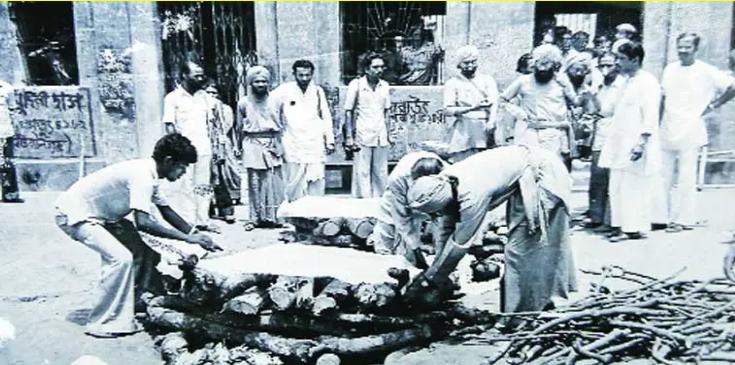
The Bijon Setu Massacre | Image Source: Indian Express
What happened on the morning of April 30, 1982, at Kolkata's Bijon Setu was dismissed merely as the "deed of a frenzied mob." On that day, in the ensuing violence, 17 Ananda Marga ascetics were beaten to death and burned alive. Allegations pointed to workers of the Communist Party. Even 44 years later, the victims' families have not received justice due to a lack of evidence. But there's a suppressed side to this incident that's rarely discussed: The story of an IAS officer who uncovered the truth hidden in the files. His name was Sher Singh. Had his words been taken seriously, it would have raised the question: Was the Communist Party government in Bengal merely incompetent during that time, or deliberately inactive?
At the time, Sher Singh was the District Magistrate of South 24 Parganas, the very district from which the Ananda Marga ascetics had set out in taxis but never returned alive. Rumors of child kidnapping spread by Communist Party workers led them to drag 17 Ananda Marga ascetics from taxis at three spots near Bijon Setu in Kolkata and kill them brutally. Several ascetics were doused in petrol and set ablaze while still alive. After this gruesome massacre, the administration claimed ignorance, calling it a spontaneous mob outburst. However, Sher Singh was among the officers who had closely observed internal meetings, messages, and file movements. According to him, it wasn't a sudden public outrage; prior intelligence about potential clashes existed but was dismissed as routine law-and-order issues. The absence of police, lack of timely alerts, and sluggish investigation appeared not as isolated lapses but as a pattern.
In 1994, Sher Singh filed petition number 1108 in the Central Administrative Tribunal (CAT). Formally against his suspension, it concealed an explosive allegation: He was suspended for refusing to parrot the government's "official line." He claimed a fair probe could reveal not just administrative negligence but possible political directives—something uncomfortable for those in power. This wasn't merely a service dispute; it was an administrative rebellion, a voice from within the files challenging the corridors of power.
In his affidavit, Sher Singh stated he had facts and documents that could reframe the massacre, but he was bound by the Official Secrets Act; he was ready to disclose everything if ordered by competent authorities. This could have been democracy's chance to unearth the truth and conduct an independent inquiry. Instead, departmental action against him intensified, leading to his suspension. The government sidestepped direct rebuttals to his claims, labeling him "insubordinate" instead of proving them false or baseless.
Bengal's then-Chief Minister Jyoti Basu of the Communist Party dismissed the killing of 17 people by saying, "What could be done? Such things happen." This statement epitomized the government's attitude. Viewed alongside Sher Singh's petition, it suggests not just insensitivity but a policy of inaction. Were the missing police, absent wireless alerts, and delayed probe mere coincidences? Or an administrative strategy to let the storm pass, and the dust settle? Sher Singh's account doesn't prove direct government orders for the murders but shows no intent to let the full truth emerge. In a democracy, inaction can sometimes play an active role.
Time has passed, governments have changed, yet neither the Bijon Setu massacre victims' families, nor Sher Singh, nor answers to his questions have received justice. The massacre remains in history's pages with words but not the full truth—one side a blood-soaked chapter of 17 ascetics' deaths, the other a silenced officer's testimony. History may decide if only the mob was guilty or if institutional silence was complicit. Sher Singh's story forces us to reflect that democracy lives not just on elections but on the ability to bring truth to light.
What was the Bijon Setu Massacre?
Ananda Marga renunciates were heading in separate vehicles from Bijon Setu in Kolkata to a religious program at the Tiljala center, intending to pray for world peace through yoga, meditation, and mantras. Unbeknownst to them, death awaited. As they proceeded with thoughts of divine meditation, Communist Party hate-mongers surrounded them near Bijon Setu, having premeditatedly spread child kidnapping rumors. They dragged the ascetics and nuns from their vehicles, attacking with stones and sticks. Soon, many bodies were bloodied—heads split, eyes gouged, limbs broken. The innocent ascetics pleaded, hands folded in prayer, but the communists' hate-filled hearts didn't melt. Instead, they poured petrol and kerosene on them and set them ablaze, burning several alive. In total, 16 male ascetics and 1 female nun—17 lives—were lost.
What is Ananda Marga?
Ananda Marga is a spiritual and social organization founded in 1955 by Prabhat Ranjan Sarkar. Its renunciates promote meditation, yoga, and spirituality. Founder Sarkar propounded the Progressive Utilization Theory (PROUT) in 1959, opposing both communism and capitalism.