The Royal Indian Navy Mutiny 1946: How One Sailor Challenged British Power | The Story of B.C. Dutt
In February 1946, hundreds of ratings of the Royal Indian Navy (RIN)—the Indian sailors—raised their voices against British rule.

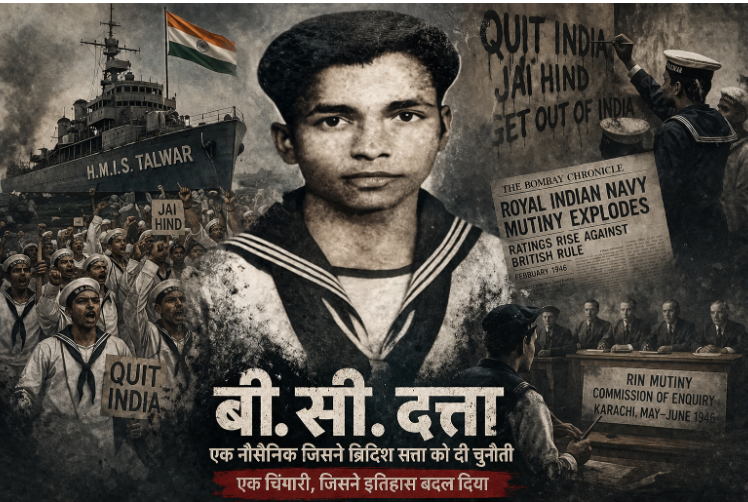
This image is AI-generated
In February 1946, hundreds of ratings of the Royal Indian Navy (RIN)—the Indian sailors—raised their voices against British rule. The spark of this uprising was lit by a 23‑year‑old junior sailor: Balai Chandra Dutt (B.C. Dutt). He was serving as a Leading Telegraphist (senior telegraph operator) at the naval training centre HMIS Talwar in Bombay.
In early February 1946, B.C. Dutt, serving as a Leading Telegraphist (senior telegraph operator) at the Royal Indian Navy’s training centre HMIS Talwar in Bombay, wrote nationalist slogans on the walls of the ship’s premises. But the sentries on duty soon caught him. They found glue still on his hands and a bottle with notices inside his pocket, clear proof of his act of defiance. The commanding officer of HMIS Talwar, Commander Frederick King, took strong objection to these slogans and ordered an immediate inquiry. When Dutt’s locker was searched, the officers found a diary, nationalist books, and receipts from the Azad Hind Relief Fund. Convinced of his role, Commander King placed Dutt in solitary confinement. The news of his arrest spread quickly across the ship, and the ratings’ anger flared into open resentment.
Following his arrest on February 18, the ratings launched a hunger strike. Dutt’s arrest, along with Commander King’s verbal abuse—calling them “sons of bitches” and “sons of coolies”—became the central triggers of the strike. The mutiny spread rapidly, engulfing 78 ships and 20 coastal stations across British India. However, on February 23, senior leaders like Sardar Vallabhai Patel and other prominent figures assured the strikers that there would be no persecution. Acting on these assurances, the Navy Strike Committee decided to surrender. Within hours of the surrender, Dutt was dismissed from service with the label “Disgracefully discharged from His Majesty’s service.” He was sent to the Mulund Detention Camp, where conditions were worse than in an ordinary jail. In all, 476 ratings were dismissed from the Royal Indian Navy.
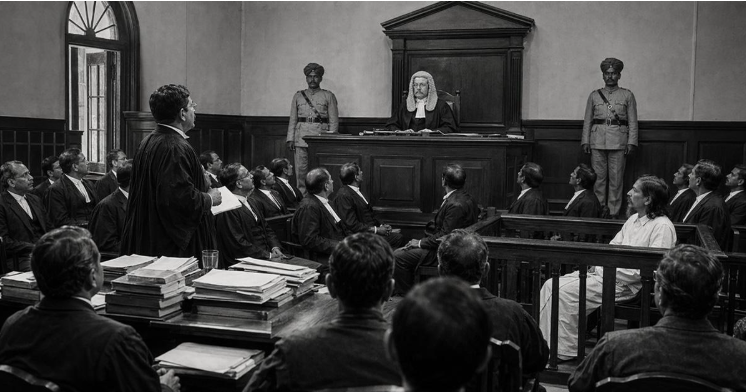
The RIN Mutiny Commission of Enquiry held its proceedings in Karachi’s Muslim Hostel from May 27 to June 1. B.C. Dutt was summoned as a principal witness. Before the Commission, he gave a full and honest account of how he, and Indian sailors generally, had been discriminated against and humiliated. His testimony in June 1946 laid bare the truth—but brought him no justice.
A summary of the Commission’s report was published in the Gazette on January 20, 1947, but the complete 600‑page report has still not been fully declassified or made public today. More than eight decades later, the injustice of that time remains a raw, unhealed wound.
After India and Pakistan gained independence, the Royal Indian Navy was also partitioned. Yet through this process, British officers retained tight control over senior positions. The command of the Indian Navy remained with Vice Admiral William Edward Parry. The sailors who had earlier been dismissed from service received no pardon, no reinstatement, and no formal review. Even though leaders like Sardar Patel had promised redress, those assurances remained unfulfilled on the ground. At a time when the ratings most needed political and public support, Mahatma Gandhi publicly condemned the strike, calling it “violent” and refusing to endorse it.
In his 1971 book Mutiny of the Innocents, Dutt wrote: “We, the ratings of the RIN Mutiny, have become an inconvenient national memory.”
B.C. Dutt, born in 1923, is not just the story of a young telegraphist, but the story of thousands of ratings who risked their lives, their careers, and their futures to challenge the British Empire directly. In June 1946, during the Commission of Enquiry, Dutt demonstrated that the RIN Mutiny was a crucial chapter in the struggle for independence. Eighty years later, the tale of B.C. Dutt and the courageous sailors like him remind us that in the battle for freedom, even ordinary soldiers played an extraordinary role. Forgetting these memories would be dangerous for us, because correctly remembering history is what can truly inspire the generations to come.