ISI’s First Indian Standard was National Tricolor Flag: Know The Full Story
The Indian Standards Institution (ISI) was established on January 6, 1947, to ensure world‑class quality for every product in the new India.

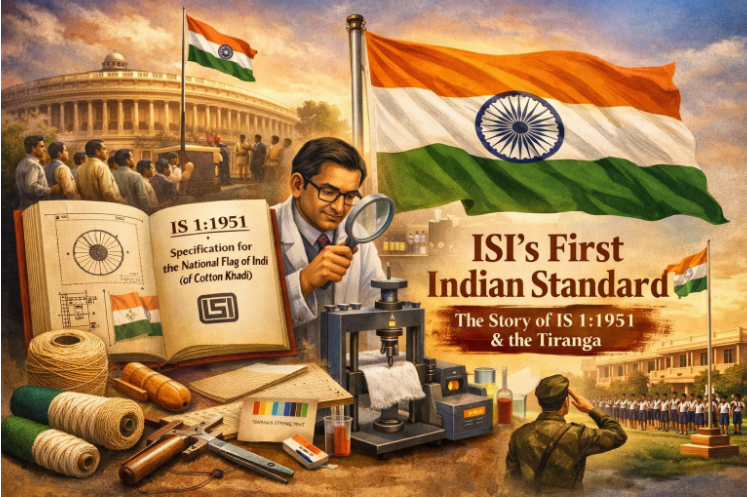
This image is AI-generated
Have you ever wondered that the very first official Indian “standard booklet” of independent India was not issued for the strength of steel, the brightness of electricity, or for some factory machinery, but simply for our national flag, the Tiranga? Yet this is actually true. Let’s understand how this unique story began, how it unfolded, and how a simple piece of khadi cloth came to be treated as a full‑fledged “engineering” product of the revolution.
The Indian Standards Institution (ISI) was established on January 6, 1947, to ensure world‑class quality for every product in the new India. Around the same time, the Constituent Assembly formally adopted the tricolor flag designed by Pingali Venkayya on July 22, 1947. The government decided that this flag would not remain only a symbol of emotion; it had to look the same, and be flawless, everywhere. A National Flag Committee was therefore formed, and work began. From here, the foundation of the first Indian Standard, IS 1:1951, was laid—a standard that would later make history.
Then came the historic moment in 1951 when ISI officially issued IS 1:1951, titled “Specification for the National Flag of India (Cotton Khadi).” This was no ordinary document. It turned the emotional spirit of khadi into a fully scientific specification. The hand‑spun and hand‑woven cotton fabric was described with such precision that each would have the perfectly same measurements, the same colours, and the same strength. In 1964, the first amendment mandated the conversion of all dimensions to the metric system, and in 1968, IS 1:1968 was published, which remains in force today. In this way, the story moved forward, and a simple piece of cloth earned the status of a nationally‑recognized “engineering” standard.
In the third phase, the entire khadi weaving process was codified. Khadi‑dockets, the exact tristimulus values of the colours, the navy‑blue shade of the Ashoka Chakra, the 24 spokes, and the precise central positioning on both sides were all firmly defined. Nine standard sizes were fixed, along with specifications for hemp cordage, wooden toggles, stitching at 4 stitches per cm, and mandatory BIS‑laboratory testing. Every small detail was written so carefully that the flag was no longer just an ordinary piece of cloth; it became a fully standardized product of the revolution.
The most exciting and important part came when ISI gave khadi the real status of “engineering.” Colour‑fastness tests, pH values, dimensional tolerance of ±2%, and the exact diameter of the chakra for every size were all fixed. All of this ensured that no Tiranga would fade, that its weave would not loosen, and that the chakra would always sit exactly in the centre. The flag thus ceased to be only a symbol of sentiment; it transformed Gandhi’s khadi movement into a scientific revolution. Now every soldier, every school, and every government building hoists the same standardized flag. This was the moment when a small technical document strengthened the unity of the entire nation at the level of engineering.
This story teaches us that in nation‑building, even small things must be defined with scientific precision. ISI’s IS 1:1951 reminds us that independence is not only political, but also scientific and cultural. Today, the Flag Code of India and BIS rules are built on this very standard, and whenever an Indian sees the Tiranga, each thread quietly carries within it the engineering revolution of 1951.