Reformer or Mughal Envoy? When Raja Ram Mohan Roy Went to England to Get Akbar II's Pension Increased
In the 1765 Treaty of Allahabad, the East India Company had promised that a share of the revenue from Bengal, Bihar, and Orissa (26 lakh rupees annual pension or offering) would be given to the Mughals.

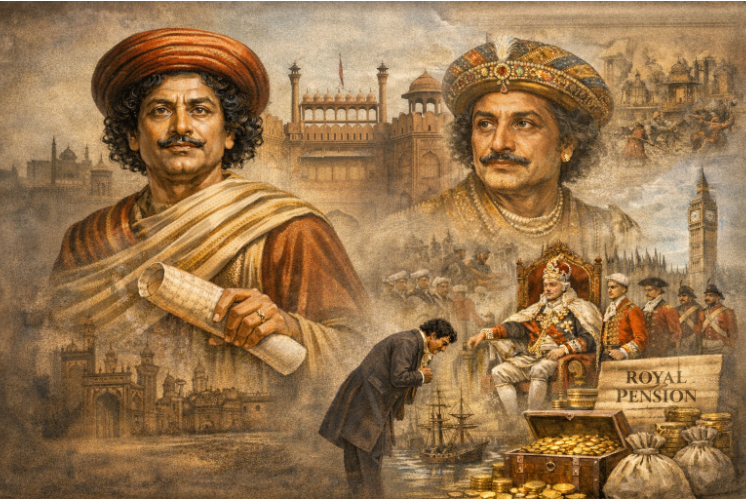
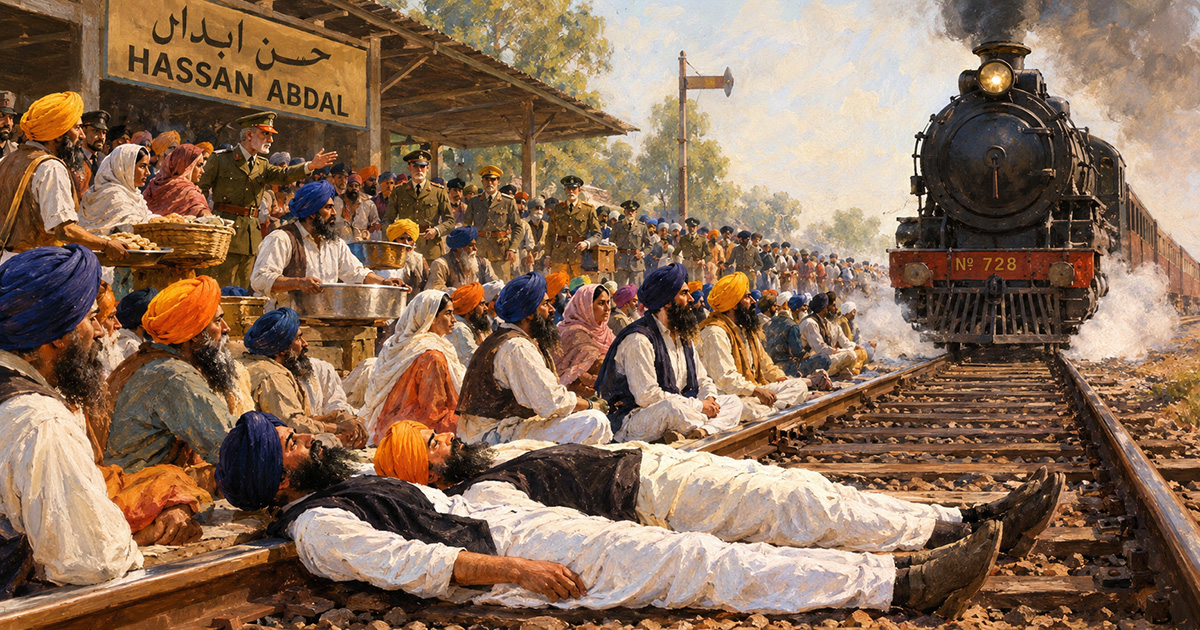
This image is AI-generated
A social reformer, who is a staunch opponent of the sati practice and dreams of modernizing Indian society, suddenly becomes the envoy of the Mughal emperor from Delhi's Red Fort. He goes to the British king's court not only to talk about reforms but also to plead to fill the pockets of those Mughals whose ancestors destroyed Hindu temples and took millions of lives, along with attempting to completely eradicate Hindutva. This is no fictional tale, but a true incident from 1831, when Raja Ram Mohan Roy arrived in England. How a reformer became a well-wisher of the Mughals, and why it still creates controversy today?
The story begins in the early 19th century, when India was trapped in the web of the British East India Company. The Mughal Empire, once the most powerful empire in Asia, had shrunk to the Red Fort in Delhi. Emperor Akbar II (reign 1806-1837) was a nominal ruler. He had neither an army nor subjects, just an old lineage. In the 1765 Treaty of Allahabad, the East India Company had promised that a share of the revenue from Bengal, Bihar, and Orissa (26 lakh rupees annual pension or offering) would be given to the Mughals. But the Company cunningly reduced it to just 12 lakh rupees. The condition of the Mughal court became such that even arranging food was difficult. In this crisis, Akbar II's eye fell on the scholar Raja Ram Mohan Roy. Born in 1772 in Radhanagar, West Bengal, Ram Mohan was aware of Sanskrit, Arabic, Persian, and English. He called himself a monotheist. He was a staunch enemy of idol worship, casteism, and superstitions. In 1828, he founded the Brahmo Samaj. His campaign against sati was so vigorous that Lord Bentinck banned it in 1829. But now, the Mughal emperor decided to make him his envoy, because Ram Mohan was an expert in English and British laws.
Around 1830-31, when Akbar II formally made Ram Mohan his diplomat, he was given the title of "Raja". However, the British government never recognized it. The mission was clear: go to England, repeat your petition before British King George IV and the East India Company directors. Ram Mohan was instructed to accuse the Company of breaching the treaty: revenue from Khalsa land (Mughal crown lands) has increased, but why isn't the emperor getting his share? Ram Mohan agreed, perhaps because the Mughals had given him the title “Raja” and he considered the Mughals part of the "monotheistic" tradition. But this decision was surprising. Ram Mohan knew that the Mughal lineage was stained with Hindu persecution. Babur destroyed temples after the 1527 Battle of Panipat. Akbar is called tolerant, but his son, Jahangir, killed Sikh Guru Arjan Dev. Shah Jahan demolished Kashi Vishwanath and Mathura's Keshavdev temples to build mosques. Aurangzeb was the cruelest: destroyed over 80 temples, reimposed jizya, forcibly converted millions of Hindus to Islam. Historians like K.S. Lal estimate that 80 million Hindus were killed during the Mughal era, which was a Holocaust-like event. Yet, Ram Mohan chose to serve the Mughals—perhaps his secular thinking made him forget the past!
In April 1831, Ram Mohan Roy arrived in Liverpool, England. He immediately contacted the East India Company directors. He presented petitions before British Parliament committees, where he argued that the Mughal emperor should get 26 lakh rupees as per the treaty. He described the pitiable condition of the Mughal court. He said that the emperor was living on such a low pension that his court was on the verge of closing. But the Company did not recognize him as a full envoy. Governor-General Lord Amherst outright rejected the recommendation for an increase. Still, he kept meeting Unitarian churches, politicians, and intellectuals. During this time, he also advocated for strengthening the sati law, but the main focus was on the pension. This period was a dual struggle for Ram Mohan - one side, Mughal loyalty, the other side, saving his reformer image.
From 1831 to 1833, Ram Mohan stayed camped in Bristol and London. Continuous efforts increased pressure on the Company directors. Ram Mohan's diplomatic shrewdness worked. He was fluent in English and took support from British legal arguments. Finally, success came in February 1833. The Company increased the pension from 12 lakh to 15 lakh rupees annually. Some sources mention it as an increase to £30,000 (about 3 lakh rupees additional). This victory was a breath of relief for the Mughal court. Akbar II could now have a better standard of living. But behind this success was Ram Mohan's controversial role. He knew that ancestors like Aurangzeb and Akbar II had committed atrocities on Hindu women and looted temples. It is said that Ram Mohan, who showed Islamic influence in Brahmo Samaj, praised the Quran, while rejecting Hindu gods and goddesses. Critics today call him a "British stooge" who labeled Hindu traditions "immoral" to promote Christian education.
Raja Ram Mohan Roy's incident reflects the complexity of Indian history. On one hand, he was a campaigner against the practice of sati, the founder of Brahmo Samaj, and a propagator of monotheism, who spoke of making society rational and modern. On the other hand, by becoming the envoy of Mughal Emperor Akbar II, he successfully endeavored to increase the pension from the British power. His death occurred in 1833 in England, and he could not return to India. This story tells us that a person's role can be multifaceted. His legacy remains a subject of debate even today, which inspires us to view the past from a new perspective.
.jpg)