The 1949 Shock: How the Mountbattens Influenced Nehru’s Decision to Stay in the Commonwealth
Many historians have also written about the relationship shared between the Mountbattens and Nehru.

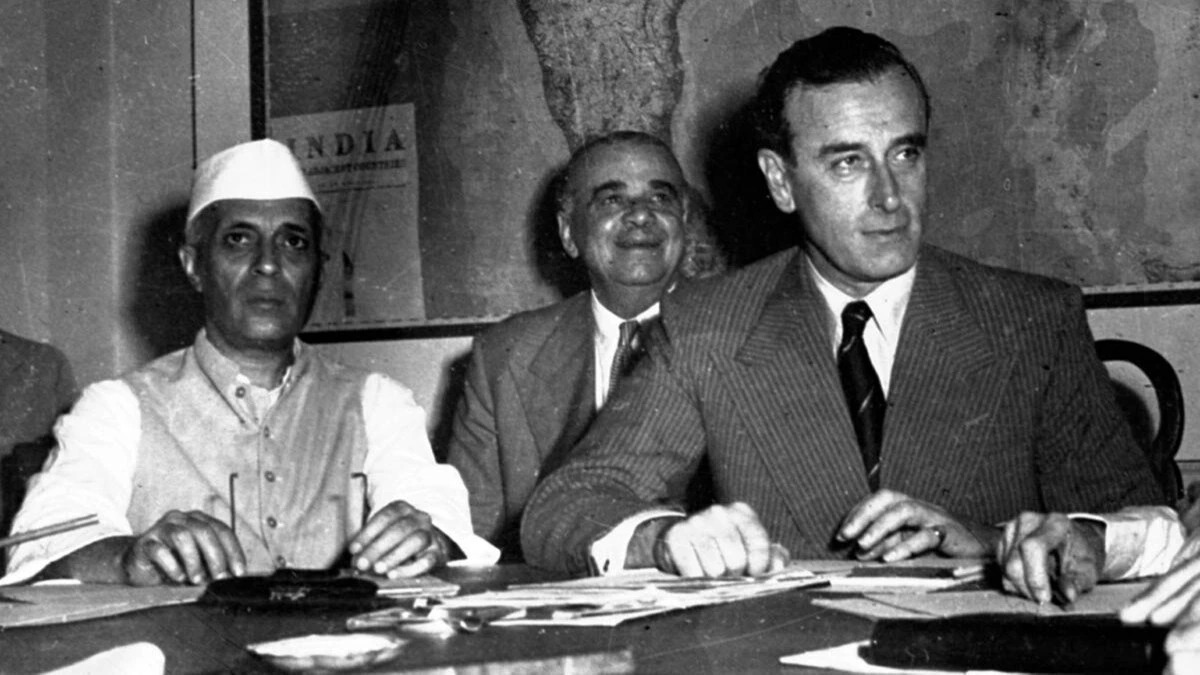
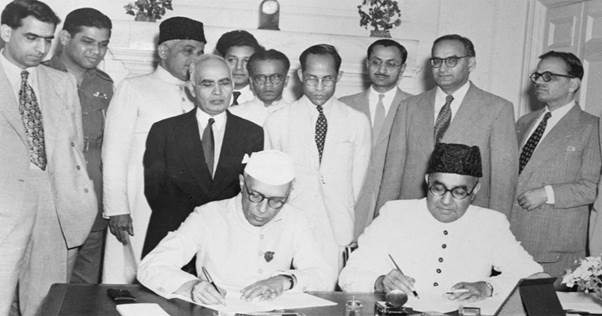
Jawaharlal Nehru and Lord Mountbatten hold negotiations | Image Source: India Today
On 16th May, 1949, the atmosphere inside the Constituent Assembly of India turned tense. The then-Prime Minister, Jawaharlal Nehru, introduced a resolution asking members to approve the government’s decision that India would remain a part of the Commonwealth of Nations. The proposal stunned everyone. Only two years earlier, in 1947, India had finally broken free from British rule, with Nehru promising a fully sovereign republic free from colonial baggage. Yet now he was advocating continued association with an organisation born out of the British Empire. How did Nehru move from outright rejecting the Commonwealth to supporting it? To answer that question, one must look at the role played by Lord Louis Mountbatten and Lady Edwina Mountbatten during the final months before independence.

Jawaharlal Nehru with Lord Mountbatten and Edwina Mountbatten | Image Source: Hindustan Times
Nehru’s Absolute Rejection of the Commonwealth
In 1947, as India was readying to gain independence and see the British regime leave India, Nehru had outrightly stated that no other option, other than total independence, would be viable — not even becoming a part of the British Commonwealth. For those unaware, the British Commonwealth is an association of countries that were once colonised by the British Empire, bound together with the British Crown as the head.
Nehru’s position on the British Commonwealth was unequivocal: “Under no conceivable circumstances is India going to remain in the British Commonwealth, whatever the consequences.” The nation did not want to remain in the clutches of a colonial regime it had fought hard to gain independence from. But this wasn’t acceptable to the British. Hence, the British regime tasked Lord Mountbatten, the last Viceroy of India and first Governor General of India, to oversee the smooth transfer of power and bring India under the British Commonwealth.

Queen Elizabeth II with the Prime Ministers of the Commonwealth in 1960 | Image Source: Constitution of India
Anxious to keep India in the British Commonwealth, Mountbatten and the British government under Prime Minister Clement Attlee believed that the quickest path to independence was through Dominion Status. Under this arrangement, India would be self-governing but would continue to recognise the British monarch as head of state, thus coming under the British Commonwealth structure. But to convince Jawaharlal Nehru was a daunting task. For the same reason, Mountbatten, who arrived in Delhi on March 22nd, 1947, with his wife, Lady Edwina Mountbatten, used personal friendship and rapport as the key strategy.
The Mounbattens’ Influence
From the moment he arrived in India, Lord Louis Mountbatten understood that the success of Britain’s exit plan depended heavily on winning over Jawaharlal Nehru, whom he considered the “most influential voice”. So, he began cultivating a strong relationship with Nehru, blending formal negotiations with constant informal engagement.

Jawaharlal Nehru and Lord Mountbatten hold negotiations | Image Source: India Today
During the tense weeks of May 1947, when the British were preparing their final plan for partition and transfer of power, Mountbatten shared several draft proposals with Nehru. Seeing the early draft, he reacted strongly against it, describing it as “Balkanisation” of India. As V. P. Menon, Mountbatten's most senior Indian aide, writes in his The Transfer of Power, Nehru rejected the proposal both verbally and in writing, leaving Mountbatten stunned. Mountbatten then shared the revised draft with Nehru again. Meetings were not limited to Delhi. A slew of informal discussions also took place in Simla, the summer capital of the British Raj. Here, too, plans for the smooth transfer of power were discussed between Nehru and Mountbatten, ensuring that Nehru agreed with the British proposal.
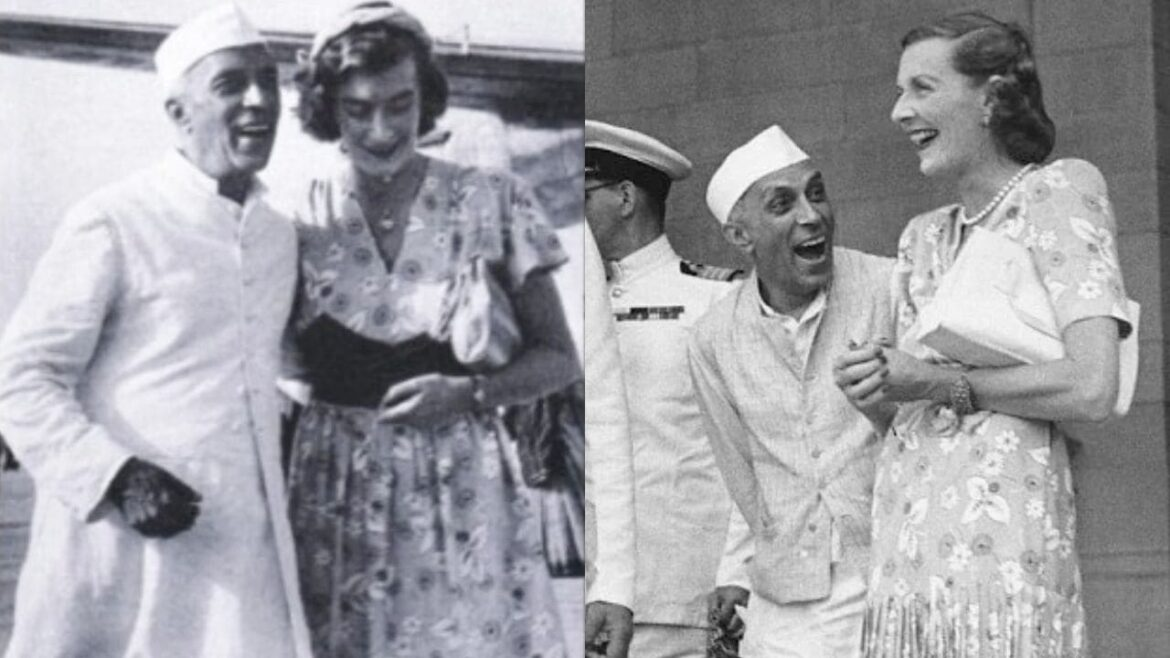
Parallel to these manoeuvres, a vital role was also played by Lady Edwina Mountbatten. Just days after she arrived in Delhi, Edwina developed a particularly close personal bond with Nehru. While Edwina did not directly participate in the discussions, she often discussed political developments privately with Nehru. In these discussions, Edwina reinforced the arguments that Mountbatten was making in formal settings. These conversations helped soften Nehru’s resistance to the idea that Indian independence could initially take the form of dominion status.
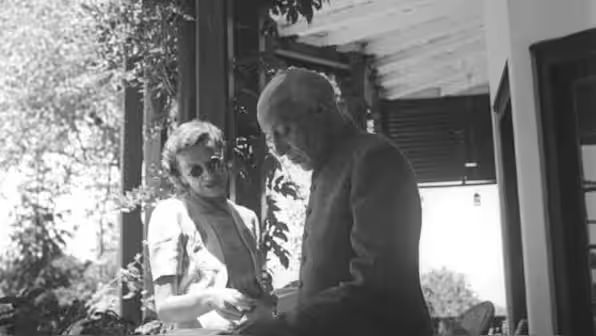
Jawaharlal Nehru with Edwina Mountbatten | Image Source: Firstpost
Many historians have also written about the relationship shared between the Mountbattens and Nehru. Historians such as Alex von Tunzelmann describe how Nehru initially reacted furiously to Mountbatten’s partition and dominion proposals. Yet, when Edwina intervened directly, she persuaded him to reconsider. Biographer Richard Hough went even further, arguing that the relationship between Nehru and Edwina had a “profound effect” on the negotiations surrounding the transfer of power. Evidence of her influence also appears in the recollections of V. P. Menon, who had told his daughter that Edwina’s conversations with Nehru played a significant role in persuading him to accept Commonwealth membership.
The influence worked. When India became independent on August 15, 1947, it technically emerged as the Dominion of India, with the British king as its monarch and Mountbatten himself serving as Governor-General.
The London Declaration and the 1949 Decision
The final transformation came in 1949, a year before India was to adopt its Constitution and become a republic on January 26, 1950. To keep India in the British Commonwealth, its leaders came up with the London Declaration in April 1949. The declaration permitted India to remain in the organization as a republic, rather than a dominion. The prefix "British" was also dropped, thus the organisation was now called “Commonwealth of Nations”. Essentially, the monarch only remained as the symbolic head of the organisation.

The London Declaration of 1949 | Image Source: Wikipedia
With these changes, Nehru was okay with India staying in the Commonwealth — such was the influence of Lord Mountbatten and Lady Edwina. Hence, on 16th May, 1949, Nehru announced before the Constituent Assembly to approve the decision to be a part of the Commonwealth of Nations. As shock and surprise were seen among all in the assembly, he argued that opposition to Commonwealth membership stemmed from lingering bitterness toward Britain and insisted, “The world has changed; England has changed; Europe has changed; India has changed; everything has changed and is changing….” However, this did not sit well with the Opposition members. While Jayaprakash Narayan criticised the move as reflecting “a lack of self-confidence and an implicit commitment to one of the power blocs,” Syama Prasad Mookerjee argued that Commonwealth nations repeatedly failed to support India on crucial issues.
These arguments against joining the Commonwealth stand true today. While for Britain, having India had clear economic and strategic motives. For India, on the other hand, there have not been obvious benefits. Membership in the Commonwealth Nations has offered little to no tangible advantages for India in spheres such as trade, security, or diplomacy, as promised. Instead, the Hinduphobia has only continued to peak. During World War II, British Prime Minister Winston Churchill said the Hindus were a “foul race” and wished for “surplus bombers to destroy them”. As it is apparent, the British media is the most Hinduphobic in the world. Particularly, the government-funded BBC, that has been portraying Hindus as communal, barbaric, and violent. Meanwhile, anti-India elements in the UK have been wreaking havoc against Indian institutions and Indian leaders. Punjab separatists have been freely attacking the Indian embassy in London, while the British police have provided little to no protection against the vandalism. Meanwhile, Islamists in Britain have freely opposed visits of Indian leaders from India.

Punjab separatists target Indian embassy in London | Image Source: The Times of India
What Did We Gain?
Now, seven decades later, the decision taken on May 16, 1949, continues to raise uncomfortable questions. India, which had fought a long and bitter struggle to free itself from British rule, chose to remain tied to an organisation — the Commonwealth of Nations — born out of that very empire. The shift from Nehru’s categorical rejection of the Commonwealth in 1947 to his advocacy of it in 1949 did not occur in isolation, but out of sheer influence. In the end, what was presented as pragmatic diplomacy is in reality a lingering colonial compromise shaped by personal influence, rather than national interest.