Two Resignations over Nehru-Liaquat Pact on April 8, 1950: After Dr. Shyama Prasad Mukherjee, another minister from Pakistan also resigned

In 1950, India was still reeling from the aftershocks of Partition. Streams of Hindu and Buddhist refugees were pouring into West Bengal, Tripura and Assam from East Pakistan (today’s Bangladesh). Each train and cart carried stories of homes seized, temples destroyed, and families separated. The Indian Commission of Jurists’ 1965 Report later confirmed that persecution in East Pakistan was systematic thousands killed in 1950 alone, women abducted, and villages razed. Facing such evidence, Dr. Shyama Prasad Mukherjee, then Minister for Industry and Supply in Jawaharlal Nehru’s Cabinet was constantly in a dilemma over India’s stand on Hindus in Pakistan.
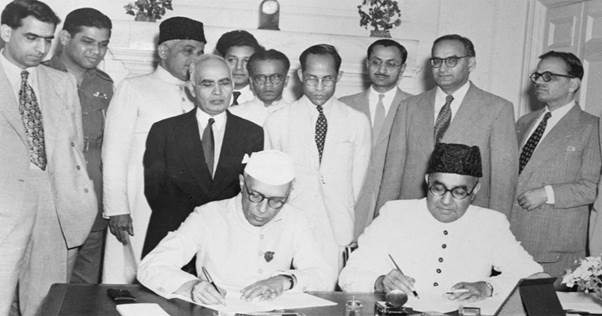
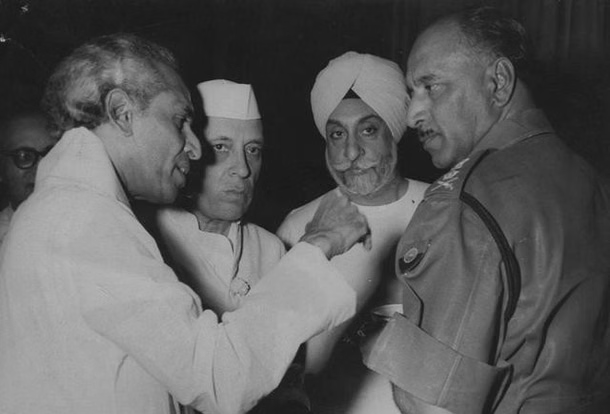
Mukherjee’s breaking point came with the Nehru–Liaquat Pact on April 8, 1950. This agreement between Prime Ministers Jawaharlal Nehru and Liaquat Ali Khan pledged equal rights for minorities in both countries.

Pakistan's Prime Minister Liaquat Ali Khan; (right:) India's Prime Minister Jawaharlal Nehru| Image Source: readersdigest
It sounded noble on paper, mutual protection, freedom of movement, and restoration of property but reality in East Pakistan made it cruelly hollow. The Commission’s findings show that within months of the pact, mass killings, dispossession of Hindu families, and forced conversions continued unchecked. Over 1.5 million refugees crossed into India that same year; nearly 850,000 fled during the 1964 crisis alone.

Dr. Shyama Prasad Mukherjee | Image Source: spmrf
Mukherjee argued in Cabinet meetings and Parliament that India could not treat the plight of Hindus in East Pakistan as a “foreign issue.” He asked, “If our own kith and kin are being slaughtered across the border, can we remain silent for fear of diplomacy?” To him, mere appeals or diplomatic assurances were insufficient India must either ensure protection of minorities through stronger measures or facilitate their safe resettlement within India.
On 15 April 1950, Mukherjee resigned from the Indian Union Cabinet. In his resignation letter, he wrote that India’s policy toward Pakistan was “one of helpless idealism,” blind to the brutality of events on the ground. He warned that appeasement would embolden Pakistan and demoralise Indian refugees and minorities. This warning proved eerily accurate. By 1951, J. N. Mandal, Pakistan’s own Law Minister and a former ally of Ambedkar, had also fled to India after documenting atrocities perpetrated by the East Pakistan authorities.
Almost a year after Mukherjee’s resignation, an account of what happened in the 1950 atrocities was given by M J.N Mandal, a leader of the Scheduled Caste, who had accepted the Cabinet appointment as Minister of Law and Labour in the Government of Pakistan and, while he was still holding that post, fled from Pakistan in September 1951.

Jogendra Nath Mandal | Image Source: Amar Ujala
In early October 1951 he sent his letter of resignation to the Pakistan Prime Minister. He describes in detail the reasons for his resignation and for leaving Pakistan. He had previously been appointed in the quota of Muslim League as a Minister in the interim Government of undivided India on November 1, 1946. In this letter in paragraph 9, he complained about the general anti-Hindu policy of the East Bengal Government and the Police administration.
In paragraph 21, he says that he was in Dacca on February 10 and what he saw and learnt from first hand information was simply staggering and heart-rending. He visited various areas where atrocities on Hindus had been committed and he says that what he saw and from the information gathered by him the number of killed was about 10,000.
In paragraphs 10 to 16 he goes on to describe various incidents in which Hindus and whole villages of Hindus had been terrorised. He complains that in Habibgunj (Sylhet) where there was a military camp the unfortunate Hindus were forced among other things to send the women at night to the military camps for satisfying the soldiers
In addition to Mandal’s Letter ,Data in The Indian Commission of Jurists’ 1965 Report justified Dr. Mukherjee’s stand. Hindu holdings of properties fell to 12.7% and nearly 90% of the Hindu citizens of Dacca had migrated to India. Similar is the case with the student population in Dacca. From about 2,900 Hindu boys in Schools before partition, 2,000 remained before February 1950 killings, and at the end of December 1950 the number was reduced to 140. Similarly, there were about 2,100 Hindu girls in Schools before Partition, about 1,200 before the February 1950 incident. Of these only 25 remained by December 1950. The population of Hindu College students fell from 65% at partition to 7% in January 1950 and at the end of 1950 only 12 remained. Similar is the case with lawyers. There were about 1500 Hindu shops at the time of Partition and at the end of 1950 only 157 remained.
Subsequent data entirely vindicated Mukherjee’s concerns. Between 1947 and 1964, East Pakistan’s non‑Muslim population fell from about 13 million to 8.5 million, a loss of 4.5 million people. The mass migration exhausted India’s eastern provinces and exposed the emptiness of Liaquat’s promises. Despite repeated agreements, minority persecution went unchecked.
In hindsight, Mukherjee’s resignation stands not as a political rebellion but as an act of conscience. He chose moral clarity over power, demanding that India’s foreign policy be anchored in justice and human protection. His stand anticipated the findings of later inquiries even 15 years later, that peace without accountability is a fragile illusion.
.jpg)