Pokhran II, Chandipur, & Cricket: How India’s Nuclear Tests Became US’ “Intelligence Failure of the Decade”
Within hours, the world realised that India had done something remarkable, in utmost secrecy, without being detected by the world’s most sophisticated surveillance systems, resulting in it being called “the intelligence failure of the decade.”

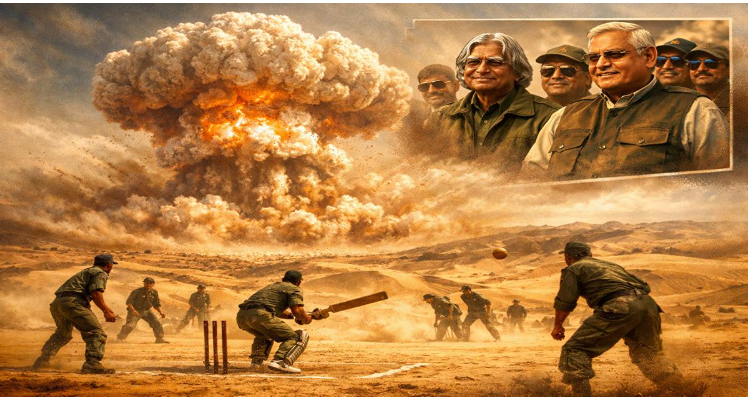
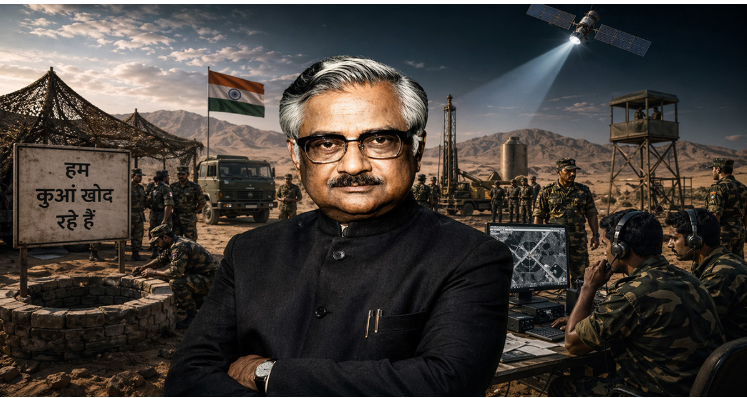
This image is AI-generated
“Today at 1545 hrs, India conducted three underground nuclear tests in the Pokhran range”: This was the statement made by the former Prime Minister Atal Bihari Vajpayee on May 11, 1998, hours after Bharat successfully conducted nuclear tests, code-named “Operation Shakti”, in Rajasthan’s Thar desert. Within hours, the world realised that India had done something remarkable, in utmost secrecy, without being detected by the world’s most sophisticated surveillance systems, resulting in it being called “the intelligence failure of the decade.” The shock it delivered to the globe prompts us to question: How did India hide something as massive as nuclear testing from satellites watching from space? Today, 28 years later, as we revisit Operation Shakti, we bring you the answer to how India managed to prepare and execute the tests in complete secrecy. This was done through the two remarkable layers of deception — one hundreds of kilometres away in Odisha’s Chandipur, and the other right in the middle of the Thar desert.

Pokhran II, nuclear test blast | Image Source: The Better India
The Chandipur Diversion & Cricket in the Thar
As Bharat prepped for the nuclear tests in Pokhran, it was well aware of the US’s constant surveillance through its eyes in the skies, costing over a billion dollars — the US spy satellites. Thus, one of the crucial plans to maintain utmost secrecy was to divert the world’s attention, especially that of the US, elsewhere. Bharat did that by shifting attention to the missile testing range at Chandipur in Odisha.
The Defence Research and Development Organisation (DRDO) began the usual preparations for the 37th test of the Trishul surface-to-air missile. But something unusual transpired in the midst of these preparations. More equipment than necessary was transported to the site of action. Some of the apparatus even resembled infrastructure used for launching the Agni intermediate-range ballistic missile. The deception worked. To the foreign intelligence, this created the impression that a major missile launch was imminent. American satellites and surveillance systems began focusing their attention on Chandipur, while the Chinese signals surveillance facility at the Coco Islands reportedly became active in anticipation of a possible Agni missile launch.
In the meantime, at the Pokhran test site, a totally different strategy was at play. In the scorching heat of the Thar desert, where temperatures often crossed 50°C, as the soldiers and scientists worked quietly to prepare the nuclear test shafts, something different was being executed. This involved a sport loved by millions of Indians — cricket. The 58th Engineer Regiment of the Indian Army, led by Colonel Gopal Kaushik, and the soldiers stationed at Pokhran regularly organized cricket matches at the site. In an exclusive interview with The Times of India, Kaushik explained, “Among the things we did was routinely play cricket, although it isn’t really a troops sport like football or hockey. That was done purely to attract people to watch and mislead the satellites that nothing significant was happening in Pokhran.”
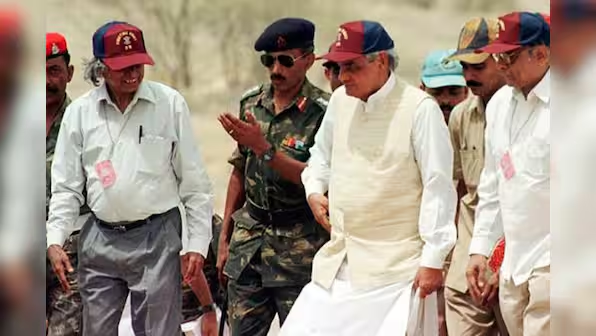
Former Prime Minister Atal Bihari Vajpayee with Dr APJ Abdul Kalam at Pokhran | Image Source: X/@igautamshah
APJ Abdul Kalam and other nuclear scientists in disguise at the Pokhran test site | Image Source: X/@Dev_Fadnavis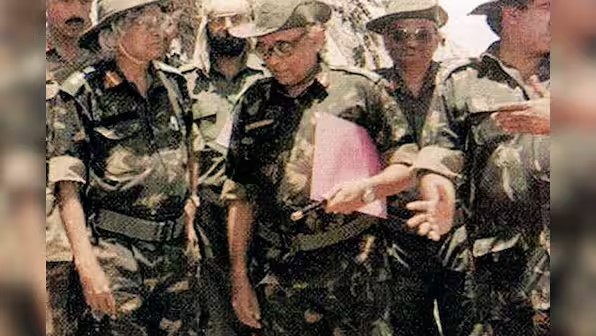
As some soldiers played cricket to deceive the international eyes, around 100 scientists, including figures such as then Defence Research and Development Organisation (DRDO) chief, A. P. J. Abdul Kalam; the former chairman of the atomic commission, R. Chidambaram, and former Bhabha Atomic Research Centre (BARC) chief, Anil Kakodkar, worked quietly to dig shafts, lay cables, and prepare the underground test chambers. Thus, even as satellites looked down at the desert, all they saw were soldiers playing cricket in the sand.
The D-Day & Why Pokhran II?
Finally, the moment arrived. On May 11, 1998, at 3.45 pm, under cloudy skies and after the desert winds had calmed, India conducted three underground nuclear tests. The devices that were detonated were: Shakti I (Thermonuclear device), Shakti II (Fission device), and Shakti III (Sub-kiloton device). Later that day, PM Vajpayee made this historic announcement to the nation. Two more underground nuclear tests followed on May 13th, completing the planned series of five nuclear tests.
Following the tests, Vajpayee addressed Parliament and praised the scientists and soldiers behind the mission. Bharat also clarified its nuclear doctrine, with Vajpayee emphasising that India would follow the principle of “No-First Use”. “No-first use. We also said, those who don’t have weapons, we will not use it against them,” PM Vajpayee had asserted. He clearly signalled the world that Bharat viewed nuclear weapons as deterrence, not aggression.
The nuclear tests conducted in 1998 were very significant, given the strategic environment India faced in the 1990s. After India’s first nuclear test in 1974, the regional security equation began changing rapidly. According to Bhabha Atomic Research Centre director, Anil Kakodkar, China had begun sharing nuclear technology and materials with Pakistan in the decades that followed. This meant India was increasingly facing the prospect of two nuclear-armed adversaries in its neighbourhood, and therefore India decided to move toward credible nuclear deterrence.
It was owing to this necessity that secrecy of the tests was required, given the fact that just three years ago, the US had detected India’s plans of conducting nuclear tests. In 1995, American intelligence satellites had already detected suspicious activity at Pokhran when India was preparing for nuclear tests under Prime Minister P. V. Narasimha Rao. Although the images were unclear, the discovery triggered diplomatic pressure from Washington, and the tests were eventually called off. By 1998, it was clear to Indian planners that any visible preparation would immediately alert foreign intelligence agencies. This time, therefore, the operation had to remain completely invisible until the very moment the devices were detonated.
Ultimate Global Intelligence Shock
Intelligence agencies in the United States launched investigations to determine how their surveillance systems had failed. The shock was so deep that US Senator Richard C. Shelby, then chairman of the Senate Intelligence Committee, called it “the intelligence failure of the decade.” While the head of the CIA, George Tenet, ordered an internal investigation led by Admiral David Jeremiah to understand how preparations for nuclear tests in the Indian desert had gone unnoticed.
Operation Shakti was far more than a series of nuclear tests. It was a masterclass in coordination between scientists, soldiers, and political leadership. India had managed to conduct one of the most sensitive strategic operations in the world—right under the watchful eyes of global surveillance. And by the time the world realised the truth, India had already entered the ranks of nuclear-armed states