How Pyara Singh Inspired Bhagat Puran Singh to Start Pingalwara?
This is the story of Bhagat Puran Singh and his “Pyara Singh”, the two souls who gave birth to the legendary institution, Pingalwara.

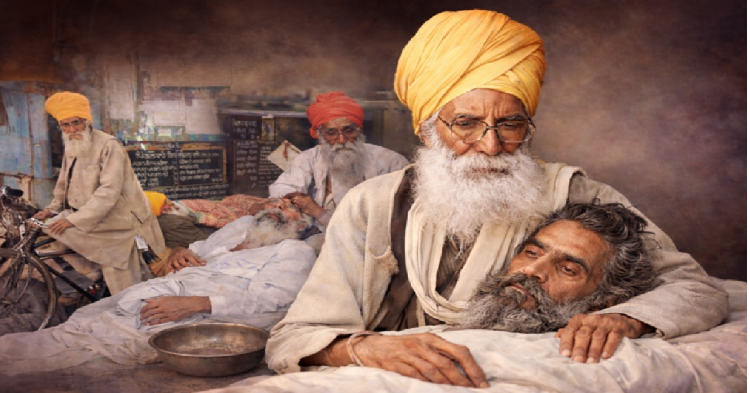
This image is AI-generated
A man who saw the Divine in a disabled child and provided his own back. This is the story of Bhagat Puran Singh and his “Pyara Singh”, the two souls who gave birth to the legendary institution Pingalwara. Through this piece, we will unfold who Bhagat Puran Singh actually was and how he derived the inspiration to build Pingalwara in the first place.
The Night of the Abandoned Child
It started back in the year 1934, a cold, pitch‑dark night of Dera. Silence lay heavy on the grand wooden gates of the historic Gurdwara Dera Sahib in Lahore. Suddenly, two shadowy figures appeared in the gloom, placed a bundle on the steps, and vanished into the darkness.
The next morning, as the first light of dawn crept over Lahore, a small child sat alone at the entrance of the gurdwara, crying. He could not have been more than four years old. His body was locked in the grip of spastic paralysis—a child who could neither speak, nor walk, nor attend to even his most basic needs. He was severely disabled, both physically and mentally, and already showing early signs of leprosy.
The boy’s mother had died, and his father had left him with a farmer before leaving town himself. The farmer had taken the child to several orphanages, but every one of them turned him away, calling him a “burden.” In the end, the farmer, too, abandoned the boy at the doorstep of the gurdwara under the cover of that black night and walked away.
The Gurudwara’s Silent Witness
By midday the next day, the boy’s condition had turned terrible. Poor digestion worsened his suffering. No one was willing to touch him, let alone bathe him or clean him. His entire body was soaked in his own excreta; flies buzzed thick around him. Devotees came and went, offering a piece of bread or a little milk, but no one stepped forward to lift him into their arms. To everyone, he was just “a burden.”
Standing nearby, Jathedar Achhar Singh, the head granthi of the gurdwara, watched it all in silence, his heart heavy. After finishing the morning ardas, he picked the child up into his arms and looked at the congregation.
“Will anyone take responsibility for this child?” he asked. An eerie silence fell. Not a single person met his eyes.
At that moment, his gaze landed on a young man quietly standing at the back—Bhagat Puran Singh. For years, Puran Singh had been serving at the gurdwara—preparing langar, cleaning, and tending to the sick. Jathedar Ji held the child out toward him and said, “Puran Singh… I plead with you, you take care of this child.”
Puran Singh did not even hesitate. He took the child into his arms. The boy was dirty, crying, and foul‑smelling—yet a smile lit up Bhagat Ji’s face. Without hesitation, he bathed him, cleaned him, fed him, and gave him a new name: Pyara Singh—the beloved.
On His Shoulders: A Fourteen‑Year Journey
The moment Puran Singh took Pyara Singh in his arms, his life was transformed. Pyara Singh could never stand on his own feet, and Puran Singh had neither money nor a vehicle. So he made a simple decision: wherever Pyara Singh went, he would go on his shoulders.
For the next fourteen years, no matter where Bhagat Ji went—whether through the lanes of Amritsar or the streets of Lahore—Pyara Singh rode on his back. People laughed and mocked, saying, “Look, a madman is carrying another madman around.” But Bhagat Ji remained calm. He called Pyara Singh “the garland around my neck” and “my whole world.”
Even when Pyara Singh soiled him on his back, Bhagat Ji never grew angry. He would gently wash him, feed him, and clean up his mess, treating him with the same tenderness he would a newborn.
Partition, Flight, and the Seed of Pingalwara
In 1947, the Partition of India plunged Punjab into one of the darkest chapters of human history. Blood flowed in the streets of Lahore. Puran Singh had chances to save himself, yet he refused to abandon Pyara Singh. With Pyara Singh on his back, he joined the caravan of refugees and made his way from Lahore to Amritsar. The sights he saw at the Amritsar railway station and in the streets tore his heart apart—bodies hacked to pieces, the old and the helpless lying unattended, nowhere to turn.
Bhagat Puran Singh and Pyara Singh | Image Source: Sikhi Wiki 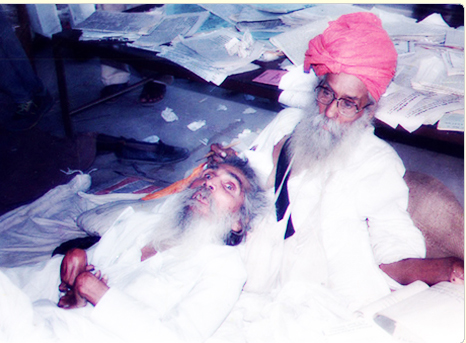
From that day onward, Bhagat Ji began picking up the sick and the hopeless straight off the platform and the footpaths. He had no house, no money. So he pitched a tent outside Khalsa College in Amritsar, and that very tent became the first Pingalwara—“the home of the disabled.”
He washed the wounds of lepers, bathed the “mad,” protected forsaken women, and worked day after day. Often he would take a rickety handcart, with Pyara Singh lying on it, and collect scraps of paper from the trash, sell them, and buy medicines for the ill.
The Child Who Laid Pingalwara’s Foundation
In the late 1940s, Pingalwara began to take shape as an institution, but its symbolic foundation was laid in an extraordinary way. Around 1948, Bhagat Ji had Pyara Singh himself place the first stone—the very boy he had carried on his shoulders for fourteen years—thus turning the child once thrown away by the world into the living cornerstone of his mission.
Bhagat Ji would often say that if he had not met that four‑year‑old disabled child on that dark night in Lahore, Pingalwara might never have been born.
He remained a lifelong bachelor, owning no property. His only “wealth” was the very people whom society had branded as “garbage” and cast onto the streets.
The Unbroken Legacy
Born on 4 June 1904, Bhagat Puran Singh was honoured by the Government of India with the Padma Shri in 1981 for his lifelong selfless service. He passed away on 5 August 1992, but his legacy lives on. Today, Pingalwara stands like a vast banyan tree, sheltering and healing thousands of the forsaken, continuing his mission in word and deed.
Bhagat Puran Singh is seen carrying Pyara Singh along | Image Source: Sikhi Wiki 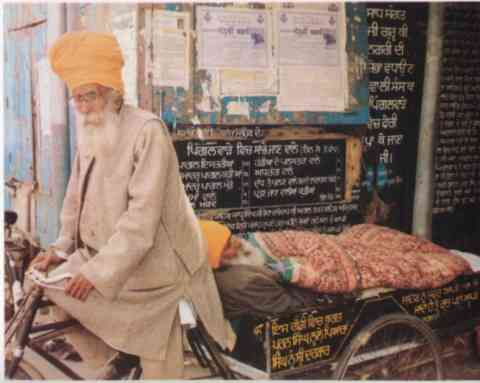
Even now, at Pingalwara, Pyara Singh’s story is told over and over again. It reminds everyone that when a human being embraces another’s helplessness, that burden does not crush him; it becomes the very path to his salvation. His life teaches us that service does not demand wealth, but an unbreakable resolve and shoulders of iron. The child whom the world had rejected, Bhagat Ji, had chosen as his God