Why Pope Said Sorry: Story of a A Child's Silent Cry from Canada's Residential Schools | Is a Sorry Enough?

From 1883 to 1996, the Canadian government partnered with Christian churches—primarily the Catholic Church, which operated 64 of 139 residential schools (46%)—to forcibly remove at least 150,000 First Nations, Inuit, and Métis children from their families for "assimilation" into Euro-Canadian society. These state-funded, church-run institutions banned Indigenous languages and ceremonies, enforced Catholic conversion, and subjected children to hunger, rampant tuberculosis (with death rates 5x higher than the general population), physical beatings, and widespread sexual abuse by priests and nuns, abuses that Canada's Truth and Reconciliation Commission (2008–2015) later classified as "cultural genocide." The 2021 discoveries of unmarked graves, starting at Kamloops, amplified thousands of survivor testimonies, pressuring Pope Francis to make a "penitential pilgrimage" to Canada in July 2022, where he publicly apologized for the Church's complicity in a system that "destroyed cultures, severed families, and marginalized generations."
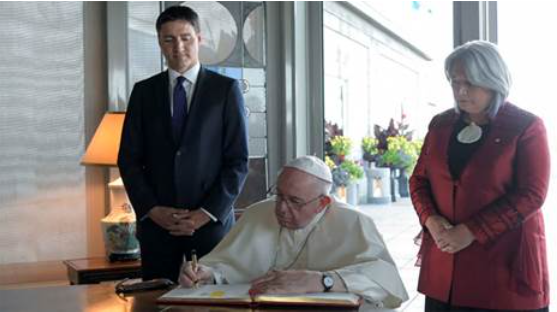
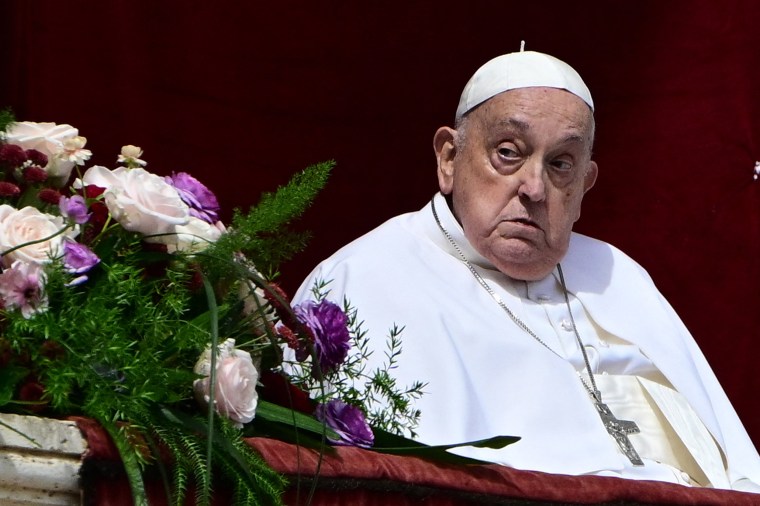
Pope Francis apologises for abuse of children | Image Source: PBS
A Child Taken from Her Family
In the early 1900s, in the northern Prairies of what is now Saskatchewan, a seven‑year‑old Cree girl named Awaniscow lived with her family on their traditional land. One day, mounted police rode into their camp to enforce new laws that made it compulsory for indigenous children to attend government‑funded, church‑run schools. Her father could only watch, helpless and angry, as officers pulled his daughter away and loaded her into a wagon for a long journey south.
The plan behind these schools was clear: Take indigenous children far from their homes, separate them from their families and cultures, and turn them into what officials called “civilized” subjects of the Canadian state. Churches were paid for each child they took in, and senior bureaucrats openly spoke of trying to “kill the Indian in the child,” meaning to erase indigenous identity and replace it with European language, religion, and values.

Abused children from the residential schools | Image Source: Aeon
Life Behind the School Gates: His Tongue was Stabbed With a Needle for Speaking Cree
After days of travel, Awaniscow arrived at a Catholic‑run residential school surrounded by fences and cold stone buildings. At the gate, she was stripped of almost everything that tied her to home. Staff cut off her long braids, calling her hair “filthy” and “savage.” They burned her clothes and gave her a stiff uniform. She was told that from now on she would be called Mary Agnes, and that her Cree name and words were not allowed.
Inside the dormitories, dozens of girls slept in metal beds lined up in rows. From the first week, any child who spoke Cree was punished. Awaniscow learned this quickly: When she whispered a single word to comfort a scared bunkmate, a nun stabbed at her tongue with a needle as a warning. Meals were thin and often spoiled. The children lived with constant hunger, and many became sick in the crowded, poorly heated buildings.
Work, Disease, and Punishment
Daily life at the school was harsh and exhausting. The children spent long hours in class learning prayers and church doctrine, often in Latin, a language none of them understood. Their own ceremonies and songs were banned and called evil. Outside class, they were forced to work. Awaniscow, still only a small child, laboured in the laundry, hauling heavy, boiling sheets, and was sent into the fields to help with farm work even in freezing weather.
When children wet the bed, they were beaten. When they cried at night or whispered in their own languages, they were strapped or locked alone in dark storage rooms. Many caught infections like tuberculosis or pneumonia in the damp, crowded dorms. Medical care was limited, and healthy children were kept close to those who were coughing and feverish, so illness spread quickly. Across the residential school system, many children died from sickness, neglect, and poor living conditions, often far from their families.
Unspeakable Abuse and Silent Graves
For children like Awaniscow, physical punishment was only part of the horror. Some priests and nuns used their power to sexually abuse the children in their care. They chose victims who had no way to escape, no one to tell, and no adults there to protect them. Many survivors later described being taken alone into sacristies, offices, or storage rooms at night, where they were assaulted and then threatened into silence.
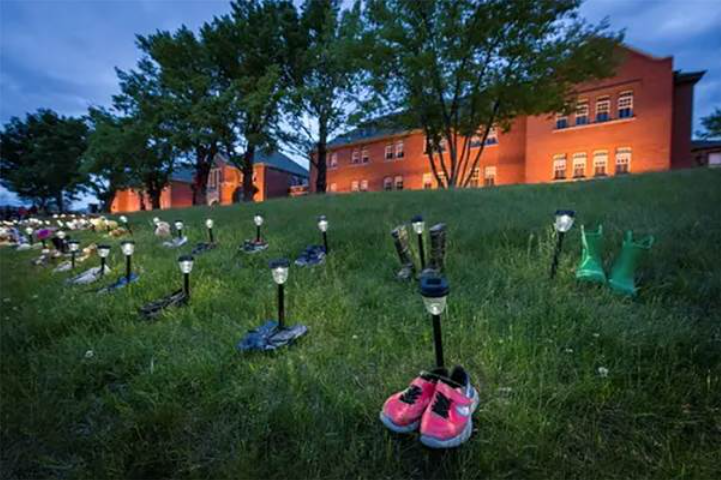
Some girls became pregnant and gave birth in secret. These babies were sometimes taken away and quietly given up for adoption. In other cases, infants and children who died were buried in school grounds without their parents ever being told exactly what had happened. In the decades since, ground‑penetrating radar and archival research have revealed hundreds, and likely thousands, of unmarked graves at former residential school sites across Canada, confirming what survivors had been saying for years.

Graves of students | Image Source: New York Times
A Life Cut Short
Awaniscow survived two winters at the school. The cold, the hunger, the overwork, and the disease slowly wore down her small body. When she caught pneumonia during yet another harsh winter, there was little treatment available. She died in the school, far away from the warm circle of her family’s fire.
Her body was placed in a simple grave on school property, without a proper marker. No one took her home. Her parents were informed, if at all, with a brief note or message. Her name disappeared into school registers and files. For her family, there was no grave to visit, no ceremony in their own language, only a lifetime of grief and unanswered questions.
Remembering Awaniscow and Children Like Her
Today, the story of a child like Awaniscow stands for thousands of Indigenous children who were taken to Canada’s residential schools and never returned. Survivors who did make it home have spoken publicly about the beatings, the hunger, the loneliness, and the abuse they endured, and about the way these experiences affected their families for generations.
In recent years, the discovery of unmarked graves at former school sites shocked many Canadians but did not surprise survivors, who had been telling these stories all along. Governments and churches have issued apologies, and there are efforts to search school grounds, release records, and support survivors and their communities. But for children like Awaniscow—children who died without their families, whose languages and songs were almost silenced—no apology can bring back a stolen childhood.
On the lands where the schools once stood, families and Elders now gather to hold ceremonies, sing, and drum. They speak the names they know and mourn those they do not. In doing so, they honour children like Awaniscow, whose short lives and silent cries in the snow still echo in Canada’s memory and conscience.


.jpg)