Adolf Hitler’s Appropriation of Swastika: How a Sacred Symbol Was Used to Spread Racial Propaganda

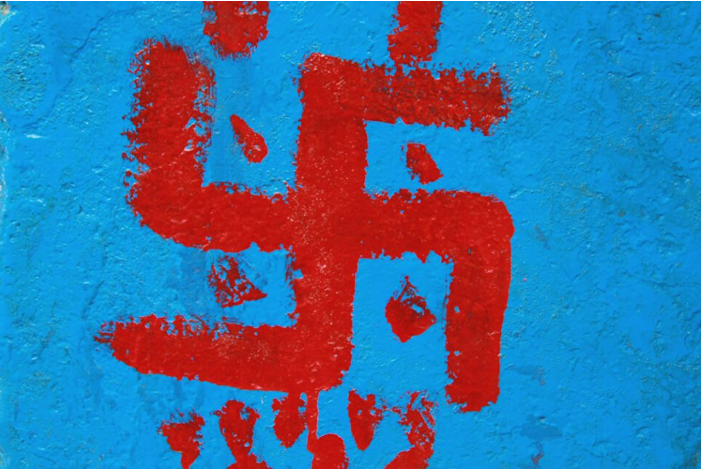
The Swastika | Image Source: The Hindu American Org
For over 5,000 years, the swastika has been a symbol of Indian civilization that has endured through time and is widely recognized across the subcontinent as representing well-being, prosperity, and auspicious beginnings. It is also a symbol of continuity, used abundantly since ancient times to the present. The swastika continues to appear on temple walls, household thresholds, sacred manuscripts, coins, architectural motifs, and ritual objects across Hindutva traditions. However, this sacred symbol of auspiciousness was once reinterpreted and appropriated in the 20th century by Nazi leader Adolf Hitler, who, in the smoke-filled beer halls of 1920s Munich, was searching for a brand. He watched with envy as his Communist rivals marched under bold red flags that unified their followers. Hitler knew his fledgling Nazi Party needed a "blazing torch" — a symbol so striking it could act as a psychological weapon. To find it, he reached into the 19th-century "Aryan Theory," setting the stage for a massive cultural heist: The appropriation of the swastika.
Thus, on Adolf Hitler’s death anniversary (April 30), through this piece, we reflect on how the Nazi leader distorted the meaning of the ancient, sacred symbol, far older than Nazism, to push racial propaganda.
The Nazi Theft of the Swastika
Deeply rooted in the Indian subcontinent, the Swastika is considered auspicious in Bharatiya households. It is a Sanskrit term where “su” means “good” and “asti” means “to be/prevail”. In Hindutva, the swastika represents prosperity, protection, and the cyclical nature of life. Traditionally drawn in red or yellow, especially during Diwali, weddings, griha parvesh, and temple rituals, it is believed to ward off negative forces and invite abundance. Its meaning is neither ambiguous nor controversial within the subcontinent; it is one of the most universally positive symbols in Bharatiya culture.
However, while the Indian subcontinent used the symbol for abundance and prosperity, the swastika’s reinterpretation began in the 19th century in Germany, when European scholars misread Indian history. They promoted the "Aryan Invasion Theory” (AIT). As per the fragmented Aryan Invasion Theory, around 1500 BCE, "a group of light-skinned 'Aryans' invaded Bharat through the northwest, and upon the invasion, they conquered the Indus Valley Civilization, established Vedic culture, and brought the swastika with them."
Adolf Hitler | Image Source: History.com
Hitler seized this flawed idea, claiming the symbol did not belong to India, but was a "racial signature" of a superior white race. He used the swastika to link Germans to a mythical "master race," while dismissing the actual people of the Indian subcontinent as "inferior" and racially mixed. In his book Mein Kampf, Hitler described his obsessive experiments to redesign the symbol to represent the “mission of the struggle for the victory of the Aryan man.” He performed a cold, calculated rebranding: Tilted the cross 45 degrees to make it look like a spinning propeller, squared the arms into thick, rigid hooks, and renamed it the Hakenkreuz (Hooked Cross) to make it sound more Germanic and less Indian.
Image comparing Hindu Swastika and Nazi Hakenkreuz | Image Source: X/@AdvAshutoshBJP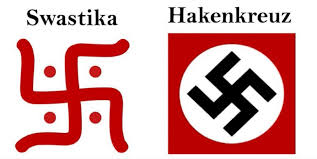
By the summer of 1920, the new flag was ready. Hitler placed the black "hooked cross" inside a white circle on a field of bright red. The red was chosen to "infuriate" his Marxist enemies, while the white stood for nationalist purity. To protect his meetings, Hitler organized squads of young men —the SA— who wore these symbols on red armbands. He noted with pride that the sight of the flag acted as a "hypnotic" force, turning his small group into a visible, aggressive political army.
Nazi soldiers carrying flags with Hakenkreuz (the hooked cross)
By 1935, the "Hakenkreuz" was raised over the Nuremberg rallies as the official national flag of Germany. The symbol that had meant "well-being" for 12,000 years was now the official face of a regime built on hate and genocide.
The Destruction of Claims Based on True Archaeological Evidence
However, modern scholars have outrightly busted these claims, stressing that this is cherry-picked evidence. In the Indian subcontinent, the antiquity of the swastika is not merely a matter of tradition; it is supported by extensive archaeological evidence. The archaeological discoveries of the Indus Valley Civilizations, dating back to the 1920s, provide the earliest evidence of the swastika's century-old usage in Bharat. Also, it should be strongly mentioned here that in our Vedic texts, such as the Rig Veda, the term “Arya” is mentioned. However, its connotation is not that of a racial or ethnic category, but instead it signifies ethical excellence. Even in our Hindu epic, the Ramayana, “Aryaputra” (noble son) is used for Lord Rama, and there are no migration/invasion references.
4500 Years Old Swastika Seal From Indus Valley Civilization | Image Source: British Museum
Unlike symbols that emerge briefly and disappear, the swastika has remained integral to South Asian culture for millennia. Archaeological evidence has proven that the swastika long predates any historical Indo-European migration models. It is found across the world where ancient Bharat traded well, and for Bharatiyas, its meaning is religious and auspicious, not racial. Hence, within the broader Hindu civilizational mindset, the usage of the swastika reflects the continuity of the symbol, one which has been prevalent since ancient times in the present, abundant usage.
In sum, the legacy of this theft created a permanent divide. Today, for over a billion people in India, the swastika remains a sacred sign of peace and luck used in weddings and festivals. However, in the West, the version with the 45-degree tilt and rigid hooks remains a symbol of the Holocaust. Hitler’s appropriation "poisoned the well" of one of humanity's oldest icons, proving how a demagogue can take a symbol of life and sharpen it into a tool of death.