Rashtriya Swayamsevak Sangh Vyakhanmala Day 2: Address on ‘100 Years of Sangh Journey – New Horizons’

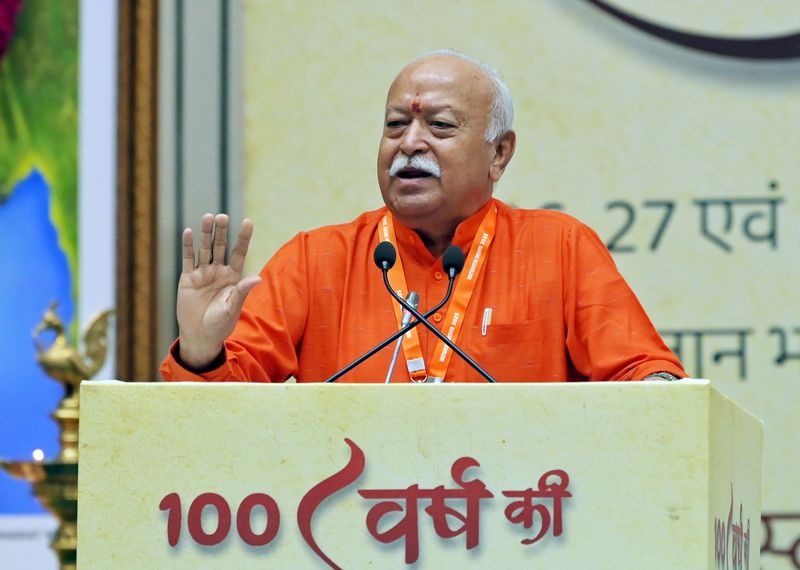
Read the full transcript of Rashtriya Swayamsevak Sangh’s Sarsanghchalak, Dr. Mohan Bhagwat’s speech on Day 2 of Vyakhanmala.
Honourable Government Minister, Honourable Sangh Chalak of Uttar Pradesh, Honourable Sangh Chalak of Delhi, Honourable members of the Sangh, Respected mothers and sisters who have shown their presence in all spheres of social life,
Yesterday, I spoke about the hundredth anniversary of the Sangh and its remarkable journey.
In the midst of ignorance and opposition, the Sangh members, through the strength of their dedication, placed themselves on the line and overcame every hurdle.
In doing so, they faced many bitter experiences. Yet, despite all this, their hearts still carry pure, Satvic love for the entire society. This is the Sangh – Pure Satvic love forms the foundation of our work. Today is not the time for conflict; it is a time for adequacy and respect for society.
Opposition has significantly reduced and lost its impact; there is no longer any result from it. Yet, the Sangh holds the belief that if there is adequacy, one should not seek comfort or convenience. If we have adequacy, then comfort should not be sought. Therefore, to unite the entire Hindu society and achieve our goals, we must keep moving forward.
How to keep moving forward? I have already shared the method. It can be summed up in four words: Friendship, Compassion, Modesty, Respect. Friendship with those who are decent people, overlooking those who may not be decent towards us. If something good is done, even by those who may not agree with us or even oppose us, yet do it well, we should show happiness.
We must show it.
Towards those who err—whether in sin or other faults—we must show compassion, not hatred. This is the way to progress.
While doing this work, as I have said, no one gains personal benefits. The Sangh offers no incentives; rather, there are many disincentives. When asked what one gains from the Sangh, I answer frankly, you gain nothing.
Instead, you will likely lose what you already possess. If you have the courage, then undertake this work. It is the work for the brave, and brave people are doing it. They do so because, by offering selfless service to society, they find meaning in life. They enjoy it.
What we do is for the benefit of everyone, and this is known from their own experience. It requires no logical explanation; through action, they experience it.
That is why the sacred verse, Atman Om Moksha Artham Jagad Gita Yajah, guides us. For the meaning of life, for liberation, and for the benefit of the entire world, we engage in this work. This experience inspires us to remain diligent on this path.
ALSO READ: “Rashtriya Swayamsevak Sangh Vyakhanmala Day 1: Read Full Text Here”
For our body, everything is selfless. There exists a relationship of pure Satvic love. Yet it is not a relationship of attachment, nor of personal love. It is the passion of a collective body, and such a body is indeed powerful.
We had an elderly worker named Dada Rao Pramarth, who is no longer with us. He was accustomed to speaking in English. He had previously worked in South Bharat. His mother tongue was Marathi. He knew Hindi well, but he would begin speaking, and just after two lines, he would switch to English.
Once, while delivering a Sangh Karyakarta’s description, he said: “RSS is the evolution of the life mission of the Hindu nation.” Swayam Sevak understands this. We are developing the life work of the Hindu nation.
So, what is the life mission of the Hindu nation? Our Hindustan is for the welfare of the world. As I have said, for us, Rashtra (nation) is not merely a state. A nation is often defined as a state. Our nation is made despite being a state. Because, as I said, in the course of development, while searching, the world stopped searching inward.
Bharat continued this inward search. It belongs to ancient times—even predating written history. In this search, an element was discovered within, the fourth element that connects all levels—the body, mind, and intellect we all know. But what connects these layers? There is the individual, the community, and all creation. What binds them? That fourth element.
Our Rishi-Muni ancestors realized this, and through it, they understood that real and eternal happiness comes from this—not from mere pleasure. Consumption satisfies the senses. The body is perishable and will end. If the world pursues only pleasure through consumption, there will always be competition and conflict, giving rise to destruction, as we witness today. Therefore, by restraining our pursuit of external happiness, we seek the eternal source of happiness within ourselves. Achieving that is the ultimate goal of human life.
By attaining this, everyone will experience happiness. All will live in harmony, and the world’s problems will cease. Peace and happiness will prevail.
Furthermore, this element revealed that while all things may seem different, all are one. If everyone is one, then everyone is ours. So, what is Hindutva? What does it mean to be a Hindu, or what is the ideology of a Hindu? If I had to sum it up in two words, they are truth and love—belongingness. The world runs on affinity, not on deals or contracts; it cannot function otherwise.
To teach this affinity to the entire world, a decision was made. If you want to partake in this, it cannot be the work of just one or two people; a full-fledged apparatus is necessary—a whole nation must be involved. That is why, through their penance, the Rashtra was built.
This is described in the Vedas:
- भद्रमिच्छन्तरुशेयस्वर्विदः (Those who desire the welfare of the world),
- तपो दीक्षाम उपसे दुरग्रे (Enduring difficult penance upon initiation),
- ततो बलं ओजश्च जातं (Then arose the strength and power of the nation).
Our culture has traditionally taught us this—by ancient order:
एतत्देश प्रसुवतस्य सकाशादग्रजन्मनार् स्वं स्वं चरित्रं शिक्षेरं प्रतिव्यां सर्वमानों
As an ancient nation, as the elder brother, the people of this land lived their lives such a way, that people from around the world came to learn the knowledge of life from them. What is this knowledge of life? That life and the universe both have diversity and mutual opposition. There is conflict, but if all this is the interplay of diversity and unity, then accepting and caring for everyone and moving forward with them may bring happiness to all.
Not just the maximum good for the maximum people, but:
सर्वेपि सुखिनस्संतु सर्वत्तका भला (May all be happy; may all be blessed).
This is our ideology, and to walk this path, balance must be established. To establish balance, humans—being intelligent and masters of the universe—must be patient with themselves, letting go of some things for the greater good.
A story illustrates this:
There was a pigeon and a falcon. The falcon is a predator, and the pigeon is prey. The falcon followed the pigeon, who sought refuge with King Shivi. The king recognized the falcon’s presence and protected the pigeon. When the falcon demanded its prey, the king refused, stating his duty to protect the refugee. This depicts diversity and opposition in the universe: the falcon and the pigeon, predator and prey. The falcon argued that nature assigned it the duty to eat pigeons; if it did not fulfill this, it would starve. That it was his dharma to eat the pigeon. What is the religious solution to this? What is the religious solution to this? The king said, “You are right; you cannot live without eating meat. So, you must eat meat. However, it is not necessary for you to eat pigeon meat. Instead, I will cut and offer you meat equal to the weight of the pigeon, which you may eat.”
Humans must uphold dharma and be willing to sacrifice for it. By protecting dharma, everyone is safeguarded, and all of creation remains in harmony. The management of diversity is sustained—without having to eliminate any differences, this balance is achieved.
If we look at the state of the world today, this principle has largely vanished. Society has forgotten these values. Over the past three to four centuries, radicalism has gradually increased and reached extremes, as has individualism. These changes are largely due to radical and materialistic ways of thinking—marked by consumerism and a life shaped by crass material desires, the life today lacks culture and values; we witness the consequences in today’s world and society: what is gradually increasing are the seven social sins, as Mahatma Gandhi described them.
They are present everywhere: wealth without work, pleasure without conscience, knowledge without character, commerce without morality, science without humanity, religion without sacrifice, and politics without principles. Mahatma Gandhi called these the seven social sins.
This tendency is spreading everywhere. What is the solution? If pleasure becomes the ultimate goal in life and there is no truth in material existence, then everything in the present world holds no meaning, no purpose. Who knows what becomes of it afterward? In such a world, life loses its true meaning.
We are not born out of our own will, nor do we know how we will die. We must live between these two points—and many strive to maximize their enjoyment.
So, people live as they wish, even if it means exploiting others or harming them for personal gain. After death, nothing is certain. As a result, the world risks turning into a jungle—a realm ruled by brute force.
We have witnessed this mentality. For many, personal comfort and fulfillment is paramount, and they do not concern themselves with the well-being of others. That is why, when development happens without manners or consideration, the environment suffers.
All these problems are evident in today’s world. The world is turbulent. After the First World War, the League of Nations was established. Yet, the Second World War still took place.
Later, the United Nations was formed. While a third World War may not be conventional, but conflict and instability persist in modern times. We cannot claim it has truly been avoided.
There is widespread unrest and division in the world. Extremism has risen sharply. Some people who don’t want propriety and decency propagate this kind of extremism, and new forms of fanaticism. Such individuals will “cancel” anyone who speaks against their set of ideals, or challenge their opinions.
This phenomenon, now labeled as “wokeism,” has become a major issue. This problem affects every nation and is especially common among the younger generation. People all over the world are concerned.
Elders are deeply worried. Why? Because the sense of connection between people is breaking down. We are all different, and there is no unifying element to bind us.
The destruction of the environment, continues to be topic of discourse but are we able to overcome it? Development create further divides, and we don’t know how to reconcile these conflicts. This is why there is endless discussion and many proposed solutions. Yet, what is actually happening? Nothing substantial. We refuse to put limits on our desires, and without restraint, change will not occur. The world is currently operating from an incomplete and flawed perspective. We need to change our outlook completely—by 180 degrees. That new outlook must be rooted in dharma.
Religion is not dharma. Religion involves rituals, worship, food practices, and other observances, but dharma transcends all of that. Dharma is not merely a path that leads to salvation; it is the very principle that governs existence. It is the dharma that transcends all religions—religion which tops religion—which accepts and embraces diversity.
Dharma teaches balance. We must live in harmony with nature, with society, and within ourselves. Everyone has their own vital role and power—not merely individualistic, but the power of nature, society, and all creation. Each has its rightful place and limits.
Recognizing these boundaries and living a balanced life—that is the essence of dharma. Religion embodies this balance and prevents us from falling into extremes. This is why dharma is called Madhyam Marg, the middle way.
Therefore, cultivating and living a dharmic life—and sharing that with the world—is essential. Today’s world longs for relationships and meaningful connections, and these bonds are being formed, acknowledged, and embraced. Which country leads this vision of unity and balance? Bharat.
And why is this so? Because this is the tradition of Bharat Varsha. Swami Vivekananda used to say, every nation has a message to deliver, a mission to accomplish, a destiny to fulfill. What is Bharat’s destiny? He would say that Bharat is a spiritual nation, and it is Bharat’s duty to offer dharma to the world from time to time. Bharat must prepare itself for this. Because if we are to address the problems of the world today, we cannot do so without considering dharma.
There are many kinds of questions. There are questions about economic growth. But economic growth often becomes destructive to the environment. Because of economic growth, the gap between the rich and the poor is widening. And in economic growth, countries of the Global South complain of exploitation. Discussions take place, solutions are proposed. Some solutions exist. But the problems persist. There is much talk about this. Peace is being discussed. Environment is also in discourse. Compassion is being discussed… Solutions are suggested as well. Good people have worked on this, but the outcome remains distant. And it continues to drift farther away. Because primarily to truly bring about change, we need to implement restraint in life, to cultivate balanced intellect for it — this work must be done. For that, we need to understand the perspective of dharma.
This dharma is universal. When we Bharatiya speak of dharma, it is not an invention of Bharat. It has existed since the creation of the universe. Like Guru Tvakarshan (the principle of gravitation). Whether you believe in Guru Tvakarshan or not, is up to you. But if you recognize and accept Guru Tvakarshan, many things will become easier for you. If you do not believe, only you will face difficulty.
Just as from breaking a small particle, the entire world was created; by understanding its speed and running it properly — that natural law is dharma. By recognizing this, we must bring discipline into our lives, we must cultivate restraint, we must embrace sacrifice. And that is why dharma is universal.
If Hindu society is organized, why would that be? Because Vishwa dharma prakashena, vishwa shanti pravartakei — the world’s dharma shines forth to bring world peace. Dharma must be known everywhere. This does not mean we go everywhere to convert others. There is no conversion in dharma. Dharma is a fundamental truth on which everything operates. That on which everything functions — that is dharma. It is called nature, it is called duty. It is water’s duty to flow, fire’s duty to burn, that is how we understand it.
By recognizing this natural order, on its basis, we must recreate human life. Recognizing the natural order, we must walk the path of dharma. We must live this dharma not by preaching or conversion, not by sermons, but by example and practice. That is why the life mission of Bharat is to live such a life, to create such a model that the world can follow. On the basis of our own nature, in our own diversity, we can recreate it.
I remember, in 1991, Laxman Rao Bhide ji, who at that time was also a Pracharak in our area, I heard one of his baudhiks at the inauguration of a Sangha Shiksha Varg. There were people living outside Bharat, from that region. He said to them, all were young people, below 30. He said, the work of the Hindu organization outside Bharat — this is your third generation. The first generation proved that the Sangha shakha can be run everywhere. It started on a ship. And today, in foreign countries, the Sangha Swayamsevaks are uniting Hindus there through various Sangh organizations. They operate with this shakha method; only through it can a good life be created everywhere.
He said the second generation proved that after becoming a Sangha Swayamsevak, through the shakha training, a person sheds excessive indulgence, addiction, and bad habits. His family runs according to his nature.
He said, now this is your third generation. It is on your shoulders to create such a Sangha in your countries that people there will say, “We too should have an RSS.” They should stand on their roots, based on their own nature, according to their situation and character, and create a national Rashtriya Swayamsevak Sangha of their country. This will be the process.
And I was very happy. I used to think, this is just a theory, where will this happen? But last time, when some people came to see our Sangha Shiksha Varg in Nagpur, while leaving, they said, “We should also have an RSS,” seeing all this.
Bharat has to do this. Bharat must do this. Because Bharat still operates with that very nature. Bharat has always, while ignoring its own losses, been patient. While ignoring its own losses, it has helped others. Those who created problems for Bharat have also been helped in their crises.
A person’s ego causes him to become hostile. Due to the ego of nations, animosity grows and persists. Beyond that Ego, is Hindustan. But from personal life to the environment, in all things, what path should be taken? Bharat’s society has to show its own example to demonstrate this. Even 40 years ago, our second Sarsanghchalak, revered Guruji, spoke about this many times in his Baudhiks.
Rajju Bhaiya was Sarsanghchalak. After him, Sudarshan Ji became Sarsanghchalak. A meeting or two before, in his gatherings, he said, “Now we must talk about the world.”
So, this thought existed from before. But it was just in our words. When we told others, “Whatever I say today, if I had said it at that time, you would not have agreed because the situation was not right. And even after the situation changed, you would not have listened. If you had listened, you would have called it a dream, saying it would never happen.” Bharat’s situation was not ready then. But today, it is. Today, Bharat’s situation is like that. Today, the Sangh’s situation is like that — whether one believes it or not. Some may not accept our ideas, but the Sangh has faith. It believes. And that is why, when we say something, society listens. And that is why we are completing 100 years.
I remember, in 1991, Laxmanrao Bhide, who at that time was also a pracharak in our area, I heard one of his bhaudhik at the inauguration of a Sangha Shiksha Varg. There were people living outside Bharat, from that region. He said to them, all were young people, below 30. He said, the work of the Hindu organization outside Bharat — this is your third generation.
The first generation proved that the Sangha shakha can be run everywhere. It started on a ship. And today, in foreign countries, the Sangha swayamsevaks are uniting Hindus there through various shakha trainings. They operate with this shakha method; only through it can a good life be created everywhere.
He said the second generation proved that after becoming a Sangha swayamsevak, through the shakha training, a person sheds excessive indulgence, addiction, and bad habits. His family runs according to his nature.
He said, now this is your third generation. It is on your shoulders to create such a Sangha in your countries that people there will say, “We too should have an RSS.” They should stand on their roots, based on their own nature, according to their situation and character, and create a Rashtriya Swayamsevak Sangha of their country. This will be the process.
And I was very happy. I used to think, that this is just a theory, where will this happen? But last time, when some people came to see our Sangha Shiksha Varg in Nagpur, while leaving, they said, “We should also have an RSS.”
Bharat has to do this. Bharat must do this. Because Bharat still operates with that very nature. Bharat has always, while ignoring its own losses, been patient. While ignoring its own losses, it has helped others. Those who have suffered losses have also been helped in their crises. A person’s ego turns into an enemy because of this. Due to the nation’s ego, the nation itself becomes its own enemy. Beyond personal ego, there is Hindustan. But from personal life to the environment, in all things, what path should be taken? Bharat’s society has to show its own example to demonstrate this.
Even 40 years ago, our second Sarsanghchalak, revered Guruji, spoke about this many times in his Bhaudhiks. Rajju Bhaiya was Sarsanghchalak. After him, Sudarshan Ji became Sarsanghchalak. A meeting or two before, in his gatherings, he said, “Now we must talk about the world.” So, this thought existed from before. But it was just in our words. Whatever I say today, if I had said it at that time, you would not have agreed because the situation was not right. And even after the situation changed, you would not have listened. If you had listened, you would have called it a dream, saying it would never happen. Bharat’s situation was not ready then. But today, it is. Today, Bharat’s situation is like that. Today, the Sangh’s situation is like that — whether one believes it or not. Some may not accept our ideas, but the Sangh has faith. It believes in itself. And that is why, when we say something, society listens. And that is why we are completing 100 years.
What is the next stage? The next stage will be that whatever we are doing in the Sangh, it should spread throughout the entire society. It is the work of character development. It is the work of awakening patriotism. And it is not that this is not already happening. Some people do this work in different ways — some personally, others through organizations. By setting good examples and living exemplary lives, they inspire others.
This exists, but it has not come to the forefront. What do we hear, read, or see? Sometimes, at an airport, the television shows news every half minute, nonstop. Eighty percent of it is about houses burning down, children dying, accidents, who killed whom — all negative events. This is what passes for news. If a dog bites a man, it is not news; but if a man bites, it makes news. So when such news floods us, we feel the world is heading in the wrong direction. These seven sins confront everyone, including Bharat, and are cause for concern. But, as grim as things seem today in Bharat, there are aspects of society that are many times better. Judging Bharat solely by media reports is a mistake.
We know from direct encounters with people serving selflessly. Poor people serving others. I once asked one such man why he did this. He was a primary school teacher who had left his job; his wife managed the household. If he found an orphan on the street, no matter the age, he would take them home and care for them until they got better or passed away. That day, there were 40 people in his home. When I asked why he did it, he said, “I like it. It gives me peace.” Many such people exist in Bharat.
Though this is a religious discourse, religious people are found both in villages and old city homes. This scattered but active strength of Bharat must be woven into a complete structure. That is why, after 100 years, what should happen? Now, whatever I say must be approved by the Sangh first. Its representatives decide; I do not. But I can share what is before them, what is in their thoughts.
To achieve this, we must reach every corner of society. Every person, every family, wherever they are, from an environmental perspective to every village, lane, house, and social segment — from below the poverty line to above the wealth line, and across all castes, religions, and communities — our work must expand swiftly so that the Sangh’s shakha reaches every corner. The shakha should nurture its own communities and villages. Creating such an organization quickly is the first priority. Everything else will build on this.
We must connect with the positive people scattered throughout society and build ties so they can continue their work their own way. They do not need to join the Sangh; they should simply network. Knowing others share their efforts strengthens enthusiasm and motivation. This is not wrong; everyone does good work. But consciously, there must be complementarity and coordination so all can collectively become forces for societal transformation.
Secondly, society is vast and diverse. As I said, there are differences by creation, oppositions, clashes. Without trust and goodwill, society cannot work together. For society to act, readiness is essential. Goodwill among people is critical. We will strive to create such societies, with their leaders and opinion makers in constant contact. In their meetings, three things must happen: the progress of their class, both physical and moral; liberation from bad habits and life improvement; and the realization that although each belongs to a specific class with its unique identity, they are also part of the larger society. If society endures, so do we. Our progress must contribute to the progress of society as a whole.
This should be their understanding. This is the first thing. The second thing is that when all such people come together and talk, they should consider that in the geographical area where we live, if there are any deficiencies or problems, then how much of the solution to those problems and fulfillment of those deficiencies we can manage with our own strength should be decided and accomplished before the next meeting.
So the first point I made is that we are part of a society — this feeling must be stronger and become an experience. The third point is that when we all meet together, if there is any weaker group in our society, then before the next meeting, we should decide what needs to be done for them and how much we can do with our strength, and complete that work. We will try to make this approach part of the nature of society, so it becomes a simple and natural process.
The fourth point is that we must remain positive. We must be positive because sometimes society becomes disheartened after hearing all this. There should be no discouragement. When we consider both these things, another thought arises that in our country, there are so many people from diverse traditions within our society, and there are people from outside as well, especially religious people. Due to various attacks, thoughts from outside have also entered. But for some reason, those who accepted those external thoughts are from here and remain here today.
There should be thoughts from outside because Hindu thought is fundamentally that of Vasudhaiva Kutumbakam — the world is one family. It embraces all paths as good. There is nothing to criticize or reject. Saints have demonstrated this by their practice of meditation. Ramakrishna Paramhansa also practiced Islam and Christianity and said that those who follow their respective paths reach the same goal. This is the general nature of society’s thinking.
Thus, society’s general nature is to think this way. But the distance that has been created between people must be bridged; something must be done to mend it. For that to happen, there must be solace, understanding of each other’s sufferings, and distrust between each other must be broken. Without any doubt, as one country, one society, with the same ancestors and culture, we must move forward together. This is very important for goodwill and positivity. Even with that, we talk about moving forward step by step.
There is a need to do something from both sides to break that distance. For that to happen, there needs to be some solace. We should understand each other’s pain. We should understand each other’s distrust, and to break that distrust, we need to move forward together as a part of one country, one society, one nation, despite our differences, as the heirs of equal ancestors. This is important for goodwill and positivity. Even in this, we need to be careful; we need to move forward step by step. This thought is present in our swayamsevaks’ minds. Now I have explained so much, that with the perspective of religion, such development will happen. It will happen, this theory is correct. Let me give an example. Based on what we are saying, we need to think a lot.
Because this perspective is generally correct, we must apply it. So what are the circumstances, what is the time, what needs to be changed according to the country’s situation, what needs not to be changed, how can this happen in today’s society, we need to set examples. Our nation should do this on a national level, too. Because if the world has to find this way, then how can a whole country run with these elements, by maintaining these values, how can these values be applied in today’s time and situation?
The topic of economy has come. We used to say that our economy will be of decentralized production, abundant production, not mass production, but production by the masses; less energy consumption; it will be beneficial for the environment; it will provide employment; it will be humane—even if it is technical, it will be humane—it will be fine, but now tell me. To establish such models, our swayamsevaks are already making efforts. So how can it be for the whole country? This should be the first thought. It’s not that only Sangh people have been part of that thinking. There are many economically knowledgeable and skilled people, and there are always different opinions on issues.
There are people of different opinions. Opinions on issues are always different. No one has disagreements on these values, but how to apply them—there can be a thousand ways, a thousand opinions. All of them sat down, discussed, and set an example which is practical and shows the way. This is a matter of both national and local level. To build small local models, swayamsevaks have moved forward; not only swayamsevaks but other people have built such models. Networking with them, exchanging, all this is happening, but based on all this orderliness, to spread this thought to the whole country, to present a model—we need to move forward in this direction, and we will move forward. We say this, but we understood this only then, because when a stranger speaks, people think it is okay to speak, but what is inside? When a stranger speaks, there is an introduction, like I introduced myself from the stage. Now, what they told you, you already know. But what I am really like, you do not know yet. You will only know after meeting me many times, over many years, and in different situations. So, things are told, but what is told should also be thought about. For this, a situation of relations is necessary. So, based on this thought, there must be a total connection, and first, it must be in neighboring countries.
Bharat’s majority neighboring country was once Bharat itself; people are the same, geography is the same, rivers are the same, forests are the same, everything is the same, only the lines have been drawn on the map. So, the first duty is to connect with the feeling of belongingness. Maybe the country will remain separate, like it was before, but based on the values that we have inherited, all this should progress, for which Bharat should make a contribution. Bharat is the biggest, and that is why, connecting them, paying attention to them, there should be peace, stability, development, environment should be good, people should have values; religious sects will be different, but what is the meaning of values, it is not like that. If we make an effort for this, people from all castes and religious traditions agree on it. This should be done.
From this perspective, what is called outreach today, we call connection, human connection, meeting human with human, talking heart to heart, man to man contact, heart to heart talk; this should start. Whatever develops from that, in that environment, these relations will prosper and become good and turn beneficial for the whole world. With this approach, what can we do? Swayamsevaks also think about this.
If we want to do all this, the main thing is, what Bharatvarsh is today, the society’s values will work, the picture of that will be seen. Otherwise, we can give this speech, but people will say, what is there in you, how is it in you, so we must start from our home. That is why, based on our expansion, we have decided that a collective workforce should be there, and on that basis, society should change. Change of society does not mean change of system; change of society means, change in society’s conduct, in the society’s collective state. On that basis, the system changes; otherwise, the system does not change. No system changes itself.
Society can change only when it is virtuous, organized, has clear vision, and lives it in practice. If we want to start with the behavior, we have begun some work to bring about change in behavior. You must have heard about it, but let me mention it again.
Now, this work should be done by swayamsevaks and also in their homes. Based on that, the neighbors in our own society should participate, and this should be implemented in society. These five things are called pancha parivartan. It is a simple task. You do not need any means. You do not need anything. You only need the desire to do it. You need an example of how to do it. The example is, become a swayamsevak, if not 100%. They cannot stop until they become 100%.
Because it is an urgent need. If the swayamsevaks take five steps forward today, they are here, and if we call the society together, it is beneficial. If the swayamsevaks take 10,000 steps forward and call the society, society will not come. It will not be within reach. But if they take five steps forward, it is easy for them to come.
These are the five tasks. You know the social sins due to lack of culture, due to ignorance of relations. To rectify it, it is Kutumb prabodhan. Children, especially the new generation, are educated. Their mindset is becoming individualistic. What their mobile is doing, we have to take permission to see it. Is it so? Everything is private. What they are doing, they do not tell us. If we ask, they say it is limited. If we ask more, they feel it is tyranny. Whatever they have been taught, they are doing. This is the path towards relationship impoverishment, and we see its negative effects.
If we want to rectify it, this should be taught in the family from childhood. That is why everyone in the family should sit together once a week, stay at home on time, do bhajans according to beliefs, eat food prepared at home without finding faults, and then chit-chat for 3–4 hours. No dictation, just conversation. Who are we? Who were our ancestors? What is our family tradition? What is the tradition of our home? What is Bhadra? What is Abhadra? What has been going on in today’s time, what can be sustained? What can happen? What is necessary? What needs to be changed? On this basis, how is our home today? How should it be? If there is agreement, implement it. Sit together once a week. Everyone should sit, father, mother, even a newborn baby. The baby may not understand anything, but should be present. There is a Shravan Sanskar too.
Parents should remember that to bring about change, we must first become the change ourselves. Children will ask questions during discussions, and we need to be ready to answer them. But most importantly, we should sit down and talk openly.
Secondly, our country and nation have an identity. We need to remember the ideals of our ancestors. This vision comes from our tradition, which holds our history and good stories. We should think about what parts of this tradition we can apply in our homes, agree on it, and put it into practice.
Thirdly, every day we earn and spend for ourselves and our families. But beyond that, my family and I exist for the nation, society, and our faith. What do we do every day to contribute? There are many small tasks, and even children can help.
For example, a girl in ninth grade teaches the children of workers in her community. Even a small child can do simple tasks, like planting a plant at home. Thinking about what can be done, who can do it, and how much time each person can spend on society is important. Discussing and agreeing on these tasks, and then putting them into action, helps children understand the value of relationships—not just through words but through real experience.
When we travel to places like Singapore or Paris, we should also take children to places like Kumbhalgarh or the Kargil border. Visiting slums in our own cities to see how people live helps sensitize children. Over 12 years, living in their own homes, children develop a mindset shaped by these experiences. This is how families grow and develop.
Secondly, what everyone understands and immediately follows is the environment. The ethical dimensions involved are significant, and it will take considerable time for meaningful change. We have advanced so far that if we try to turn suddenly, like a car making a sharp turn, it will overturn. Instead, we must move gradually, following a long, sweeping arc. But that doesn’t mean we cannot take small, meaningful actions in our daily lives.
I have shared three simple actions: save water, eliminate single-use plastics, and plant a green tree. People embrace these actions with enthusiasm. These small steps bring out humanity in us and help improve the environment. Everyone should actively participate in social activities, starting within their own homes.
The third important aspect is social contribution, which is challenging but necessary. Talking about equality is easy, but recognizing where inequality exists is more difficult. Why does the system perpetuate inequality? It is created by humans. Inequality exists within the human mind. When I see someone or hear a person’s name, I often immediately think of their caste. This is wrong.
When I see a person, I should see just a human being — not a caste. But unfortunately, I sometimes see only a caste person. Whether Class 1 or Class 4, this mindset must be removed from our thinking. To achieve this change, we will need to take action.
That is why in the places where we live, where we come and go, where we work or settle — whether it is our office or our neighborhood — people from all backgrounds must come together.
We consider the entire society to be one, but people believe in that, they believe in caste, they believe in everything, it is a problem of caste inequality, all types of people, should have their own friends, personally, and their kutumb (families)should have their own friendship, their coming and going, sitting and getting up, being a partner in good and bad times, the way friendship works, similarly our family, should be in all types of families, in all types of people, start today
In 3-4 years, it will be complete, but we will have to start; everyone will have to start, and where we have such a community, it is a part of that. When they say it, it happens. There should be no discrimination in the temple, water, or cemetery; it is for everyone. It is for the devotees of the temple, it is for the devotees, it is for everyone, there is no discrimination, in that, even after death, why should there be discrimination in the cemetery?
Do this, in your village, and the fourth thing is, self-reliance, it is the key to everything, so in everything, our country should be self-reliant, start from your own home, when they talk about their own country, it seems that they will not have any relation with the foreigners, it is not like that, self-reliance does not mean, shutting down other people, it is self-reliance.
But the world is based on self-reliance, the family is also based on self-reliance, the family is also based on self-reliance, and that is why, international trade will work, and there will be trade, but there should not be any pressure, everything should be clean, and that is why, follow self-reliance, means, do not bring home-made food, in summer, you can make lemon pickle and eat it, or drink it.
Then why bring Coca-Cola, or Sprite, why bring outside food, bring home-made food, you get good food at home, nutritious food, it has good health benefits, all the doctors know and tell, but again and again, if you go once or twice to have fun, you can go. You should have self-reliance, but why eat outside on every Sunday, you should not do that, these are a few things and what happens in your village, if you bring it from outside it affects your village’s employment.
Buy from your village. If you have work in your state, buy from your state, why buy from a foreign state? Cheap petrol from Haryana, buy from wherever you are, buy from wherever you are, because it is profitable. Similarly, what happens in our country, does not need to be brought from outside. Life is important, and it does not happen in our country; we will bring it from outside, in the policy of the country. There should be self-reliance; there should not be pressure.
This is Swadeshi, what to buy, how much to buy, to bring investment from outside or not, these are issues, these are the questions of that time, but this should be the principle.
Swabhasha (own language), Swabhusha (own attire), Bhasha (language), Bhusha (attire), Bhajan (devotional song), Bhojan (food). In our own homes, it’s important to uphold our traditions. Our Brahman (priest) and Bhavan (home) should reflect our heritage. Even if one builds a Pujaghar, if a Pujaghar (prayer room) is missing, it does not embody Hindu tradition.
A Pujaghar should be placed respectfully. If you are making a Pujaghar, don’t just place it beneath the staircase. Avoid such disrespectful arrangements.
Bhasha, Bhusha, Bhajan, Bhavan, Brahman, Bhojan—similarly, regarding Brahman (tourism), I suggest taking people to places like Kumbhalgarh. One should also travel abroad—see Paris, Singapore, and observe the world. But alongside, witness Kumbhalgarh and Jhukijhopdi (slums) too. Those are also our people, our friends. Tomorrow, one of them might become a millionaire and build a grand structure right in front of us.
This sense of connection should shape our behavior at home. Wearing full pants or living in Western ways isn’t wrong. In our tradition, there is no discrimination in dress—wear what suits you. But forgetting to wear dhoti is not ideal. On special occasions and festivals, according to our tradition, dhoti should be worn.
This is what self-realization means. Some can’t even sign in their own language—that is a small thing; change it. If you sign in English, try using your language instead where possible. This builds good habits. Self-realization is transformative.
Progress begins with self-realization—this is the fourth principle.
Fifth: in every situation, follow the constitution, rules, and laws. If a provocative incident occurs, do not take the law into your own hands. If someone insults or hurts your faith, it is a crime—approach the police. If needed, protest in a peaceful, appropriate manner. There are ways to express dissent. The only exception is self-defense—if your life is truly threatened. But these moments are rare, perhaps once in a lifetime.
Normally, upon provocation, people may burn tires or throw stones. This should not happen. We should not take the law in our hands and talk. The disruptive elements take advantage of this, and they use it to break us apart. Don’t get provoked. And don’t behave illegally. Fill your bills on time. Renew your license before it expires. All this is to do for our country. What is patriotism in life? There was a time when we had to hang ourselves for the country. So our ancestors proudly sacrificed their lives. But today, we need to live for the country for 24 hours. And that life is like this.
Even small acts—caring for society, country, self—matter. Suppose during a famine, the king asked all to bring pots of milk, but one clever person thought to fill his pot with water, imagining no one will notice. But everyone had the same idea, and only water was collected.
Don’t think this way. Change begins at home, spreads to society, then to Bharat, and ultimately, attracts the world’s attention. This gives value to our words and actions. Our Sangh works to advance society in this direction.
This is the duty of our Sangh—to deepen understanding in society, and we do so. Discussions among Swayamsevaks are leading to decisions. Many points people expect will be included—like Panch Parivartan (five transformations)—as well as other issues raised. Actions will be determined by our Pratinidhi Sabha and conveyed by our Sarkaryavah ji.
All this is for Bharat’s endurance. Whether we survive or not, our identity as Bharatiya must persist. This mission endures for us, for the nation, and the world—there is no one else to deliver this Dharm; it is our responsibility, not to be done arrogantly. We are not “Tees Maar Khan” imposing ourselves. Vishwaguru status is achieved through humility and exemplary conduct.
There is a Bengali poem— ‘O Mother Bharat, with your glory-filled vessels, your sons across the world seek your blessings. Their sweet voices soothe even the harshness of the world. The day such history is made, let it be met with heartfelt devotion.’ Bharat’s recurring contribution to the world is part of the divine order. We must make ourselves deserving and build our nation for this. That is why the Rashtriya Swayamsevak Sangh exists—committed to the life mission of the Hindu Nation. It belongs to everyone, to all.
There are many opinions, many groups with self-interest. Rising above all this, our goal should be the nation alone. With the thought: ‘May your glory be eternal, whether we exist or not,’ the Sangh plans to shape all of society into a united force. The Sangh seeks no credit or ego, only the advancement of society such that the world takes note.
Bharat has transformed, and with it, a peaceful, harmonious world is emerging. This is the work of the Sangh. Visit Sangh members, go to a shakha (branch), attend its events—announced or unscheduled. There you will encounter all these ideas, sometimes as seeds, sometimes as growing realities. These words are not to promote the Sangh but to clarify its essence. These are facts.
Judgment should be fact-based. Form your own view—it isn’t a request, but a suggestion. Even after hearing all this, you may disagree, but base your opinion on what the Sarsanghchalak (chief) and your own observation in the Sangh reveal. Take your time; don’t conclude prematurely. As attendance increases, space will be limited, so visit in turn and observe the Sangh from inside.
If the Sangh’s work resonates with you, participate as a cooperative worker in this mission—to equip Bharat with a universal Dharma guiding not just individuals, but the whole world. I place this invitation before you. Thank you for listening attentively these two days. Tomorrow, I welcome your questions. There will be many, and we’ll summarize them to cover all topics. With this, I conclude my words.