Rashtriya Swayamsevak Sangh Vyakhanmala Day 1: Read Full Text Here

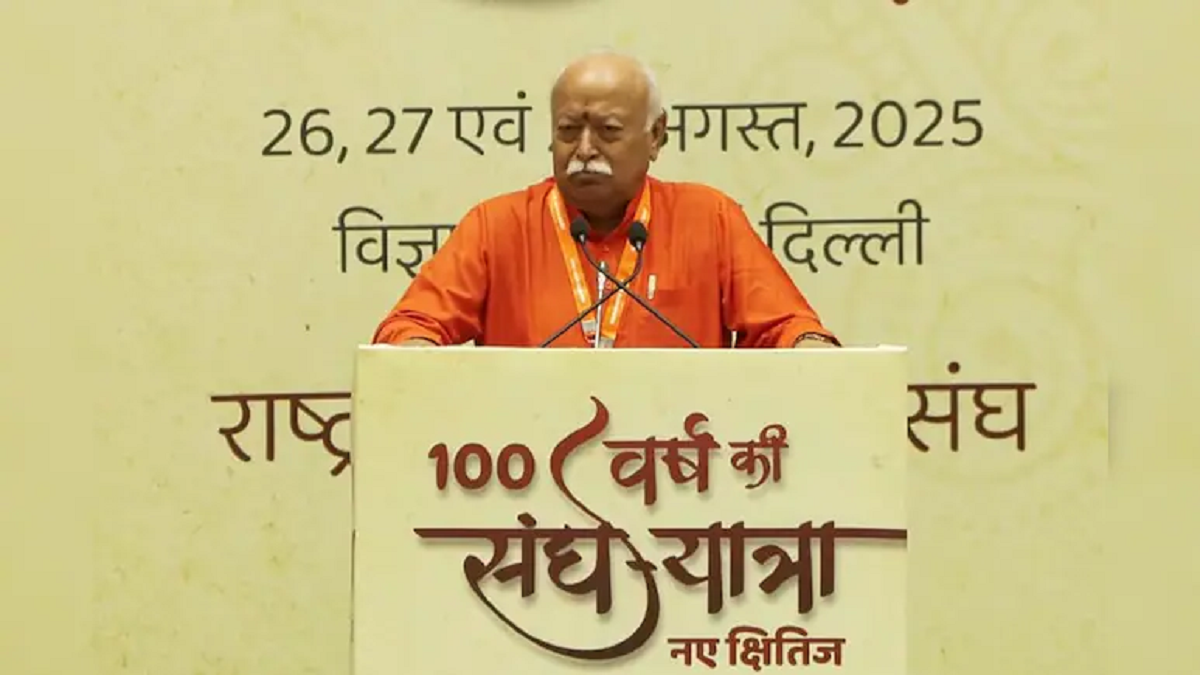
Read the full transcript of Rashtriya Swayamsevak Sangh’s Sarsanghchalak, Dr. Mohan Bhagwat’s speech on Day 1 of Vyakhanmala.
Respected Sarkaryavah Ji,
Respected Kshetra Sanghchalak Ji, Respected Prant Sanghchalak Ji, All esteemed officers of the Sangh present here, And all distinguished personalities working in different fields of national life.
I also extend my greetings to all diplomats representing their countries in Bharat, to revered saints, and to all respected mothers and sisters. In 2018, a similar programme was held in this very hall. Discussions about the Sangh are always ongoing, yet what is often noticeable is that these discussions lack correct information. Even where information exists, it often lacks authenticity.
Therefore, our purpose has been to provide truthful and accurate knowledge about the Sangh, so that discussions are not based merely on perception but on facts. Once the facts are known, it is entirely the right of the listener to form their own conclusions.
We do not aim to convince anyone; we only wish to explain. With this objective, that dialogue was organized, and it turned out to be very meaningful. Many misconceptions dissolved once the truth about the Sangh was understood. It is not that everyone who attended became part of the Sangh, nor was that the aim.
Now, with the centenary celebrations being planned, the thought arose again—why not hold a dialogue of this nature once more? The rearlier one was confined to a single venue, but this time, such dialogues are being organized at four locations across the country so that more people can participate and engage with questions later.
Even at that time, the media had effectively conveyed the essence of the event across the entire nation. The question, therefore, was whether we should repeat the same content? The Sangh is a subject in itself, and there isn’t something new to announce about it every year.
This year marks one hundred years of the Sangh’s journey. Hence, besides reflecting on the past, we must also share our vision of how we see the Sangh’s work evolving in the future. That is why this series of lectures carries the title New Horizons (Naya Kshitij).
Another conscious decision has been to ensure that 70–75% of the participants are new people. Therefore, of the two lectures planned, in today’s address I will speak about the Sangh. What was explained in two speeches earlier, I will now present in a single one.
The Sangh has been on a journey of one hundred years—but why has this journey continued? The aim was never merely to run an organization; the Sangh was created with a purpose.
Why, then, was the Rashtriya Swayamsevak Sangh founded? So many obstacles came in the way, yet the swayamsevaks continued to find a path through every difficulty and kept this movement alive. And even after a hundred years, why do we still speak of new horizons? If I have to answer in a single sentence, it lies in what every swayamsevak recites daily at the conclusion of the Sangh prayer: “Bharat Mata ki Jai.”
This is our country, and her glory must resound. Our nation must secure a leading place in the world. But why should it? There are hundreds of countries in the world, and only one can occupy the foremost position. Does this mean we aspire to compete for supremacy? No, that is not the intention. Behind this lies a deeper truth.
The world has drawn closer, and therefore, we are compelled to think globally. In such a context, what is the significance of a nation’s rise? While it is true that the life of the world is one, that humanity is one, it is not uniform. Humanity expresses itself in diverse forms, in different colours, and this diversity enhances the beauty of the world. Each colour has its own unique contribution. Looking at world history, we are reminded of Swami Vivekananda’s words: “Every nation has a mission to fulfil.” Every nation carries a mission in this world, a responsibility to contribute something of its own, which it must fulfil from time to time.
In the same way, Bharat too has its own contribution to make. When a nation grows, it should not be for the sake of its own pride. Its rise must bring forth a new and essential momentum for the life of the world, that is the true contribution. Therefore, Bharat must become capable of making such a contribution, and that is why it must rise. This is precisely the purpose of the Sangh’s creation—Bharat. The purpose of the Sangh’s work is Bharat. And the true meaning of the Sangh lies in Bharat’s becoming a Vishwaguru, because Bharat has a contribution to offer the world, and the time has come for it to fulfil that mission. We will discuss this in greater detail tomorrow. But when did this journey of ’s resurgence begin? It has been a slow, long process, and it is still unfolding.
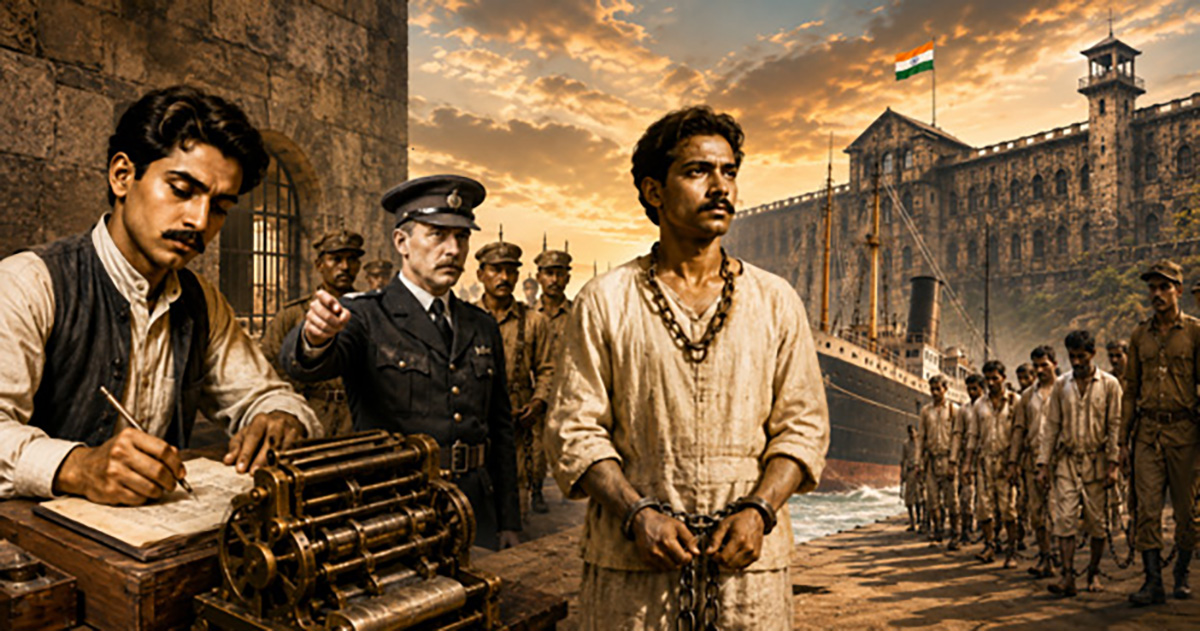
In our history, we know that we once stood at the pinnacle of prosperity and were free. Then came invasions, and we were subjugated. After enduring foreign rule twice, we finally regained our independence. The first task, therefore, was to free ourselves from subjugation. To make our country great, freedom is essential. A person bound in chains cannot attain freedom, nor can he achieve anything for himself. Thus began the struggle for independence, culminating in a nationwide effort, which led to the war of 1857. That war, on the whole, ended in failure. Yet this very failure sparked reflection within the country: This is our land; our population is vast; our kings and rulers belong to us. How, then, did we lose to a handful of foreigners who came from thousands of miles away to forcibly control our nation? Why did we lose?
The optimists responded by saying, “So what if we lost this time? We must try again—once more, through armed revolution.” Thus, a new current arose, a current of revolutionaries. From this stream emerged millions who offered their lives and their youth for the nation, examples that continue to inspire us even today. They remain ideals, teaching us what a life dedicated to the country truly means.
However, the purpose of that stream came to an end after independence, and Veer Savarkar was one of its brilliant jewels. After independence, he formally concluded his revolutionary campaign in Pune through a public event. That stream no longer exists, nor is it needed. Yet, it continues to serve as a source of inspiration for living and dying for the nation. Some people, however, felt that our failure in the struggle was not due to a lack of courage, but because we lacked political awareness. The masses were politically unawakened. If only soldiers fought, the work could not succeed; ordinary citizens also needed to rise. Therefore, it became necessary to undertake political initiatives to make people aware of their subjugation and their responsibility in the political sphere. After the war of independence and post-1857, measures were being taken to ensure that Bharatn discontent was properly expressed and did not cause harm. However, these leaders brought it under their control and transformed it into a tool for the freedom struggle, giving rise to a movement under the name of the Bharatn National Congress. From this very stream, many different political currents emerged, and today we see numerous political parties in the country. Before independence, the political awakening of the people for freedom was their primary goal, and it was achieved successfully, even ordinary citizens participated. The charkha (spinning wheel) was traditional and not new in itself, but the political movement taught the lesson of spinning it for the nation. It instilled the idea of living and dying for the country, and of considering the nation in every action. This atmosphere spread throughout the country, ultimately leading to independence. Armed struggle was also ongoing, contributing significantly, alongside certain global circumstances.
After independence, that stream should have been guided and enlightened in some way. Had that happened, the present situation might have been somewhat different; but as we all see, it did not. This is not about blaming anyone; it is simply a fact.
There was a current of thought that attributed these challenges to certain shortcomings in our society. It was burdened with rigid customs and superstitions and lacked the benefits of modern education. This needed correction, which is why various reform movements arose in our country, some continuing even today.
Their efforts yielded results and made an impact, but not everything was fully accomplished. Even now, initiatives, campaigns, and movements for reform remain necessary. There was also a stream that insisted, “Return to your roots first”—a message later forgotten. Two prominent names associated with this approach are Swami Dayananda Saraswati and Swami Vivekananda. They endeavored to lead society back to its foundational principles, and whatever followed from their efforts continues to influence Bharat to this day. Their impact pervades the nation; in some way, they remain a source of inspiration, and the flow of ideas in society still connects to them.
However, all four of these streams have flowed, shaping Bharat as we desire. Seventy-five years of independence have passed, yet we cannot say that Bharat has fully risen as envisioned. What is the reason for this?
The founder of the Sangh, Dr. Hedgewar, had actively worked within all these streams. We call him a patriot by birth because, from childhood, he bore the conviction that one must live for the country and, if necessary, die for it. Orphaned young and compelled to struggle through poverty, he never ceased participating in the nation’s work. As a student, he diligently pursued his studies and never failed to rank among the top ten in his school.
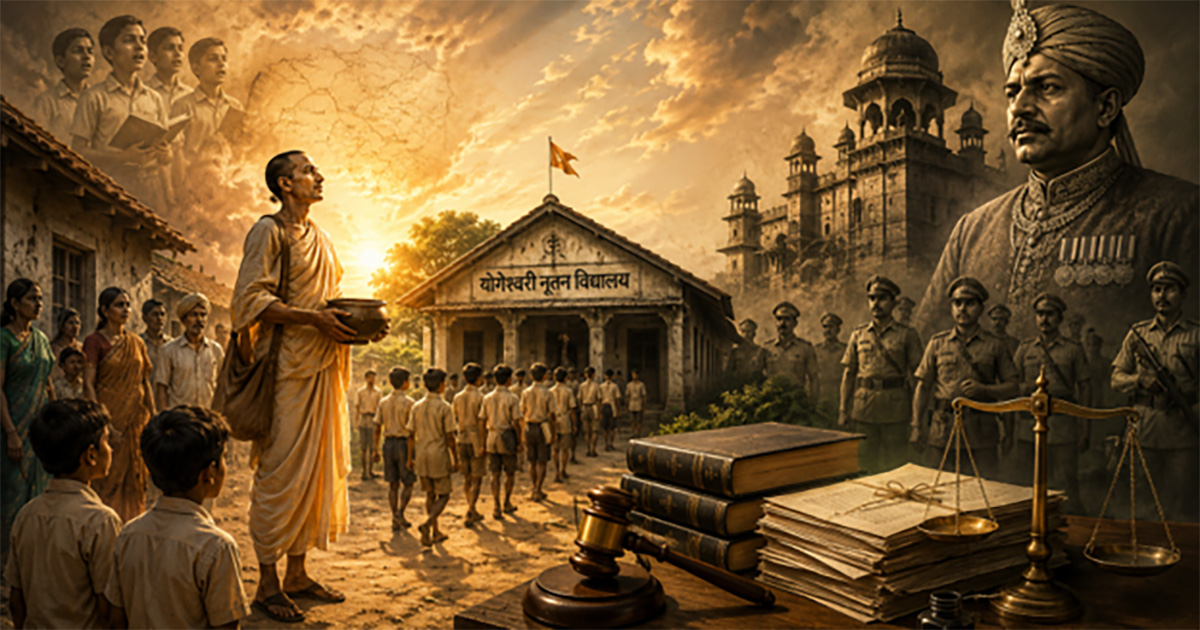
The Vande Mataram movement of 1905-06 was organized by him in all schools in Nagpur. During school inspections, students welcomed inspectors in every class by chanting Vande Mataram. The authorities became angry and closed all schools. They tried to discover the movement’s leaders. The schools remained closed for four months without revealing the culprits. Finally, a compromise was reached: at the school gate, a nominal apology was to be offered by the teacher, who would ask the students if they wanted forgiveness, requiring a nod. The schools reopened.
Yet two students from Nagpur refused even this token apology, declaring: “We are Bharatiya. We cannot dream of denying our mother Bharat her freedom. Saying Vande Mataram is our right, and that can never be denied, not even in dreams.”
Naturally, both were expelled. One of these students was Dr. Hedgewar, who later became a doctor. At that time, he attended Nagpur National University and completed his studies there, passing in first class.
Leaders in Nagpur recognized his spark and decided he should study medicine in Kolkata, but his real goal in going Kolkata was to establish a connection with the Anushilan Samiti, a committee of revolutionaries. Even without financial means, saving every penny received as charity, Dr. Hedgewar went to Kolkata.With no accommodation, two friends shared a room; he made his bed in the middle and completed his medical studies in first class. He established connections with the Anushilan Samiti. In the chronicles of the late Trilogyanath Chakraborty and Raj Bihari Basu, his codename was “Cocaine.” He was known in Chandranagar, and when the CID sought him, they mistakenly arrested the wrong “Cocaine.”
Though he contributed to the revolutionary movement, due to loopholes and shortcomings, the British successfully suppressed it. After finishing his medical degree, he received a monthly salary offer of Rs. 3000 in Burma. When questioned, Dr. Hedgewar said, “I have not come here for a job. I am here to work for my country.”
Therefore, he returned to Nagpur. When asked about marriage by his uncle, he replied that he wished to dedicate his life solely to the country, because he had promised so before joining the Anushilan Samiti that this birth was for Bharat and personal happiness would be considered in the next life.
And that is why, when the Congress movement was underway, he actively participated in it. In 1920, while promoting that movement, he gave a speech for which he was charged with sedition.
During the trial, he chose to defend himself in court. He famously said that if he presented his own defense, it would be like giving another speech in court, attracting journalists and providing another opportunity to campaign for his ideals. He then delivered his defense speech.
After hearing it, the judgment given by the judge stated that the defense speech was even more seditious than the speeches he was originally accused of giving.
In his defense, he began by stating that the British were ruling over them and questioned the legitimacy of their rule. He asked, “What kind of law is this? Who gave them the right?” He affirmed that freedom is the birthright of every person, and that he had merely communicated this to the people.
He emphasized that he had not spoken against anyone. He critiqued the fact that those who drafted the accusations did not properly understand Marathi, while his speech was in Marathi. Thus, he called their accusation false and declared that the court and the judge were themselves illegal and that he did not accept the judgment.
Because of this, he was imprisoned for one year. All such movements—the revolutionary struggle, political awakening, social reform, and religious revival—traced their roots back to these efforts. In all his work, he acted with honesty and selflessness as a dedicated Karyakarta. He understood how to work, the status of society, and the realities within it because he experienced them firsthand.
Throughout this long period, he interacted with outstanding individuals, those in positions of authority and leadership. His engagement and discussions remained consistent even after the establishment of the Sangh.
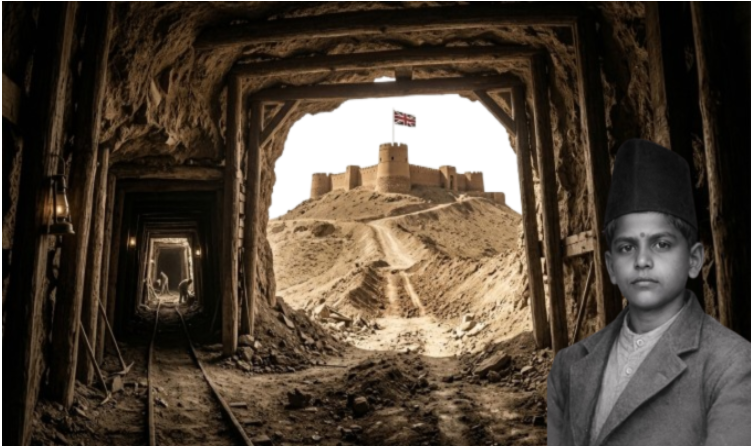
After the Sangh was founded, in 1930, the Jungle Satyagraha took place. During that Jungle Satyagraha, Dr. Hedgewar also became the Sarsanghchalak (Chief Mentor). Later, he appointed a new leader and went to participate actively in the movement.
For this participation as well, he was imprisoned for a year. After his release, the leader who had taken charge handed back all responsibilities to him, and he once again resumed the position of Sarsanghchalak.
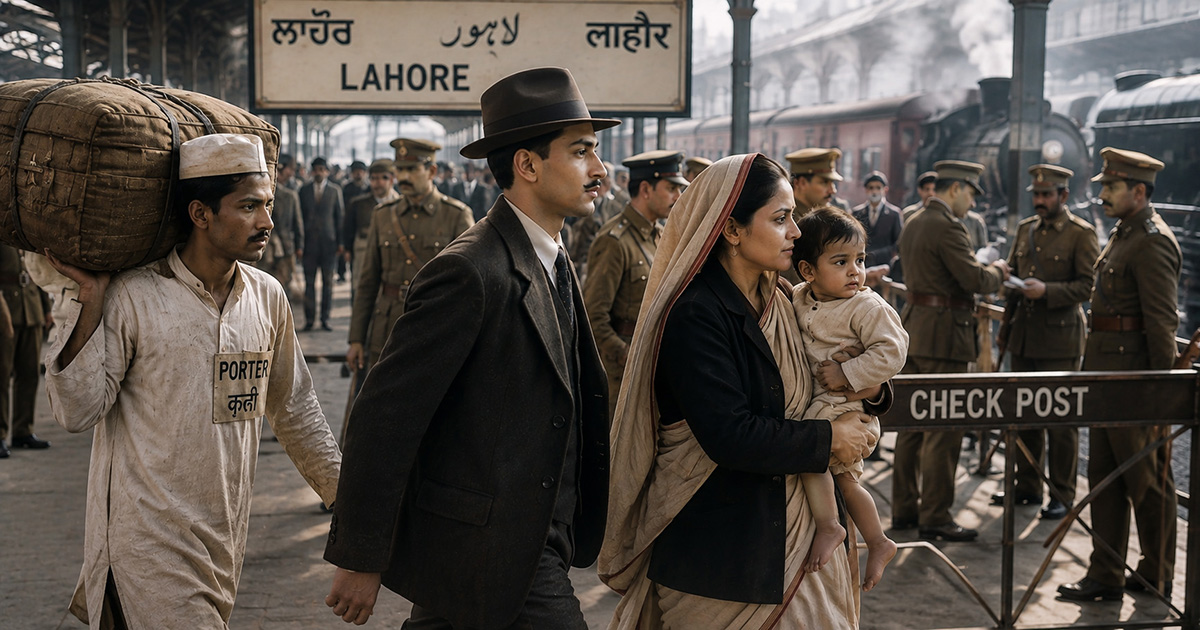
Thus, he gained valuable experience and made contact with many important figures. He engaged with Subhash Chandra Bose, Mahatma Gandhi, Lokmanya Tilak, Chandrashekhar Azad, and Bhagat Singh. Rajguruji kept him underground in Maharashtra; later, as Nagpur became unsafe for him, he was sent to Akola. Throughout this period, he was in continuous discussion with these leaders.
From these interactions, he realized that no method would fully succeed unless the negative qualities that had penetrated society were removed. One thing was clear: for the country to grow, to be truly independent, or for any meaningful change to occur, it cannot depend solely on leaders or organizations. Yes, they facilitate progress, but ultimately, everyone in society must work together and bring about change.
Today, if we want our country to grow, we cannot depend on others alone. Everyone must contribute. Politicians, policies, parties, avatars, ideologies, organizations, and power structures all play assisting roles; nevertheless, the fundamental driver of change is the transformation and positive progress of society.
Without societal transformation, our efforts will falter. Though issues may be addressed temporarily, they might resurface. There is no guarantee of permanent success.
If we examine our history of independence struggles, we see repeated cycles of attack and recovery. Every time invaders came, we were defeated, but then awakened and retaliated—only for another to arrive. Why this repetition? Because certain flaws remain uncorrected; certain qualities require development, and that responsibility falls on us.
Why have we not fixed these flaws? Because we have chosen our own priorities and tasks. Dr. Hedgewar’s studies and reflections were based on this insight. Reading about the great men I have mentioned, one senses a common understanding.
Many writers have elaborated on this. Rabindranath Tagore, in his novel Swadeshi Samaj, stated that national progress cannot be achieved solely through politics. Instead, society must establish local leadership—what he called Nayak. A Nayak is a person of pure character, consistently in touch with society, trusted by people, one who can sacrifice life and death for the nation. Such Nayaks are needed.
He said that in a vast country like ours, villages and streets require such Nayaks — individuals who can cultivate an environment conducive to societal transformation.
Rabindranath Tagore’s Swadeshi Samaj clearly conveys this. He wrote that to build a nation, one should not simply create a new set of people. Gandhi Ji, in Hind Swaraj, recounts a young man’s question to an elder: because the British introduced railways, the country became united. Gandhi Ji’s response was that this unity was inherent long before British arrival. Bharat was already a whole.
In Swadeshi Samaj, Tagore wrote that if a new person approaches us, Bharatiya are not afraid because of our inherent inclusiveness. Hindus, Muslims, Buddhists, and others Anushwill not fight each other relentlessly but live and die for this nation, resolving conflicts and living together. Tagore further said this solution would be especially Hindu, but not divisively so.
What is that word? I will explain later. But the shared belief was that our country has always been one, and our goal must be to make our society prosperous. Only through this can harmful traditions be overcome. However, time is of the essence. And so, Dr. Hedgewar felt there was no time to waste.
He shared these ideas with Trilokya Nath Chakravarti between 1911 and 1914, while living in Kolkata. After completing his medical studies and returning to Nagpur, he actively participated in protests and sought various ways to unite the entire country, expand its influence, and foster a strong national identity. He explored many paths.
Having witnessed the work of the Bharat Seva Sangh and being a member of the Anusheelan Committee, which ran numerous human development programs, he gathered valuable experience. This led him to conceive a solution, which he then tested. Following the success of that experiment, he discussed his thoughts with his young colleagues active in civil society, with whom he shared a close relationship.
In 1925, he formally announced the establishment of this movement. Today, we celebrate its centenary. The seed of this Sangh had already taken root in Dr. Hedgewar Ji’s mind years before its official founding. That seed grew within him, nurtured quietly until Vijayadashami of 1925, when he declared, “From today, we are starting this Sangh.” His objective was to create a complete Hindu society.
Now, why did he focus on the rest of the people? The first reason: those whom we call the Hindu society today bear responsibility for this country. This is a society of accountability, for the name “Hindu” was given to the people of this land long ago. Mahavir Prasad Ji, a Dvivedi scholar, wrote that during the time of Zoroaster (founder of Zoroastrianism), outsiders named us. We did not have a separate identity by ourselves.
When we composed our Dharma Shastra, it was meant to be the human Dharma Shastra. We used to say the following: “Mata cha Parvati Devi, Pita Devo Maheshwara, Bandhava Shiva Bhaktascha, Swadesho Bhuvanatraya. Ayam Nijah Paro Veti, Gananam Laghu Chetasam, Udhar Charita Namtu, Vasudhaiva Kutumbakam.” We did not differentiate between humans; all humanity was one.
Our worldview was that humanity and creation are interconnected with God. What affects one affects all. Hence, an individual’s development depends on the development of these three aspects, and one must plan accordingly. This is the very nature of this land. We needed no separate name. But when Zoroastrians arrived, they were asked, “Who are you?” They said their ancestors had migrated from India to Kyrgyzstan, crossing the Sindhu River. At that time, the people of Iran called those on the other side of the Sindhu “Hanad,” which later became “Hind,” and thus we became known as Hindus.
This is one story. The second story is that in the aftermath, when the people of Iran asked the people of Jews, they said that ‘we have a Hindu Guru.’ And while narrating this story, it spread into the western parts of the world. The merchants took up that word. But it didn’t matter much to them. They didn’t have to wrestle with the meaning of the word. Business went on as usual.
Later, the term spread among intellectual circles. After that, it even entered our Puranas: “Tam deva nirmitam desham hindusthanam prachakshate.”
It took a long time for such terms to take root in the local languages. And whenever words enter local tongues, they usually pass through the hands of saints and seers. That is why in the Bani of Guru Nanak Dev Ji, this word appears first: “Hindusthan khasmana kiya, Khurasana khasmana kiya, Hindusthana dharaya.” Here, he describes the atrocities committed by Babur. He laments that neither the honour of Hindu women remained, nor the dignity of Muslim women remained.
Now, if we reflect on this, a question arises: why did he use two different words? Because, at that time, there were Muslims as well—but these were converts from among our own people. On the other hand, why were they called Muslims? Naturally so—because they believed in Allah, they believed in the Qur’an, they believed in the Prophet. Therefore, they were Muslims.
But there is no corresponding certainty in calling someone a Hindu. Who exactly is a Hindu? There is no Hindu who believes in a single God. Among Hindus, divinity takes many forms—it is believed that there are 33 crore deities. There is no single scripture binding them, nor is there a single Guru.
At that time, there were—Buddhists, Jains, Shaivas, Shaktas, and various other sects, each with its own philosophy. Yet, there was a common disposition that connected them all: AN ACCEPTANCE OF DIVERSITY.
The belief was—every path of worship in this world ultimately leads to the same goal. No path is wrong. Yes, some may reach later, some sooner. Some paths are very easy, others quite difficult. As one text describes it: “Ruchi-nām vaichitryāt rūju-kuṭila-nānā-pathā-yutām.” (Human tastes differ, intellects differ, interests differ. Because of these differences, there are many types of paths—straight and crooked alike.)
Just like reaching this gathering today, you could have come by any route. There wasn’t just one way. Some paths were more direct, others circuitous. Perhaps you even came by a difficult path. Yet, even from the wrong way, you could still arrive here. This is how our own tradition has looked at the diversity of ways.
There are many such paths. “Ruchi-nām vaichitryāt rūju-kuṭila-nānā-pathā-yutām.” This means: Human beings (naraṇām) have many paths, but all of them ultimately lead to the same destination. And who is that destination? God—the one who belongs to all.
“Naraṇām eko gamyas tvaṁ asi.” (For all human beings, God is the one final goal.)
How is it so? Just as anywhere in the world whenever it rains, in the end, all the waters inevitably flow into the ocean. Those who held this faith, they were all called by one name—Hindu.
So, what does Hindu mean? It means the person who believes in this principle: Follow the path that has come to you naturally, have faith in it, do not abandon it, and do not forcefully change others’ paths. Have faith in your way, and allow others to have faith in theirs. Respect it fully. Accept it wholeheartedly. Never show contempt for it. And do not quarrel over the path. Walk together. This is their tradition. This is their culture. And whoever carries this culture is a Hindu.
And why did such a culture develop here? The reason lies in Bharatvarsha, in the geography of this land. From all four sides, we were protected. In the beginning, invaders never even arrived here. Who would cross the vast oceans? There were no ships. Who would dare to cross such frozen mountains? Without proper means, no one could come. That is why we were safe.
And within our land, there was abundance. The population was not as vast as it is today. That is why, naturally, people here cultivated an attitude of harmony—because why fight unnecessarily? Elsewhere, the world may have been dominated by the law of struggle for existence, “the survival of the fittest.” But in ancient Bharat, there was no such struggle. Who would fight with whom? That is why we attained freedom, security, and prosperity. We had time. We had peace. And because of this, we could turn the human quest inward.
All over the world, people searched externally for truth. They reached a point and then stopped. They declared: There is nothing beyond what is visible to the eye. Perhaps with a microscope, you may see finer details. But, they said, there is nothing beyond that. Thus, the world stopped there.
But we did not stop. Instead, we turned our gaze inward and discovered the truth within ourselves. And that discovery revealed to us that everything is one. What appears outwardly as diverse, at the core, is one. So what is our natural religion? It is the religion of equality, not of conflict. That is the culture that arose here, and this is why our devotion to the Motherland is so deep. The Mother has not only given us food and shelter; she has also given us this culture. Bharat Mata has given us this way of life. She is our Mother.
And this is not a mere myth. Based on this very truth, our ancestors have lived since ancient times. To shape such a life, they have shed blood, given their sweat, and made countless sacrifices. For the protection of this sacred land, they have given their lives and offered great effort. That history is what inspires us.
Those ancestors are our ancestors. Whoever believes in them—such a person is truly a Hindu. But when conflicts arose, the circumstances became such that not everyone called themselves Hindu. And even today, there are some who do not.
Still, we uphold Hindutva—the essence of Hindu identity. Among us, there are those who know that they are Hindus and feel pride in it. There are also those who know they are Hindus but say, “What is there to be so proud about? We are Hindus in this world, let it be.” And then, there are those who know inwardly what they are, but for various reasons, do not declare it openly. And finally, there are also those who truly do not know they are Hindus. Yet, such people rarely feel any discomfort in being called Hindu. Nor do they object to being called Bharatn. Some even say, “We accept Sanatan.” Now, what is this word Sanatan? It is simply another synonym. That is why we do not go around insisting you must identify as “Hindu.” Instead, we say—we are Hindus; we are Bharatiya.
But one must understand the content behind these words. Behind them lies not mere terminology—it is not a matter of vocabulary alone. It carries meaning. And that meaning is not merely geographical. Within it lies our devotion to Bharat Mata. Within it lies the continuity of our ancestral tradition—a tradition that belongs equally to all of us.
Look even at the science of it: our DNA. Forty thousand years ago, the DNA of the people of Bharat was the same. Across the land of Akhand Bharat, it has remained one. And we share a culture of living together. These truths do not divide us. Because for us, unity has never meant uniformity. Oneness does not require sameness. Unity can flourish even amidst diversity. Indeed, diversity itself is a product of a deeper unity.
But there is also a test—expressed as four questions. Two of those are very difficult. Two are easy. Which shall we take first? Let us begin with the easier ones. That is—those who already identify as Hindus, first bring them together. Organize them. And make their lives better. So, those who for some reason have not been calling themselves Hindus, they too will begin to say it. That process has already begun. And those who had forgotten, they will also remember. That will happen as well. But the real task is to organize the entire society.
Why do we emphasize the word “Hindu”? Because behind it lies the substance. The meaning of Hindu is not Hindu versus someone else. The meaning of Hindu is inclusivity.
And what are the limits of this inclusivity? There are no limits. Keep going forward— Not just one person, but the whole family. Not only the family, the entire village. Not only the village, the community. Not only the community, the whole region. Not only the region, but the entire nation. And not only the nation—the whole world. Not only humanity, but the whole of creation.
This is inclusivity. It means embracing everyone, giving space to all, treating all as equal, and ultimately moving toward unity with the Eternal. This boundless inclusivity is what raises our society to the highest level. That is why Hindu is not a narrow notion. On the contrary, it is a vision that points the way—toward unifying our entire society, and toward developing harmony with the entire world.
It is all about uniting, not dividing. That is why this Sangha was formed—because a society can only become like this if it organizes itself. But for this to happen, something must be done. Mere willingness is not enough. Preparation must be put into action.
So it was understood that preparation has two parts: To prepare the human being. To have the human being act.
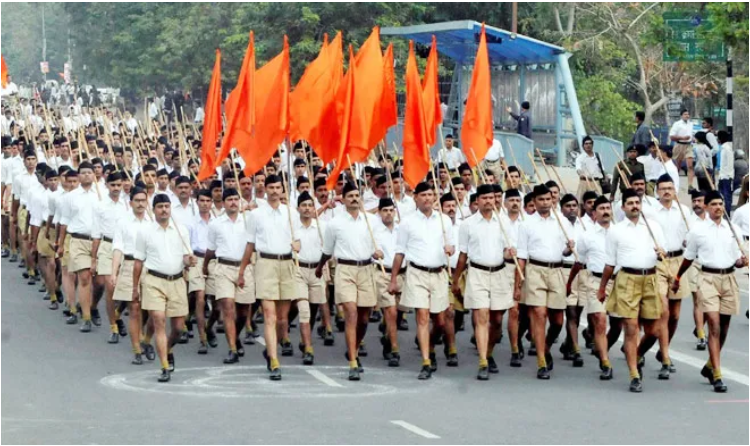
For the first part—preparing the human being—a methodology was developed. The one organization devoted solely to this is the Rashtriya Swayamsevak Sangh. It does nothing else. It has shakhas. It has swayamsevaks.
As for the second part—the actual work to be done in society—that will be carried out by the swayamsevaks themselves. The organization as such does not enter into it.
And there are countless swayamsevaks. Even if those needed only to run the Sangha remain within it, a huge number still go out beyond it. Let them be active in wider society. The tasks that need to be done outside, they will accomplish.
At one time, this dream seemed even more impossible than an illusion. Many swayamsevaks used to ask, “But how will it happen?” The Doctor ji used to say simply: It will happen. The Sangha itself will not directly do anything. Everything will happen, naturally. And truly, it is happening. Today, swayamsevaks are working in countless spheres of society.
Based on the thoughts and values that we have received, it becomes necessary to re-create and re-shape various spheres of life. And indeed, this work has already begun. For instance, the Swayamsevak Sangh went into the field of labour through the Bharatn Labour Union. They gave to the entire world a new vision of labour. Wherever they have worked, they have brought positive improvements by shaping those environments anew—based on Bharat’s independence and spirit of self-reliance.
Why is this work of re-creation necessary? Tomorrow, we will reflect upon that. But for now, it is enough to say—this is the work of the swayamsevaks. It belongs to them. It is their effort, their independent contribution. The credit goes to them, not to the Sangha.
The Sangha only carries the responsibility when things go wrong. Because, while the inspiration comes from us, the achievement is theirs. The Sangha does not control them—neither directly nor indirectly. There is only one bond—their relationship with the Sangha is unbreakable. It is eternal. The Sangh’s prayer can be sung anywhere, and the bond never breaks. Because of this connection, we meet, we converse, we ask, we tell. We support, and we are supported. We help in every good work; not only in great undertakings, but even in small acts. And this help is not limited only to swayamsevaks—it extends to all. This is the truth, and this, in itself, is a profound example.
Yet, the swayamsevaks are not under our compulsion. They listen to us—not as a command, but to understand. After understanding, they do what they feel is right, because it is their field of work. They have the experience, they have the expertise. It is not that we do not have it, but it is they who must do it. And they must have the freedom to act. That freedom is given.
And remember, sangathan is not confined only to the Sangha. Many people are part of it. The organization belongs not to the Sangha alone—it belongs to the society, to the people. It is true that swayamsevaks played the pioneering role in establishing it; they were present at the beginning, and even today, remain part of it. But as the organization grows, the swayamsevaks are less visible; society itself becomes more deeply involved. This is the essence of what we have learnt as swayamsevaks—to bring everyone together.
Even if there are differences of opinion, there should not be division of heart. Opinions may vary, but minds should remain united. Everyone must have this spirit. That is the meaning of sangathan. This is the expectation we have from society.
For this, both the swayamsevak and the larger organization must be on the right path. A swayamsevak must live rightly, and so must society. We keep reminding them of this. And gradually, they become independent, self-sufficient—not in need of asking for help. What matters is that thoughts, values, and conduct remain right. Such is the concern we carry for swayamsevaks. Such is the concern we carry for sangathan. Not as “ours” in a narrow way, but in the spirit of guiding and uplifting all. This is how we keep moving forward. We do not wish to put pressure on anyone in Bharat. The mission of the Sangha is to unite everyone in Bharat.
Many of you may have seen this in your own lives. Thirty or forty years ago, some among you may have opposed the Sangha; later, some among you may have supported it. But whether you opposed or supported, you were still part of us. And even today, you are part of us. Because there is only one truth—we are a single nation. We are one country of 142 crore people. Within it, there are many religions, many beliefs. But it is not a crime to have different beliefs. In fact, this is a richness given by nature itself. When diverse thoughts are heard together, and consensus emerges from them, progress takes place.
As the English saying goes: Coming together is a beginning. Staying together is progress. Working together is success. That is what sangathan truly means. That is our task—to unite the entire society.
If it is written in this country that the nation has been saved only because of the Sangha, then that is not right for us. We do not accept this. Nor is that what we want. If that alone were our desire, it would have been enough long ago.
Consider this: If Ravan had never existed, what then? If Shivaji had never existed, what then? How long can we wait for Shivaji to come again? How long can we wait for Ram to come again? Even God helps only those who first help themselves.
Because of failing to grasp this, we have developed a bad habit—handing over alms. Give alms to the leader, give to the party, give to the government—‘you look after the nation, we will stand aside and discuss.’ This is not right.
The responsibility for the nation rests with all of us. The way we are, that is how our representatives will be. Likewise, the way we are, that is how our parties will function. The way we are, that is how our leaders will act. Therefore, it is we who must first improve ourselves and work sincerely for the nation. The whole society must unite for this.
In our daily prayer, we say: “Vijay gātra-triśūla samvata kārya shakti” (the power to accomplish united action). On what should this united power be based? On what foundation? On the entire Hindu community. Because before anything else, that is how we identify ourselves—we are members of the Hindu Samaj. It is the responsibility, therefore, of the entire Hindu Samaj. And so the whole Hindu Samaj must rise to this. Our collective capacity means nothing less than the collective strength of this entire community.
And yet—when we speak of the Hindu Samaj, questions often arise. Why? Because when we translate the word Rashtra as “nation,” it shifts into a Western concept. In that concept, “nationhood” is tied inseparably to “statehood.” But in our tradition, a Rashtra can exist without a state. We have always had a Rashtra. From the very beginning. Remove, for a moment, the word “Hindu”—still a Rashtra remains. We have possessed that sense of nationhood from time immemorial.
Mahatma Gandhi himself affirmed this. As a nation, we fought—again and again, century after century. From north to south, from east to west, this shared consciousness, this shared striving, is spread and endured. Our sensitivity, our collective awareness, has always been bound to the whole of this land. That is why we are, and always have been, a nation.
Yes, within this nation we were not always a politically independent people. But still, we were a Rashtra. Sometimes we had kings of our own; sometimes foreigners became kings. The British became rulers. Before them, Turks and Arabs became rulers. But through all this—we remained a nation. We were never a single king. We were never solely one state. There were many kings, many states, many systems. But still, we were one Rashtra.
We say this in the mantra Pushpanjali: Swasti Sāmrājyam, Bhōjyam, Swarājyam, Vairājyam, Rājyam, Parameṣṭhyam, Mahārājyam, Mahā Gaṇādhipatyam, Swasti Sāmrājyam, Vairājyam… —there are so many types of kingship, states, and systems. And yet, even after listing them all, it is further said: “Samudra paryantāya eka-rāṭ iti.” —meaning, this entire earth up to the ocean’s limits has one sovereign. When the land was fertile under Prithviraj Chauhan, even then we said this. When we had Chakravarti emperors ruling, we said this. When we did not have a Chakravarti, and were divided into different states, still we said this. When the British ruled as kings, even then we said this. When foreigners came and established their rule, still we continued to say this.
We were always a Rashtra. The rulers changed, power shifted, systems came and went, but the Rashtra remained. That is why the word Hindu Rashtra has nothing to do with political power. The system of Hindu Rashtra, which has flourished here through the ages, is not a system of mere parties or sectarian dominance. It has always been based on one principle: justice equally for all. Be it across sects, communities, or languages—there is no question of discrimination. Justice is the same for everyone.
That is why, when we say Hindu Rashtra, we are not excluding anyone. When we say Hindu Rashtra, we are not opposing anyone. The Sangh was not born out of opposition. The Sangh was not born as a reaction against anything.
At one press conference, Guruji was asked: “In our village, there are no Muslims or Christians—then what is the use of having a Sangh shakha in such a place?” Guruji replied: “Forget your village—even if there were no Muslims or Christians in the entire world—if Hindu society were in the condition it is today, there would still be the need for a Sangh shakha. Because this organization is not against anyone.” You all must be doing exercise—at least a morning walk, an evening walk. But if someone were to ask you: “Why are you exercising? Whom are you planning to beat?” what would you answer? Exercise is not for beating anyone—it is to keep oneself fit. If ever the occasion arises to fight, yes, that fitness comes into action—that is another matter. But the very purpose of exercise is not enmity. Its real purpose is health, and health is the natural state of the body. Similarly, being organized is the natural state of society. Without organization, things do not function. Without it, society’s potential remains wasted. That is why the organization of the entire society is the natural and necessary work.
And this has been going on now for a hundred years. And if we speak about this hundred-year journey, what can we say? Dr. Hedgewar had once told us that in the life of any organization there are three stages it must pass through. After crossing those, the work becomes firmly established. The first stage is the stage of rejection. In the beginning, the organization itself was not accepted. Dr. Hedgewar was not a well-known leader across the whole country. He was, in appearance, an ordinary man—he had a sturdy build, a dark complexion, smallpox marks on his face, simple teeth, ordinary attire. He lived like a typical middle-class Maharashtrian of those days, and he spoke in a very simple, everyday language. That was him—nothing flamboyant, no trappings of fame. There was no publicity machinery, and there was no acceptance of his thought. People used to say, “Has Dr. Hedgewar gone mad? He is talking of creating a nation by working with children!”
At that time, the very idea of a Hindu Rashtra was not accepted at all. Even well-regarded Hindus would say, “The Hindu community is dying now. Leave it alone. This is a dead society.” Such was the opinion. And so, there was no acceptance of the thought. Still, early pracharaks went out from the Sangh. There was no recognition, no publicity. But a spark had been lit within, and so they went.
When the first pracharaks went from Nagpur to Bhagalpur in Bihar, they had no place to stay. Dr. Hedgewar himself gave them money for train tickets. At that time, the fare to Bhagalpur was Rs. 3.12, so after buying the ticket, they had only Rs. 1.25 left. In Bhagalpur, they knew no one—no contacts anywhere in the whole of Bihar. The work had not yet started, and there was no place to stay.
A passenger train arrived from Patna late at night, and they used to stay in the waiting area there through the night, sleeping on the floor. In the morning, they would freshen up in the station itself, and then all day they would wander through nearby villages, meeting people and speaking to them.
There was nothing to eat. Eventually, they befriended a man who used to sell roasted chickpeas. He would give them a little more for the money than usual, and on that they managed to survive. When the work began to grow, there was then a serious problem of food. One villager, after speaking with them, asked: “Are you a Brahmin?” They replied, “Yes.” The man then said, “Come with me. We are in need of a Brahmin here.” They went to his house. The mother of that house came to know that this young man was an M.Com graduate, who had left everything to devote himself to the Hindu society, for the nation, through the Sangh. She was moved. She told him: “In Bhagalpur, by eight o’clock, you should eat food somewhere. If not, then come to our house. I shall keep food ready till eleven. I will even go out into the village to see whether you have eaten or not. If I know you have eaten, I will not worry. If you haven’t, then you must come here and eat.”
Many years later, when I visited there as a pracharak for the area, I saw that the little boy who had been in 8th grade at that time in that household had now himself become our department karyavah. That family had been deeply tied to the Sangh since then.
At that time, we had almost no resources. Once, a famous eye surgeon invited me, and we ate at his place. Our karyavah was also present. I told him to come and sit with us, but he replied, “There is food at my own home. But I must first complete my report to you. Only after finishing this responsibility can I go to eat at my house.” Such was the discipline and dedication that bound our work, even in those difficult beginnings.
Society took care of us. We lived on whatever care it gave us. People did not believe in us at first. For a long time, there was bitter and intense opposition. One could even make a book out of all that happened. There were false accusations, even attempts of violence and murder. We endured, we struggled as much as needed—but all the while, we reminded ourselves: this is our own society.
In February 1948, Guruji’s house was attacked. People rushed to protect him. But what did Guruji do? He sent everyone back. He said: “Go home. This is our society. Even if they come to kill me, let my blood flow—not the blood of society. All of you go back.”
This was the spirit. Because what is our foundation? The work of the Sangh is not built on opposition or reaction. The Sangh’s foundation is pure, satvik love. On this foundation, we embrace the principle of unity in diversity. It is the form of truth, the form of love, the form of compassion. This is the basis of our work. The swayamsevaks always remembered: Trials will come, opposition will come—but all are our own. That is why I often say—the Sangh runs as Hindu. And “Hindu” here does not mean a section or a group—it means the whole family. In seed form, the family is run on the same spirit of our own. The village is run as our own village. The nation is run as our own country. This is the natural and gradual expansion of human life. And in doing this, self-interest has never been central. Rather, what developed was self-respect, self-love, and self-confidence. It is on this basis that the Sangh has grown.
The Sangh has never relied on external support. No “ready-made” workers were taken; we built our own workers. Workers are made, shakhas are run, more branches are opened, and more workers are created. Each swayamsevak himself offers gurudakshina once a year. And note this carefully—they do not offer it to the Sangh. They offer it as a measure of their own dedication to the service of the nation. How much sentiment of dedication do I carry? How much enthusiasm do I live with? It is this that is being tested. For this, swayamsevaks save all year. Sometimes they skip eating dal; sometimes they cut down on tea; sometimes they adjust their children’s meals—just so they can offer something in gurudakshina.
There was once a young swayamsevak named Shamu Pawar. He was a student in Navi. Both his parents were daily-wage laborers. They cooked whatever they earned each day. They lived in a hut . At the time, the target was that every swayamsevak should offer ₹21 in gurudakshina. Shamu began helping his mother prepare chheena-badam—salted peanuts. On Sundays, once every three months, he would go to the local cinema hall and sell peanuts outside. Month after month, he kept saving until he collected the ₹21. He placed it at home, and for fifteen days no one touched it. When the day came, he took those 21 rupees and offered them as gurudakshina. This is the spirit with which swayamsevaks work.
In Nagpur too, when I was young and attended shakha, I remember a temple box kept near the ground at Reshimbagh. Every time we received something—even just a guest visitor’s old copper coin—we would put it into that box. All of Reshimbagh was built with the contributions of swayamsevaks in this way. The Sangh never stretched a hand before anyone. The Sangh has always been entirely self-reliant. And that is why we can speak freely. Whatever we feel is good, we can say it openly. Whatever we feel is wrong, we can say courageously. But behind this there is never hostility. There is no friendship with some and enmity with others. For us, all are our own. And so there is love for all. On the basis of that love, and on the dedication of the swayamsevaks, we have reached here. On their countless sacrifices, on their tireless commitment—we stand. We know this well. What I feel for them is difficult even to express. And such feelings live in every swayamsevak’s heart. It is upon this that we must carry the Sangh forward. Why must we carry it forward? Because we have to build India. And India has a contribution of her own to make to the world.
What that contribution is—we shall reflect upon in tomorrow’s discussion. Thank you.