Varsh Pratipada: Nature, Not the Clock, Determines the New Year: The Astonishing Story of Indian Time Philosophy

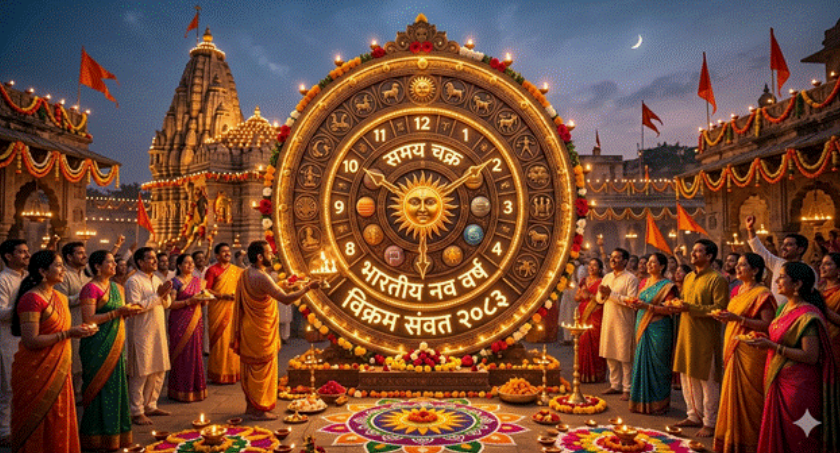
In India, the year doesn't change; it is reborn. This is not just a line, but the essence of Indian time philosophy. While the world welcomes the English New Year with the clock's hands on January 1st night, India commences the new Samvatsara in sync with the universe at the dawn of Chaitra Shukla Pratipada. Here, the New Year is not merely turning the pages of a calendar; it is a festival of renewing consciousness. In Western tradition, time is seen as a straight line racing from past to future. But in India, time is viewed as a cycle, an unending flow of creation, preservation, and destruction. Just as spring returns every year, in India, the New Year reminds us that rebirth is possible after the end of life. Thus, the Indian New Year is not merely a social tradition or festival; it is also a declaration of humanity's spiritual bond with the cosmic rhythm.
The definition of time in Indian scriptures is immensely vast. The Brahma Purana states, “चैत्र मासि जगत ब्रह्मा संसर्ज प्रथमेऽहनि,” meaning creation began on Chaitra Shukla Pratipada. This day is also regarded as the beginning of Satyayuga. Here, the unit of time is not just the year, but the yuga. Satyayuga, Tretayuga, Dwaparyuga, and Kaliyuga — these four together form a Mahayuga (duration of 4,320,000 years). Further vast concepts like Manvantara (71 Mahayugas) and Kalpa (4.32 billion years) follow, described in detail in the Vishnu Purana and Bhagavata Purana. A Kalpa is considered one day of Brahma, in which creation arises and after dissolution, is reborn. This idea shows that in Indian wisdom, the nature of time is cyclical — what ends reappears in a new form. The New Year is the subtle manifestation of this very cycle.
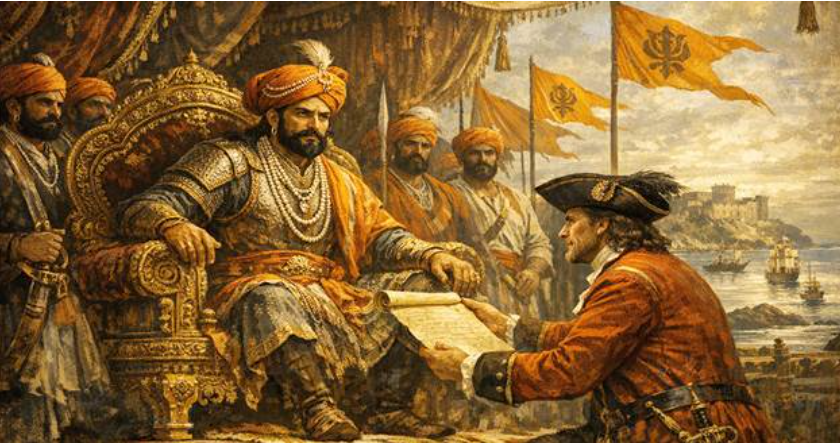
History too bears witness to this cyclical vision. In 57 BCE, Ujjain's Emperor Vikramaditya defeated the Shakas and began the Vikram Samvat from Chaitra Shukla Pratipada. This was not just a historical victory; it was a decision to usher in time reckoning into a new era. Even today, Vikram Samvat is Nepal's official calendar and is widely used in India for religious purposes. The ancient astronomical text, Surya Siddhanta, provides a detailed mathematical description of the panchang's structure based on the sun and moon's movements, calculations done by Acharya Varahamihira in ancient India. This demonstrates that the Indian New Year is not merely a religious faith but a tradition rooted in scientific astronomical balance. Here, the year begins when nature and the universe enter a new rhythm.
Nature itself is the witness to this rebirth. In the spring season, trees shed old leaves and new buds sprout. New crops sway in the fields. This is why, in different parts of the country, this day is celebrated by various names. In Hindi-speaking states like Uttar Pradesh, Bihar, Rajasthan, and Madhya Pradesh, the New Year is observed as Varsh Pratipada. In Maharashtra, it's Gudi Padwa; in Andhra Pradesh, Telangana, and Karnataka, Ugadi; the Sindhi community celebrates Cheti Chand; and in Bengal, Poila Boishakh. All these festivals share a common thread: 'New beginnings.' At some places, the Gudi victory flag symbolizes self-confidence; at others, Ugadi's pachadi conveys the message of embracing life's six flavors. This diversity reveals that Indian time philosophy is not a mere philosophical fancy but an experience woven into everyday life.
From a philosophical perspective, the Indian New Year is an invitation to self-rebirth. In the Bhagavad Gita, Lord Krishna declares Himself as spring among the seasons, “ऋतूनां कुसुमाकरः,” meaning among the seasons, I am the flower-bearer. Spring signifies rejuvenation, new energy, and fresh consciousness. Indian time philosophy teaches us that through our actions, resolutions, and thoughts, we can reinvent ourselves every year. It is not a race forward like linear time, but a process of returning in the cycle to refine oneself. Just as in meditation, the mind returns repeatedly to the same point, the New Year offers an opportunity for self-introspection: What to renounce? What to embrace? And in which direction to proceed?
In today's fast-paced, stress-filled world, this cyclical time vision is profoundly relevant. Linear thinking pushes us into constant competition, where the past is left behind, and anxiety about the future dominates. Indian thought says: Pause, return, and restart anew. The new Samvatsara tells us that life is not a racing line but a circle, in which every year the soul gets a chance to renew itself. Therefore, the Indian New Year is not just a tradition; it is civilization's message. Time is not the enemy but an ally. An end is not destruction but the gateway to rebirth. Indeed, in India, the year doesn't change; it is reborn. In 2026, Varsh Pratipada will be celebrated on March 19. On this day, Varsh Samvat 2082 will end, and 2083 will begin.
.png)