How Did Vasudev Balwant Phadke Establish India’s First Provisional Government After the Failure of the 1857 Revolt?

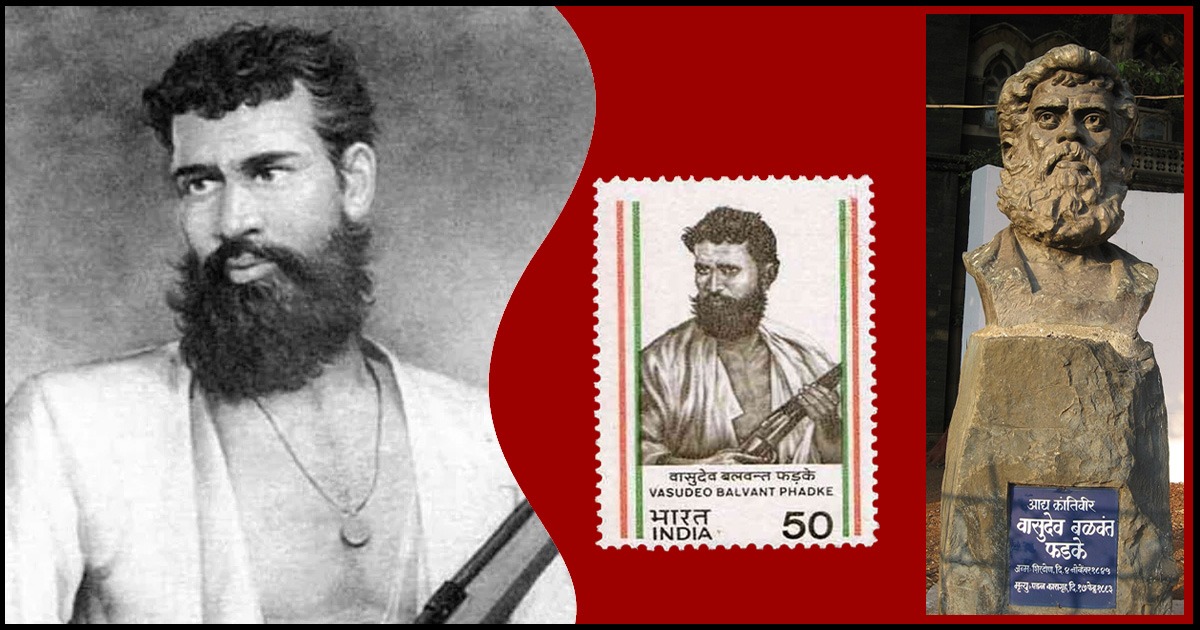
Can you imagine a single individual setting up a parallel government to the British in 1879? How did he accomplish such a feat?
Let us delve into this remarkable episode from the life of Vasudev Balwant Phadke.

Vasudev Balwant Phadke | Image Source: Aaj Tak
This is neither fiction nor exaggeration. It is a vivid chapter of history—one that has been deliberately sidelined. And at the center of that chapter stood Vasudev Balwant Phadke.
After the failure of the 1857 uprising, it was widely believed that challenging British rule was impossible. The educated class began moving toward compromise with the colonial administration. The common people were crushed under famine, heavy taxation, and repression. The idea of independence seemed like a distant dream.
But for Vasudev Balwant Phadke, freedom was not a dream—it was an unavoidable resolve. A question kept stirring within him: Were Indians incapable of governing themselves? If a few hundred British officials could rule an entire nation, why could millions of Indians not unite to form their own government?
During the devastating famine of the 1870s in Maharashtra, the British government continued collecting taxes and enforcing harsh measures. It became clear to Phadke that the problem was not merely individual officers, but the entire structure of British rule. He decided that it was not enough to remove the colonial administration; a parallel indigenous system of governance had to be established—one rooted in Indian strength and responsive to Indian suffering.
When Phadke sought support from influential sections of Indian society, he met with disappointment. He was warned that confronting the British Empire would be suicidal. But the spark within him had already turned into a flame. He turned instead to those most neglected by the British, the janjati communities. Under the guidance of Lahuji Vastad Salve, he organized and mobilized them. This marked a decisive turn in history.
With nearly 300 men, Phadke formed a disciplined force. It was not a mob, but a trained band of fighters skilled in firearms, swordsmanship, horse riding, and strategy. Their purpose was not merely combat; it was to instill confidence among the people that the British were not invincible. Funding such an effort required resources. Instead of burdening the public, Phadke targeted British treasuries, wealth extracted from Indians through taxation.
His forces raided government treasuries. The money seized in raids across villages in the Pune district was distributed among famine-stricken people. These were not ordinary robberies; they were political statements. The wealth taken from Indians would be returned to Indians. Gradually, word spread across villages that someone had risen who did not fear the British. The direction of fear was shifting. It was no longer the people who were afraid; the British had begun to worry.

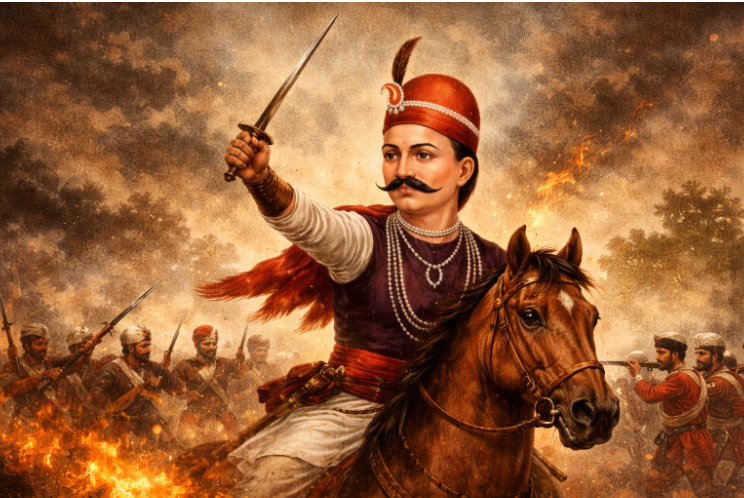
One who challenged the British: Balwant Phadke | Image Source: The Better India
By 1879, British communication lines in several parts of the Pune district were completely disrupted. Phadke and his men captured forts such as Dhamari and Torna. Colonial administration in those areas became ineffective. It was here, without formal proclamation, without a crown, that India’s first parallel indigenous provisional government emerged alongside British authority. It did not exist on paper; it existed in the confidence of the people. In many villages, Phadke’s word had become law. This was the greatest threat to the British; it proved that Indians could not only fight, but also govern.
The British understood that if Phadke’s experiment in parallel governance succeeded, it could ignite resistance across India. A reward was announced for his capture. Military and police teams were deployed to hunt him down. Finally, amid illness and betrayal, Vasudev Balwant Phadke was captured on 20 July 1879.
He was sentenced to transportation for life and endured severe hardships and humiliation in prison. Yet his resolve did not break. Even behind bars, he refused to surrender in spirit. His body was confined in the Aden prison, but his ideas remained free, ideas that would outlive him. On 17 February 1883, after enduring brutal treatment, Phadke died in prison. His struggle, however, had already entered history.
.png)