Fact Checking Maritime Myth of British Raj: How Indian Maritime Expertise Powered the British East India Company

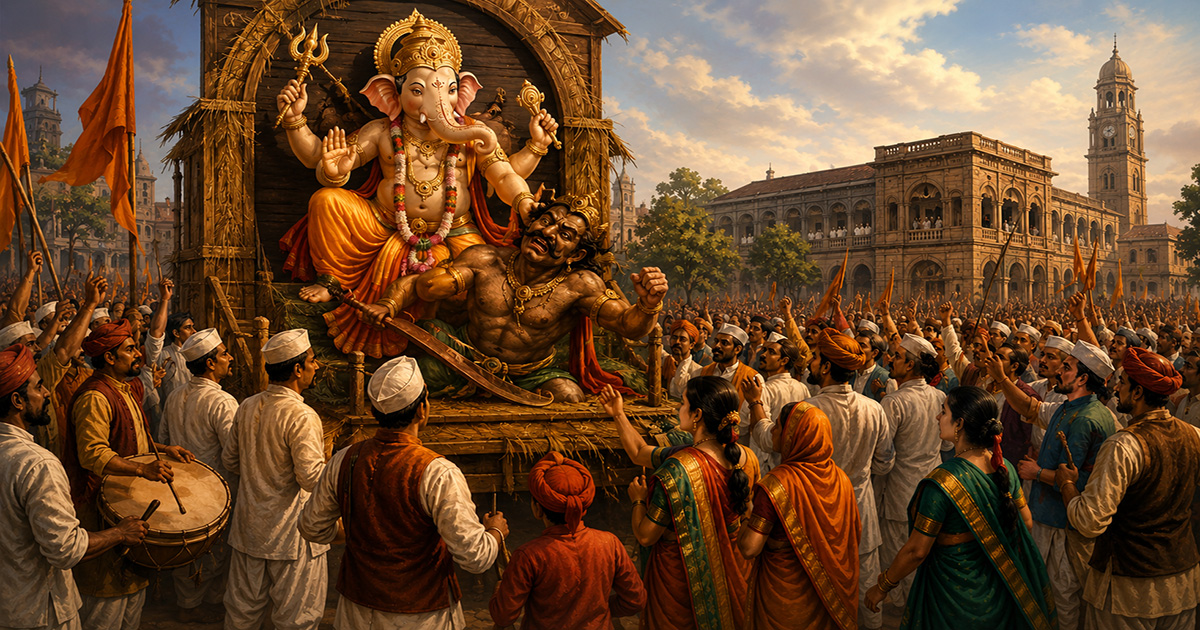
This image is AI-generated
For generations, the British, who colonised Bharat for nearly 200 years, told us one false story very confidently: That it was the British East India Company that brought order, safety, and modern shipping to Bharatiya waters. According to their narrative, the British were the ones who opened sea routes, suppressed “piracy”, and brought in a disciplined maritime system. Yet behind this narrative lies a striking reality: The ships that enabled British dominance were a product of Bharat’s existing expertise in the waters. The ships they used were built largely from Bharatiya materials, in Bharatiya dockyards, and with techniques long familiar to the Bharatiya shipbuilders. In sum, the empire that claimed to civilize the seas relied heavily on Bharatiya expertise in the very maritime world it sought to dominate. Today, we’ll not only tell you how the facts about Bharat’s long-standing expertise were exploited and twisted by the British, but also fact-check their lies with established truths.
A Witness to Bharat’s Maritime Power
Maritime prowess in Bharat stretches back thousands of years. As early as the third millennium BCE, merchants of the Indus Valley Civilization maintained maritime links with Mesopotamia for trade across the Arabian Sea. Excavations at Lothal in present-day Gujarat have revealed what many scholars identify as one of the world’s earliest known tidal dockyards, demonstrating sophisticated knowledge of tides, hydraulics, and ship handling. Ancient Sanskrit literature also reflects familiarity with maritime expertise. The Vedas mention ships and seas. In the Ramayana, the Nishada chief Guha commands fleets of boats along the Ganga. Whereas the Mahabharata describes a specially engineered vessel built to withstand storms. Kautilya’s Arthashastra even refers to officials overseeing shipping, ports, and waterways, suggesting organized maritime administration.

Arthashastra manuscripts
Powerful dynasties in Southern Bharat, especially the Cholas, had formidable naval capabilities, projecting influence as far as Sri Lanka and Southeast Asia. Meanwhile, kingdoms such as the Cheras, Pandyas, Pallavas, and Kalinga maintained extensive overseas trade networks. Temple sculptures, cave paintings like those at Ajanta, and reliefs at Borobudur in Java depict large ship vessels with sails, masts, and crews, reinforcing textual accounts of long-distance voyages.
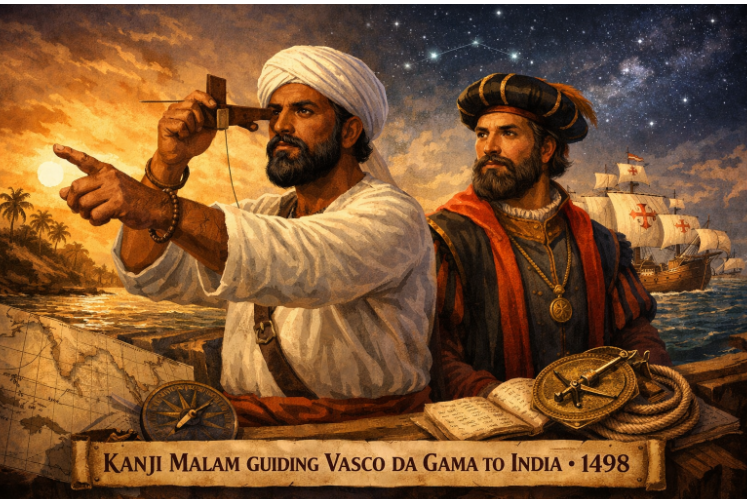
It was this centuries-old maritime ecosystem that Portuguese explorer Vasco da Gama also encountered upon reaching Calicut (Kozhikode) in May 1498. He witnessed a thriving maritime civilization on Bharat’s western coast. In his “A Journal of the First Voyage of Vasco da Gama,” the Portuguese explorer described a harbour crowded with large merchant ships arriving from Gujarat, Arabia, and beyond. The merchant ships he witnessed were roughly ranged between 300 and 600 tons, built from durable teak wood, and capable of long ocean voyages. As per one of the interesting chronicles mentioned in the journal, Da Gama met Kanji Malam, a prominent Gujarati merchant-navigator, whose ship was "three times larger" than da Gama's flagship São Gabriel.

Portuguese explorer, Vasco da Gama
In fact, Da Gama relied heavily on the local expertise, with Kanji Malam guiding the Portuguese fleet across the Arabian Sea using established monsoon routes. The Portuguese visitor also observed active shipyards constructing teak vessels, warehouses overflowing with goods, and Calicut port, which he saw managing enormous commercial traffic. Thus, Vasco Da Gama’s testimony stands as one of the clearest external confirmations that Bharat’s maritime capabilities were already highly developed before any European invasion.
“Lawless Seas”: The British Shift the Narrative
The same maritime traditions that surprised the Portuguese were labeled as “piratical,” “backward,” or “weak” by the British Raj. When Vasco da Gama first encountered the ports of the Indian Ocean, he described thriving markets, organized harbours, and powerful merchant fleets. Yet the British Raj descriptions of the same region changed dramatically. British officials argued that shipmen in the Indian Ocean required firm control by a modern navy. Indigenous maritime powers were described as “petty states,” and local shipmen were described as “pirates”. For instance, during the 19th century, the then Viceroy and Governor-General of Bharat, Lord Curzon, claimed that Britain had “opened these seas to the ships of all nations.” The British also tried to paint a picture that before them, the region was marked by “strife,” and that Britain had transformed it into a zone of stability. Traditional practices such as collecting tolls for safe passage, long recognized in regional maritime systems, were reinterpreted as extortion when imposed on British shipmen.

Lord Curzon, the Viceroy and Governor-General of India
Nonetheless, this overlooked a simple fact that trade in Bharat had operated through complex systems of diplomacy, customary law, seasonal navigation, and mutual economic dependence. Ports such as Calicut, Surat, Muscat, and Malacca had managed immense commercial traffic for centuries without British supervision.
Borrowing from the Very Traditions They Dismissed
Even as the British East India Company downplayed Bharat’s maritime expertise, it was here only that the British relied. The British shipyards adopted Malabar teak because it outperformed European oak in tropical conditions. Teak was prized for its exceptional resistance to rot, insects, and tropical humidity, qualities that made it far superior to European oak in Indian Ocean conditions. Essentially, ships built of teak commonly served for 20–30 years or more, and some lasted considerably longer. For example, the teak-built HMS Cornwallis (1813) reportedly remained in service for over four decades. And, it was the Bharatiya craftsmen, who had long experience working with teak, who played a central role in this production.

HMS Cornwallis
However, this heavy reliance on Bharat came at a high cost. After securing control of the Malabar Coast through the Anglo-Mysore Wars in the 1790s, the Company imposed strict administrative regulations over timber resources. Large trees were reserved for naval construction, private cutting was restricted, and extraction intensified to meet the demands of shipyards. Logs were felled deep in the forests and floated down rivers to the coast in enormous quantities. Moreover, the Company negotiated long-term contracts for vast quantities of timber, including one agreement to supply 7,000 kanties annually for a decade to support a sawmill project. Such practices disrupted local economies and contributed to deforestation across parts of the Western Ghats.
Thus, if we analyze every piece of evidence, we can clearly see that long before the East India Company appeared on the horizon, the Bharatiya subcontinent was already embedded in a vast network of maritime trade. Building ships, navigating monsoon routes, administering ports, and trading across continents — Bharat was doing it all for centuries. The British claim that it was they who opened the trade and ports in Bharat, brought order and safety to the Bharatiya waters, and introduced modern shipping was entirely false. What the British actually did was not create a maritime system but insert themselves into an existing one, and eventually dominate it using the region’s own resources and exploiting them. In the end, the greatest irony that stands today is that the empire that claimed to rule the seas did so using timber grown in Bharatiya soil, skills honed by Bharatiya shipbuilders, and routes charted by Bharatiya navigators. Far from civilizing the maritime world of Bharat, the British Empire was built upon it.