Birth of Kasturba Gandhi’s Political Mobilisation Phase

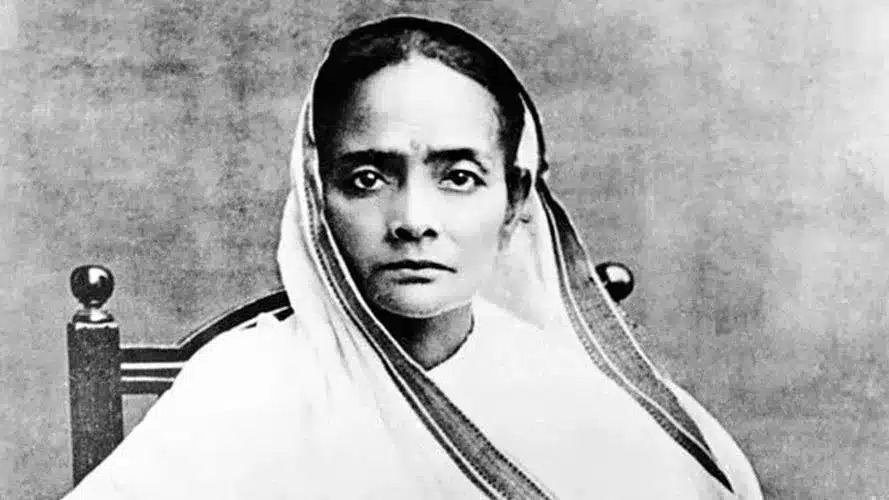
Before the iron gate of Maritzburg Jail closed behind her, Kasturba Gandhi was primarily known as the wife of Mohandas Karamchand Gandhi. Born in 1869 in Porbandar, she had little formal education and was married at a young age Her early life followed the rhythms of a traditional household. When Gandhi left for South Africa in 1893, she remained in India with their children. Later, when she joined him there, she entered a society marked by racial discrimination and legal injustice against Indians.
In South Africa, Indians were denied basic civil rights. Gandhi had already begun organizing resistance. Kasturba supported him in settlement life, participating in community work and discipline. Yet until 1913, she had not directly confronted the colonial state through imprisonment. That changed in 1913. On 14 March 1913, a judgment of the Cape Supreme Court declared that marriages not performed according to Christian rites were invalid in South Africa. Hindu, Muslim, and Parsi marriages were reduced to legal nonexistence. Wives ceased to be legally recognised as wives. Children could be declared illegitimate.
If Indian marriages were declared invalid, then every Indian wife stood dishonoured in the eyes of the state.Kasturba understood the implication clearly. She conveyed her decision to take part in the resistance. The women at Phoenix Settlement stood by her. Phoenix was not merely a residence; it was a disciplined community founded by Gandhi near Durban, where men and women were trained in simplicity, service, and satyagraha. When the marriage judgment struck at the dignity of Indian women, it was from this settlement that the first organised group emerged.
On 15 September 1913, the first batch of satyagrahis left Phoenix for the Transvaal border. The group consisted of twelve men and four women — Kasturba Gandhi, Kashi Chhaganlal Gandhi, Santok Maganlal Gandhi, and Jayakunwar Manilal Doctor. They were fully aware that crossing into the Transvaal without permits violated colonial regulations. Indians were required to carry official passes to move across provincial boundaries. The group deliberately crossed without permits as an act of civil disobedience.
Later they got arrested and sentenced for three months’ hard labour. In Maritzburg Jail, the struggle truly began. The prison authorities tried to break the women through humiliation, women were assigned laundry work. The food given to them was coarse, insufficient, sometimes barely edible. Complaints were ignored. When Kasturba protested about the food and sanitation, she was told to accept what was given or face punishment.
The harsh conditions weakened her health. She suffered physically. When prison authorities considered easing her treatment because of her standing, she declined unless all women received the same consideration. She would not accept dignity for herself alone. Weeks of hard labour, poor nutrition, and confinement drained her strength. By the time her term neared its end, she was visibly frail. On 22 December 1913, Kasturba and the other women were released. A public procession had been planned to welcome her, but it was cancelled because her health had deteriorated severely.
Her body had paid a heavy price. But her suffering did not remain confined to prison walls. News of the imprisonment of Indian women stirred public opinion in South Africa and in India. Public meetings were held. Leaders condemned the treatment of women satyagrahis. The moral force of the movement intensified. The government could no longer ignore the pressure. A commission was appointed to examine Indian grievances. Negotiations followed.
In 1914, the Indian Relief Act was passed. It recognised Indian marriages and addressed the grievances that had triggered the agitation. Her effort had not gone to waste. Before 1913, Kasturba had supported a movement. After 1913, she had entered it as a participant in her own right. Her political mobilisation did not arise from rhetoric or ambition. It began when she chose imprisonment over dishonour and accepted its consequences with quiet resolve.