The Forgotten Partition Before 1947: How Burma Was Separated from India

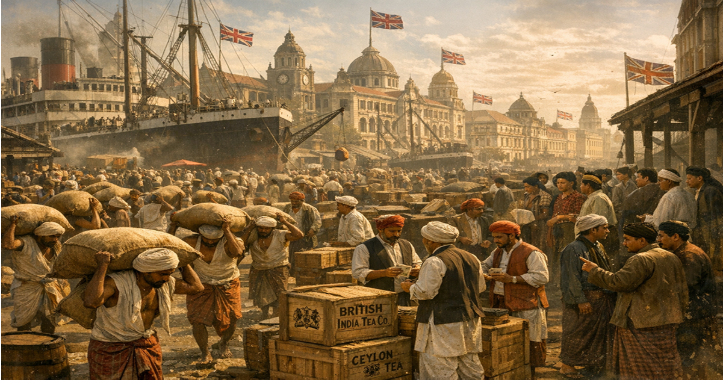
This image is AI-generated
In the early decades of the 20th century, Rangoon (Yangon) looked surprisingly similar to many Indian colonial cities. Indian merchants ran businesses, Tamil dock workers unloaded ships at the port, and clerks from Bengal worked in government offices. This was because Burma was not a separate colony—it was governed as a province of British India. The arrangement dated back to the annexation of Burma after the Third Anglo-Burmese War in 1885, after which the British integrated the region into the administrative system of the Indian Empire. For decades, decisions about Burma were made by the same colonial bureaucracy that governed Bombay, Madras, and Calcutta.
Migration, Tensions, and a Changing Society
By the 1920s, Rangoon had become one of the busiest ports in Asia. Large numbers of Indian laborers and traders had migrated there, encouraged by British policies and economic opportunities. Burmese nationalists began to worry that their economy and administration were being dominated by outsiders. This created political tensions, and debates began in both India and Burma about whether the two regions should continue under one colonial administration. Historians note that the influx of Indian workers and traders significantly reshaped Burma’s society and politics in the early 20th century.
The Debate in the British Empire
During the constitutional reforms of the 1930s, British officials began arguing that Burma should be governed separately. One memorandum circulated in London claimed that the Burmese were as distinct from the Indians in race and language as they were from the British. This argument became the foundation for the policy that would eventually separate Burma from India. The proposal was incorporated into the sweeping reforms of the Government of India Act 1935, one of the longest and most complex laws passed by the British Parliament to govern the empire in South Asia.
Conversations and Political Reactions
The proposal triggered intense debates across the region. Burmese political leaders were themselves divided—some believed separation would give Burma greater autonomy, while others feared it would isolate the country from the larger anti‑colonial movement in India. In India, too, nationalist thinkers questioned British motives. A commentary from 1937 argued that Burma’s separation was another example of imperial policy designed to divide political resistance within the empire.
April 1, 1937: The Map Quietly Changes
On April 1, 1937, the change finally took effect. Under the Government of Burma Act 1935, Burma officially ceased to be a province of British India and became a separate British colony with its own constitution and legislature. The new administration created an elected assembly and a cabinet system, and Burmese politician Ba Maw became the first Prime Minister / Premier after separation. For the British Empire, it was presented as a constitutional reform, but for millions living in the region, it meant the map of South Asia had quietly changed.
A Forgotten Partition of the Raj
Today, the separation of Burma from India is often overshadowed by the much larger Partition of India in 1947, but historians increasingly see it as one of the earliest partitions of the British Indian Empire. It marked the beginning of a process in which imperial borders were repeatedly redrawn—separating Burma, Aden, and later dividing India itself. The episode reminds us that the political geography of South and Southeast Asia was shaped by administrative decisions made during the final decades of colonial rule.