How Colonel Gurbaksh Singh Dhillon Held the British Army at Bay in Burma for 5 Weeks?

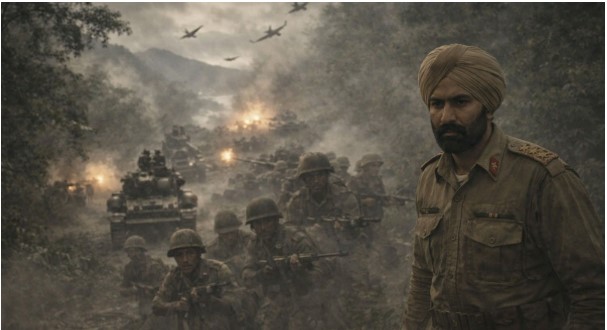
Hidden in the dense jungles and hills of Burma (present-day Myanmar) lies a chapter of India’s freedom struggle that history has relegated to the margins. This is not the story of a vast army, but of one resolute Indian military officer, Gurbaksh Singh Dhillon. In an era when the British Empire was the world’s mightiest military power, this Azad Hind Fauj officer forced the British army to retreat despite his limited resources. For five weeks in Burma’s thick jungles, the British army couldn’t advance. Colonel Dhillon’s confrontation with the British forces was no ordinary clash; it was that historic moment when Indian soldiers first directly challenged the British government on the battlefield.
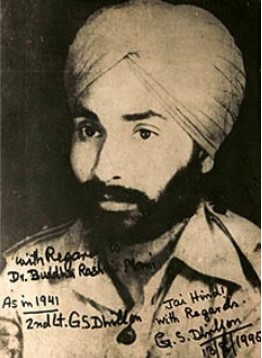
Colonel Gurbaksh Singh Dhillon | Image Source: Wikipedia
In the final phase of World War II, Burma was a crucial hub of British strategy. The British army was pushing forward in this region with tanks, heavy artillery, and air support. They aimed to establish full control over Burma and secure India’s eastern borders. This was because Netaji Subhas Chandra Bose’s Azad Hind Fauj, advancing from Burma to uproot the British Empire from India, posed a direct threat. But the terrain here was far from easy; it consisted of dense jungles, towering hills, rudimentary roads, and the banks of the mighty Irrawaddy River. It was amid these harsh conditions that Colonel Dhillon took command of the Azad Hind Fauj’s Nehru Brigade to challenge the British army. Colonel Dhillon realized that fighting the British in open conventional warfare would be suicidal. Instead, he chose to fight not their strengths, but their weaknesses.
Colonel Dhillon organized Azad Hind Fauj units into small guerrilla squads. These squads weren’t meant for direct battles but for sudden strikes on British supply lines, communication networks, and forward posts. They adopted a policy of nighttime attacks followed by melting into the jungles. This guerrilla warfare tactic was entirely new to the British army. The Azad Hind Fauj’s invisible resistance from all directions began to confound them. Their plans were repeatedly disrupted, and their soldiers’ morale started to crumble.
In February 1945, the British army devised a plan to cross the Irrawaddy River to gain a decisive advantage in Burma. Crossing this river was strategically vital for them. On February 12, 1945, the British attempted to cross the river at a shallow point in the Nyangu and Pagan areas under heavy aerial bombardment and artillery fire. But the Azad Hind Fauj unit under Colonel Dhillon’s leadership thwarted this effort. Their guerrilla attacks scattered the British forward lines. Communications broke down at several points, logistics and supplies were severed, and British units fell into disarray. In the end, the British army had to pull back. This was the first time that the Azad Hind Fauj had forced the British army to retreat from a key front, leaving a profound impact on the British military leadership’s mindset.
After the Irrawaddy, the struggle spread to Mount Popa and the Kyawkpadang hills. Conditions here were even more grueling. With heavy tanks, artillery, and relentless aerial bombing, the British attacked from three directions. Holding ground in such a situation would have been nearly impossible for any army. But instead of retreating, Colonel Dhillon organized the resistance even more tightly. His units held the British army back for five straight weeks. During these five weeks, British supply routes were cut off, creating shortages of fuel, ammunition, and rations. The British were forced to take long, arduous detours, resulting in massive time and resource losses. The momentum of British military operations nearly ground to a halt. Despite their superior modern weapons and overwhelming numbers, the Azad Hind Fauj gained the upper hand over the British army.
For the British army, this was not just a military setback but a profound psychological blow. For the first time, British leadership realized that if Indian soldiers fought with organization and purpose, even their vast empire’s military might could be checked. Colonel Dhillon had shattered the long-held myth of British invincibility through his valor and shrewd tactics. Though global circumstances—especially events in the war’s closing phase—eventually forced the Azad Hind Fauj to withdraw, Colonel Gurbaksh Singh Dhillon’s military feat was far from in vain.
He proved that courage, strategy, and unwavering resolve could halt even a mighty empire. He had no limitless resources or massive army, yet through his leadership, Colonel Gurbaksh Singh Dhillon compelled the British army to retreat. History may condense this chapter into a few lines, but this military struggle on Burmese soil laid the foundation for India’s independence. It stands as proof that freedom is won not through political deals, but through such armed resistance.
Birth and Life
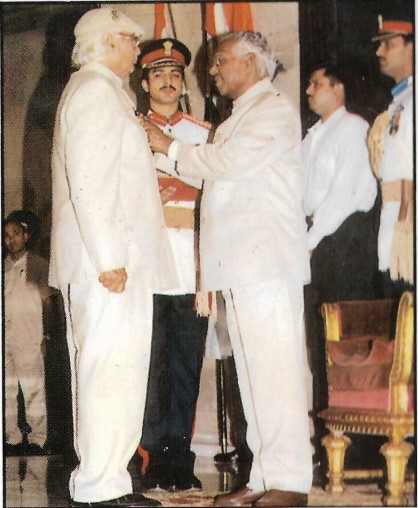
K.R. Narayanan, president of India, awarded Padma Bhushan to Col. Gurbaksh Singh Dhillon in 1998 | Image Source: Jat Land
Colonel Gurbaksh Singh Dhillon was born on March 18, 1914, in Punjab’s Tarn Taran district. In 1936, he was commissioned into the British Indian Army’s 14th Punjab Regiment. But during World War II, while fighting for the British, he was captured by the Japanese army. Later, in 1942, he joined Netaji Subhas Chandra Bose’s Azad Hind Fauj. Netaji entrusted him with command of the Nehru Battalion. Through his military prowess and capabilities, he forced the British army to retreat on multiple fronts. In 1998, the Government of India honored Colonel Dhillon with the Padma Bhushan. He passed away on February 6, 2006, in service to the nation.
.png)


.jpg)