The Strategy of Hemu That Won the Battle of Tughlaqabad & Drove Mughal Empire Out of Delhi Within Hours
The story of how Hemchandra reached Tughlaqabad was no less remarkable than a thrilling military campaign.

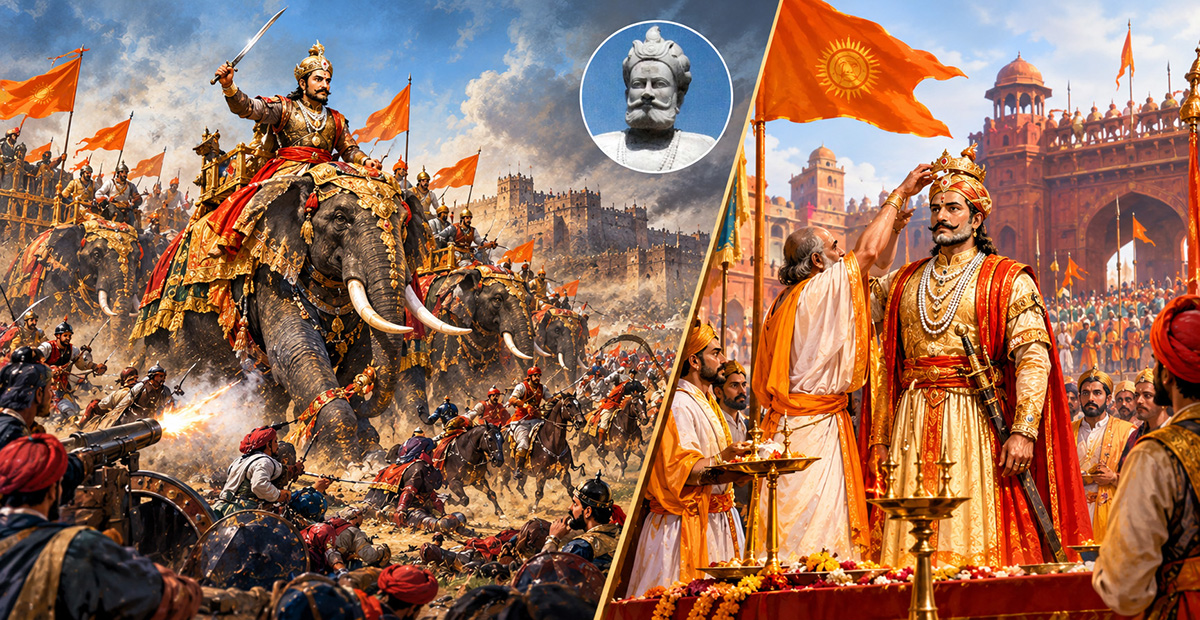
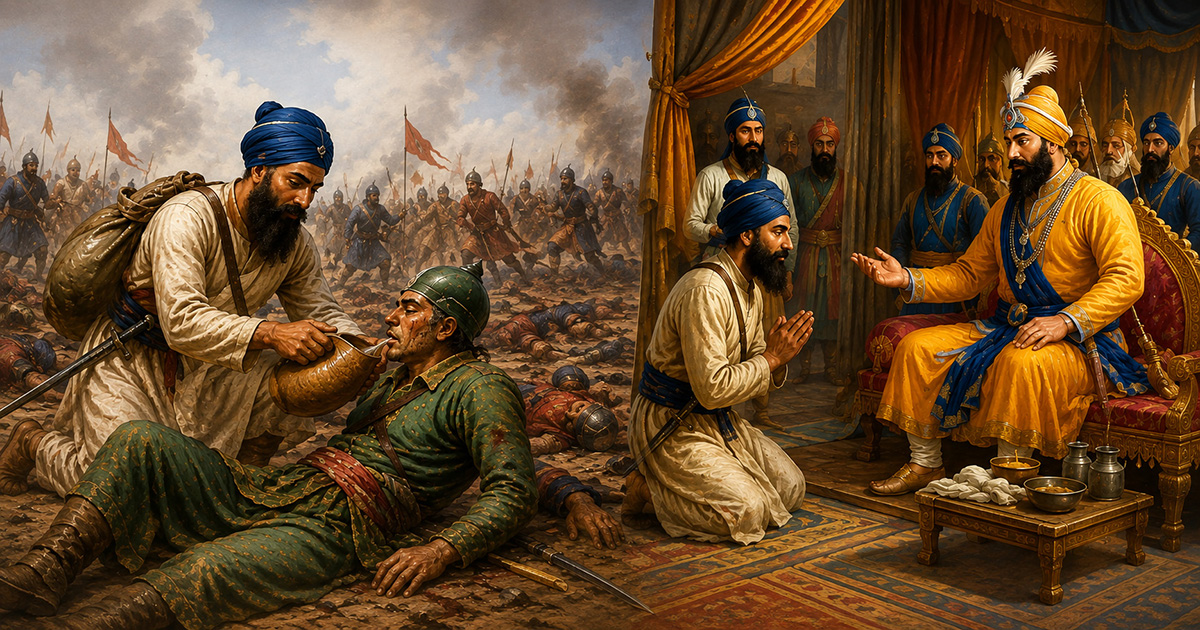
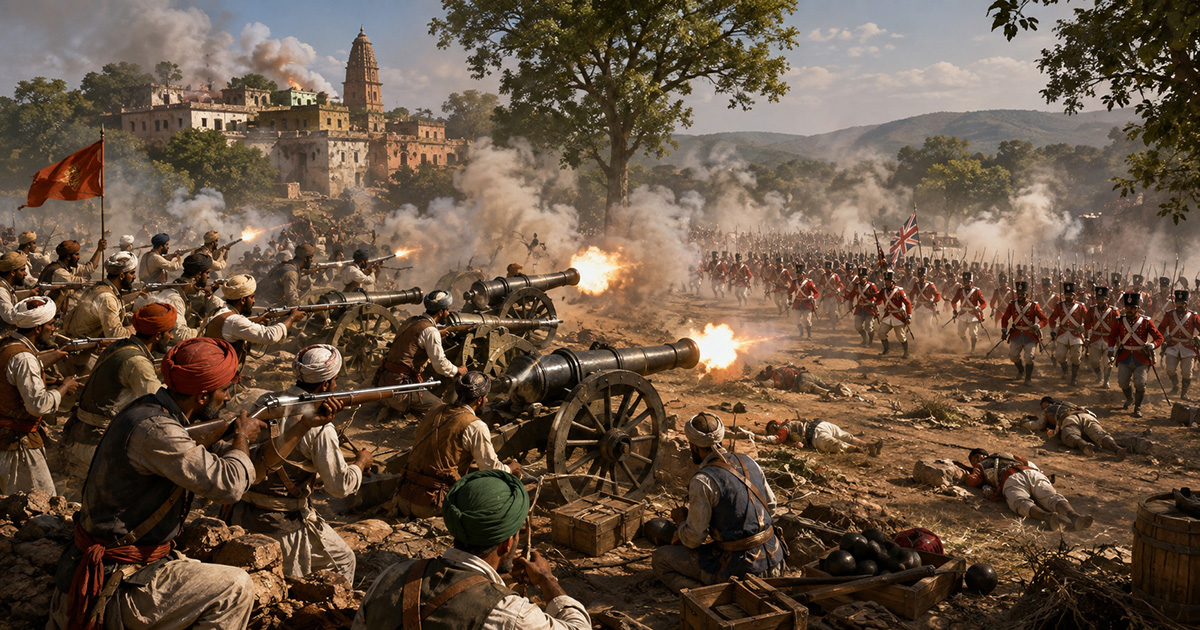
Battle of Tughlaqabad | This image is AI-generated
An Indian Hindu emperor once changed the course of history by sending a massive force of 300 armoured war elephants against the Mughal army. He not only defeated the Mughals on the battlefield but also uprooted the Islamic rule that had dominated Delhi for centuries. That day, the battlefield of Tughlaqabad looked less like a battlefield and more like a terrifying storm. Behind the massive force of 300 elephants, 3,000 elite cavalry warriors, artillery, and soldiers armed with firearms launched continuous attacks on the Mughal army. The elephants broke through the Mughal ranks, while the cavalry behind them launched swift attacks on the Mughals’ disintegrating positions. This shattered the unity of the Mughal army. Panic spread among its soldiers. The battlefield was strewn with the bodies of Mughal soldiers, while their commander, Tardi Beg, fled. The hero of this battle was Emperor Hemchandra Vikramaditya ‘Hemu’.
The story of how Hemchandra reached Tughlaqabad was no less remarkable than a thrilling military campaign. Hemu immediately recognised the power vacuum created after Humayun’s death and saw it as an opportunity to drive the Mughals out of India. Therefore, setting out from Chunar, he advanced towards Delhi, driving the Mughals out of Etawah, Kalpi, Bayana, and Gwalior. The Mughals could not withstand his valour anywhere. Finally, on October 6, 1556, Hemchandra’s army reached Agra. The Mughal officials fled as soon as they heard of his arrival. Thus, Hemchandra also gained control of Agra. But he was not one to stop and celebrate a victory. Delhi was all that occupied Hemchandra’s mind, and he was determined to uproot Mughal rule from the city at any cost.
Finally, the moment that Hemchandra had been waiting for years arrived. On 7 October 1556, he reached Tughlaqabad, on the outskirts of Delhi, with his army. His army consisted of 50,000 cavalry soldiers, a large number of infantry and soldiers armed with firearms, 51 cannons, and 1,500 elephants. As soon as the Mughals received the news, Akbar’s commander Tardi Beg Khan took charge of the battlefield. He too arrived at the battlefield of Tughlaqabad with his large army. Now both armies stood face to face. Who would control Delhi would now be decided on the battlefield.
At the centre of the Mughal army stood its commander, Tardi Beg Khan. The right wing of the army was commanded by Haider Muhammad, while the left wing was under the command of Iskandar Beg. The cavalry was led by Abdullah Uzbek. All of them were well-known jihadis of that era. This formidable Mughal army was capable of intimidating even the most seasoned warriors. But Hemchandra had complete faith in his own courage. As Hemchandra was preparing his forces for battle, a surprising turn of events took place. Driven by a jihadi mindset, the Mughal army launched a sudden and deceptive attack on the right wing of his forces. The surprise attack gave Hemchandra little time to prepare, resulting in the deaths of many of his soldiers and throwing his army into confusion. The Mughal cavalrymen believed that Hemchandra’s army had already lost the battle. Under this misconception, they advanced into Hemu’s camp and began looting.
Hemchandra could have tried to stop the Mughal soldiers from looting, but he adopted another strategy. While the Mughal cavalry contingent was busy looting on one side, he surrounded the Mughal army from all directions and launched an attack. The brave warriors in Hemchandra’s army surrounded the Mughal forces from every direction. Hemchandra himself attacked the centre of the Mughal army with his 300 elephants and approximately 3,000 of his finest cavalrymen. As lines of armoured war elephants advanced towards the Mughal soldiers, the entire scene of the battlefield changed. The elephants began breaking the soldiers’ formations, while the cavalry behind them intensified the attack on the disintegrating Mughal positions.
On the other side, the long-range striking power of the artillery and armed soldiers placed the Mughal army in a double crisis. As the battle progressed, the unity of the Mughal positions began to collapse. Confusion spread among the Mughal soldiers. Hemchandra’s army continued to advance. Eventually, panic broke out within the Mughal army, and their commander Tardi Beg fled. Many Mughal soldiers were killed, while the survivors fled. Finally, Hemchandra achieved a decisive victory on the battlefield of Tughlaqabad. The road to the capital, Delhi, was now open to him.
After the victory at Tughlaqabad, on 7 October 1556, Hemchandra entered Delhi with his victorious army. His coronation was held with great ceremony. The entire city of Delhi echoed with the sounds of bells, conch shells, and chants. The saffron flag was hoisted over the fort. The priests honoured Hemchandra with the title of Vikramaditya and declared him Emperor. And thus, nearly 400 years after Prithviraj Chauhan was removed from Delhi in 1192, Vikramaditya Hemchandra drove the Mughals out of Delhi and laid the foundation of a Hindu empire for 29 days.