From Cutting His Hair Tuft to Serving Him Beef: Incidents at a Christian Missionary School That Shaped Birsa Munda into Dharti Aaba
The missionaries at the school would mock the Munda community and portray Christian traditions as superior. But one day, things went too far.

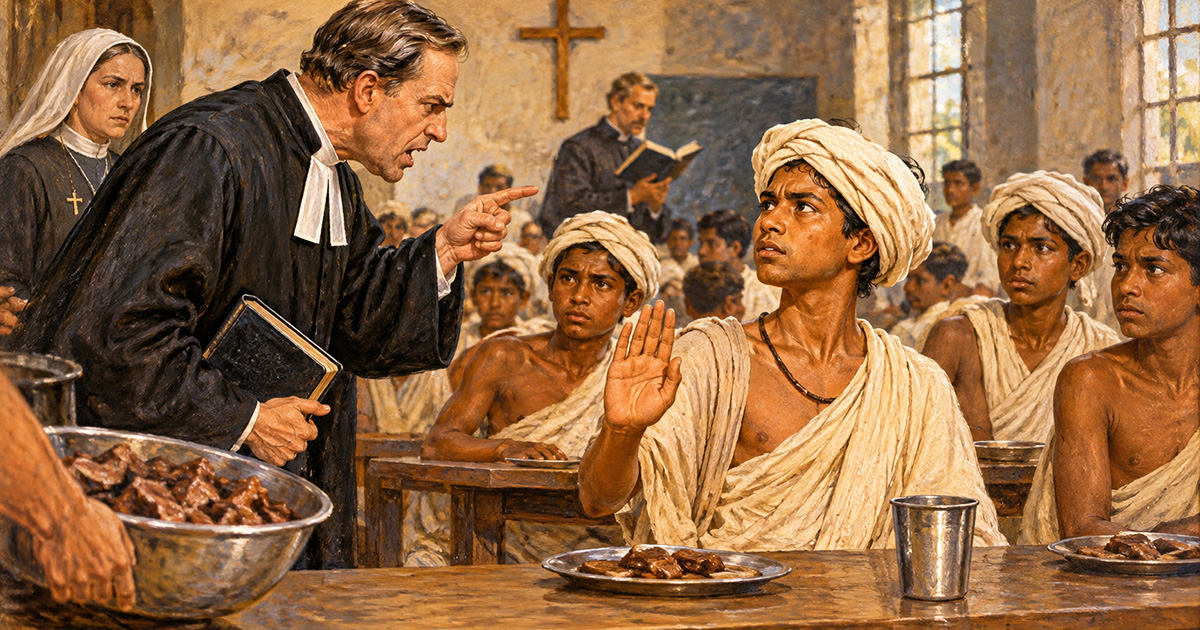
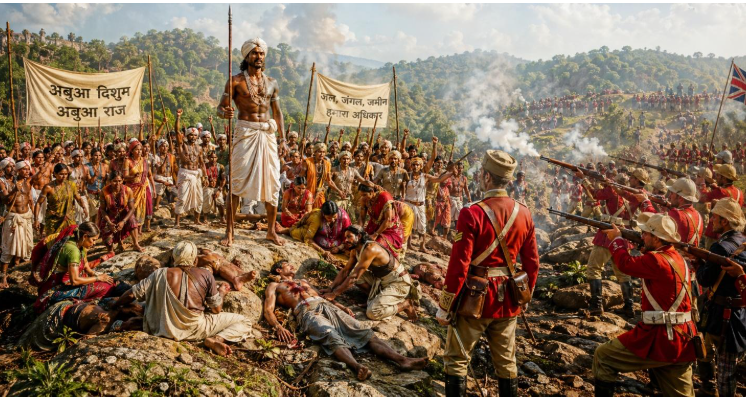
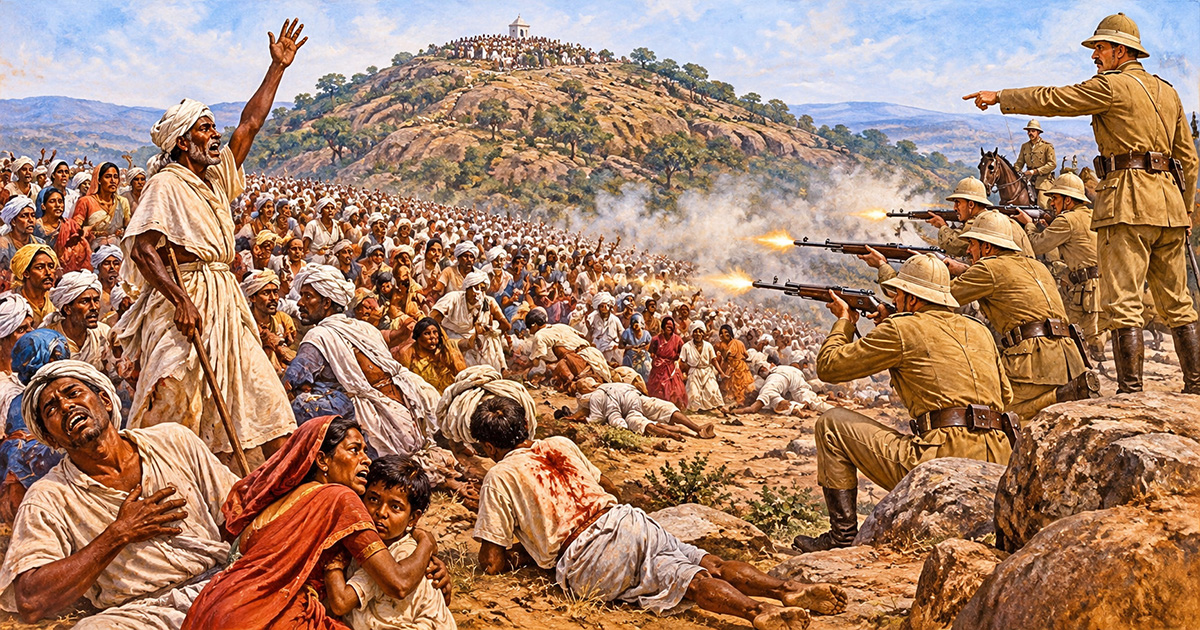
When Birsa Munda stood against the Christian missionaries | This image is AI-generated
On November 15, 1875, a Janjati woman named Karmi Hatu gave birth to a child while working in a field in Chotanagpur. Due to poverty, the mother wrapped the newborn in a few leaves and brought him home. Little did anyone imagine that this very child would one day shake the foundations of British rule. This child was none other than the great Janjati hero, Birsa Munda, whom people call ‘Dharti Aaba’ or ‘God of the Earth’. However, there was a phase in the life of this great revolutionary, who took on the British, when missionaries took advantage of his family’s poverty and converted him to Christianity during his childhood. He then had to endure humiliation for his own culture and traditions. This humiliation became one of the major reasons behind his revolutionary journey.
When Birsa Munda was still very young, his father, Sugana Munda, sent him to his maternal uncle’s house. There, he would graze sheep and goats. However, Birsa was deeply interested in education and wanted to achieve something great in life. Around this time, his family came into contact with Christian missionaries. In exchange for providing Birsa Munda with an education, the missionaries converted him to Christianity. He was only 11 years old when the missionaries baptised him. Following his conversion, he was admitted to the first grade at Burju School, where his name was registered as Birsa David. Later, in 1886, he went to study at the Lutheran Mission School in Chaibasa. He lived in the school hostel.
However, at that school, greater emphasis was placed on pressuring students to adopt Christianity than on education. Birsa had to face extremely harsh and humiliating treatment. Converted students were kept away from their Janjati culture and were also pressured to read the Bible. Beef was served to them in the hostel as well. Imagine what Birsa must have gone through, coming from the Munda community, where the cow is worshipped. Birsa firmly refused to eat beef. He also encouraged the other students to do the same. But when the school administration came to know about this, they reprimanded Birsa and threatened to expel him from the school.
The humiliation did not end there. The missionaries at the school would mock the Munda community and portray Christian traditions as superior. But one day, things went too far. Birsa was present at the school when a student cut off his hair tuft. This was deeply hurtful to him because keeping a tuft of hair on the head was an ancient tradition in Munda society. He complained to Father Nottrott, but his complaint had no effect. Birsa could not tolerate this humiliation. He told Father Nottrott, “Sahib-Sahib, ek hi topi” (The British priest and the British officer are the same). That day, in 1890, Birsa left the hostel and went to Bandgaon.
In Bandgaon, he met a man named Anand Pandey, who was associated with the Vaishnav sect. This marked a new turning point in Birsa Munda’s life. Anand Pandey possessed deep knowledge of Sanatan culture and religious scriptures. He introduced Birsa to books such as the Ramayana, the Mahabharata and the Hitopadesha. Birsa, along with his elder brother Sukhnath, stayed with Anand Pandey for nearly three years. During this period, he embraced Vaishnav traditions. He gave up eating meat, began wearing the sacred thread (Janeu), started tying a yellow turban, worshipped the Tulsi plant, and applied sandalwood paste to his forehead.
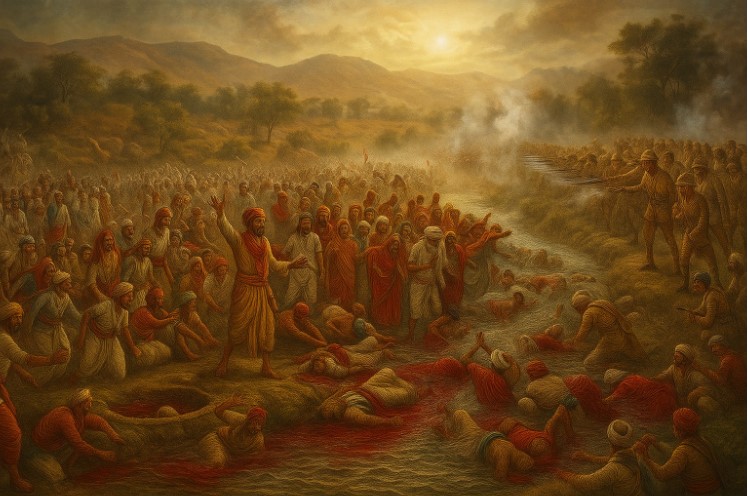
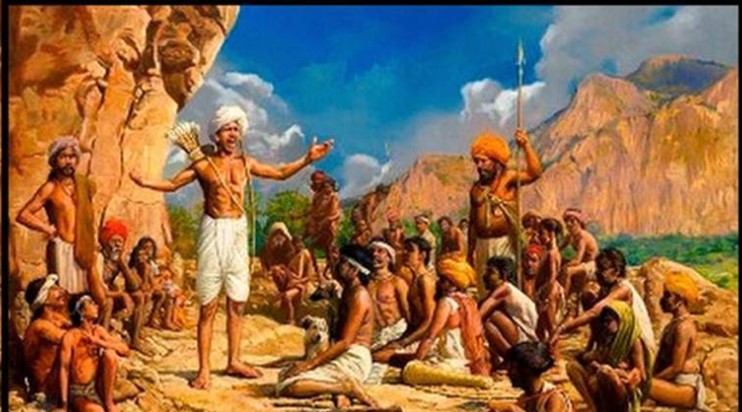
Reading the stories of warriors described in the Ramayana and the Mahabharata strengthened his resolve to fight against evil. In the years that followed, he united the Janjati community to protect it from the conversion tactics of Christian missionaries. On one hand, he reconnected the Janjatis with their ancient traditions. On the other, he formed an army armed with bows and arrows and fought against the British government in the hilly regions of Chotanagpur. As a result, the faith of the Janjati community in Birsa Munda continued to grow. People began to see the image of God in him. The Janjatis came to regard him as Dharti Aaba, meaning the God of the Earth.