“Birsa David” to “Dharti Aaba”: The Story of Birsa Munda’s Fight Against Christian Missionaries

On November 15th every year, Janjatiya Gaurav Diwas is celebrated across India to honor the immense sacrifices and contributions of tribal communities. It is also the birth anniversary of Bhagwan Birsa Munda, the legendary tribal freedom fighter of Chotanagpur.
What is particularly striking is that Birsa Munda’s legacy extends far beyond his resistance to British colonial authorities. His life also represents a powerful struggle against the forced conversions carried out by Christian missionaries in the Chotanagpur region, an aspect of his story that is often overlooked. And to understand this part of his legacy, we must begin with his early years.

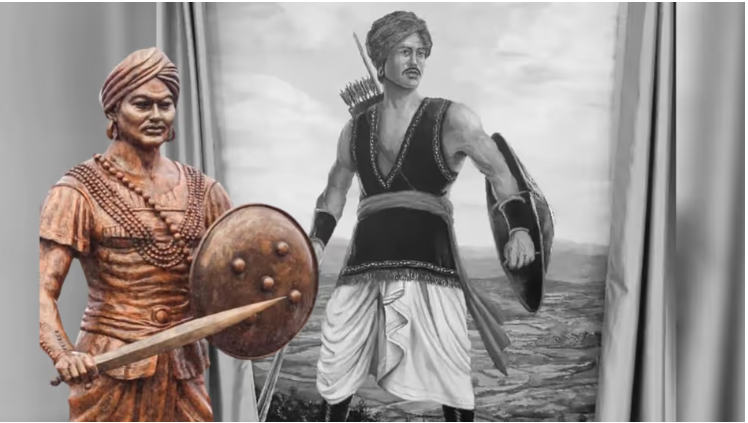
Bhagwan Birsa Munda | Image Credit: The Indian Tribal
Early Years Of Life: Exposure to Christianity and Conversion for Education
Birsa Munda was born on 15 November 1875 in a humble tribal family in present-day Jharkhand. Birsa Munda’s initial contact with Christianity was primarily motivated by the pursuit of education. He converted to Christianity in order to receive an education from a missionary school, thus attending the German Mission School. In the process, he was baptized, and his name was changed to Birsa David.
The Awakening: Realisation of British and Missionary Exploitation
During his early years at the Chaibasa missionary school (1886–1890), Birsa got to see how missionaries were trying to convert tribal people to Christianity. He soon understood that the British wanted to control the local tribal communities using both government-backed exploitation and missionary activities. By the late 1880s, Birsa Munda had clearly realised how the British were mistreating and exploiting the native tribal people.

Birsa Munda’s Lutheran Mission School in Chaibasa | Image Credit: The Indian Tribal
During this time, he met a Christian missionary who often came to the village, converted local families, and criticised the traditional Munda customs. Owing to this, Birsa Munda gradually lost trust in the missionaries and was disappointed with their actions.
He later gave up Christianity and left the missionary school because the missionaries often insulted Munda culture while trying to convert people. As a result, in 1890, his father took him out of the school, and the family stopped following Christianity and returned to their traditional tribal faith.
Birth of Birsait: A Revolt Against Conversion
In 1894, Birsa founded the Birsait faith as a direct response to the growing pressure of forced conversions. This new faith quickly gained followers among the Munda and Oraon communities, becoming a significant obstacle to the British and missionary efforts to convert tribal people.

Birsait Followers Pay Homage To Birsa Munda | Image Credit: The Indian Tribal
Christian missionaries saw Birsa’s religious movement as a threat, calling him a “stumbling block” to their conversion activities. His simple and traditional system of worship directly opposed the Church’s practices, especially since the Church imposed a tax on its followers while Birsait did not.
By 1895, Birsa openly urged the Mundas and other tribal groups to reject Christianity and to return to their ancestral Sarna religion, reviving tribal customs that were being eroded. He encouraged the community to boycott missionary schools and reject the imposition of foreign ways. Birsa’s message spread quickly, and he became known as Birsa Bhagwan, a divine leader called to awaken the tribal spirit. His followers saw him as a protector against outside religious and cultural domination.
The Political Awakening
Birsa’s religious movement soon merged with a political one. He declared that both British officials and Christian missionaries were dikus (outsiders), identifying both the British and the Christian missionaries as enemies of the tribal communities and their way of life. His followers often repeated his famous slogan: “Topi topi ek topi,” meaning, “All hat-wearing white men are the same,” whether they were missionaries or government officials.
He envisioned the establishment of a Munda Raj, a self-ruled system free from all external exploiters. In Birsa’s vision, the tribal community would no longer live under the control of missionaries, moneylenders, landlords, or British authority.
By 1898-99, his night meetings evolved into centres of political instruction. Here, Birsa guided his followers on how to protect their land and identity. He repeatedly warned them not to trust missionaries, believing that they were cooperating with the colonial administration in grabbing tribal land and weakening traditional tribal systems.

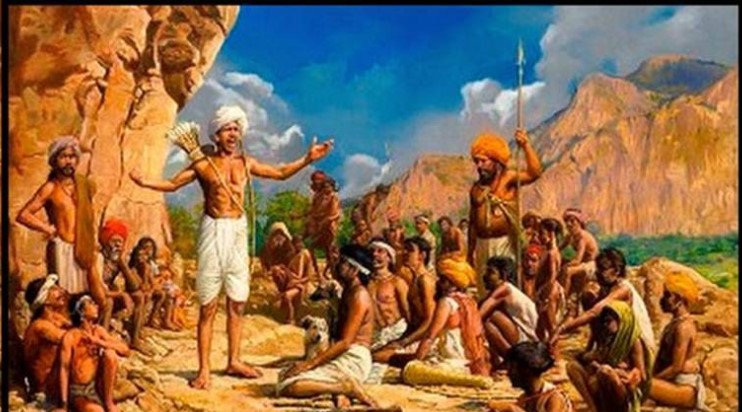
An illustration showing Birsa Munda interacting with people of his community | Image Credit: VSK Telangana
The Armed Conflict and Attacks on Churches
In night meetings held between 1898 and 1899, Birsa encouraged his followers to kill Christians.
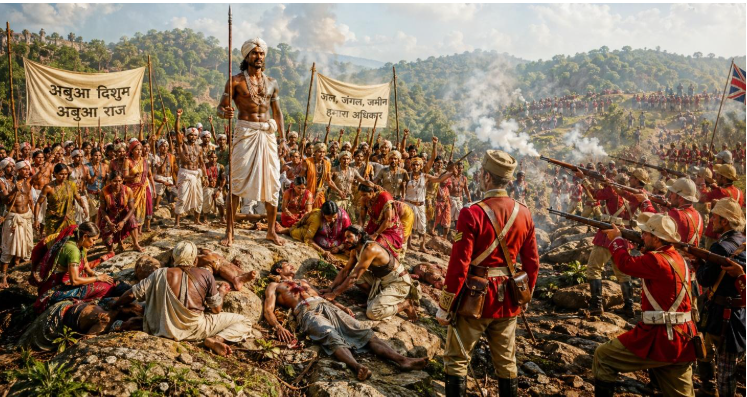
The movement reached its peak on Christmas Eve, December 24, 1899. On this night, Birsa’s followers launched coordinated attacks targeting churches, mission buildings, and police stations. They shot arrows and attempted to burn down several church establishments across the Ranchi and Singhbhum districts. For the first time, Christian missionaries directly experienced the force of a tribal uprising determined to halt conversion activities.
In response, the British administration declared Birsa a dangerous rebel. Christian missions pressed the government for his immediate arrest, arguing that he had become a major “stumbling block” to their conversion efforts. The growing influence of his movement deeply alarmed both colonial officials and missionary groups, who now viewed him as a serious threat to their authority and objectives.
The Aftermath
Birsa Munda was eventually captured, and on 9 June 1900, he died in Ranchi Jail at just 25 years old. But the fire he lit could not be extinguished. His spiritual fight protected tribal identity from cultural destruction. He denounced the missionaries’ role in aiding the British and their exploitative systems.
Today, he is remembered as “Dharti Aaba” (Father of the Earth), not only a freedom fighter but a cultural warrior who defended his people’s faith, land, and dignity. His story stands as one of India’s strongest examples of resistance to both colonial rule and cultural-religious domination.
.png)