The Chaturanga Story: How India Gave Chess to the World
One Indian invention was so extraordinary that it did not merely entertain kings; it humbled them. That invention was Chess.

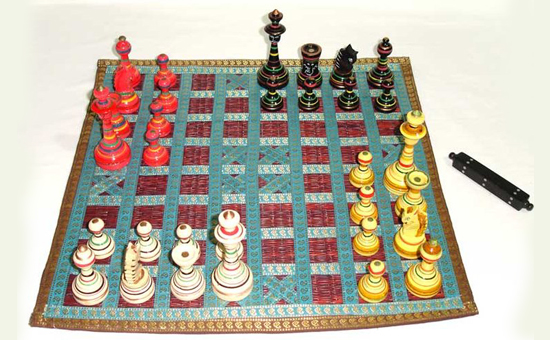
Chaturanga | Image Source: eSamskriti
In 1817, the British historian James Mill, a man who had never set foot on Indian soil, arrogantly penned The History of British India. In it, he insulted an entire civilization, claiming that Indians lacked originality and were merely “imitative” people incapable of true innovation. It was a cold, calculated attempt to justify colonial rule by stripping a nation of its intellectual dignity. But Mill ignored one invention so extraordinary that it did not merely entertain kings; it humbled them. That invention was Chess.
Chess, Hansel Mieth, 1939-12 | Image Source: LIFE Photo Collection
The true weight of this genius is best captured in the Persian courts of King Khusrau Nushirvan (531–579 AD), also known as “Shah”. In the 6th-century Middle Persian text Chatrang Namak, King Sharvavarman of Kannauj (referred to as Dewasarm) launched an intellectual siege against Sasanian Shah Khosrow I Anushirvan (531–579 AD) to avoid paying tribute (revenue and taxes (bāž ud sāv) that regional empires demanded from subordinate or defeated kingdoms). The king sent a sage named Takhtritus to the Persian court, challenging the Shah to deduce the rules of a 64-square game, Chaturanga, or pay tribute to India. If Persia failed, then King Khosrow I would be forced to acknowledge India's intellectual superiority and pay a massive, ongoing financial revenue and tribute to the Indian court. If India failed, the Indian king, Dewasarm, would have to surrender his own sovereignty and pay that exact same monetary tribute to Persia instead.
The sage’s challenge left the Shah’s royal scholars speechless. “This is not just a game,” the sage declared. “It is a battlefield of intelligence. Here, victory belongs not to strength, but to strategy.” The Persian court was stunned. Never before had they seen a game that mirrored warfare so perfectly while demanding such deep concentration and intellect. The Shah himself studied the board carefully and finally managed to decipher the game created by the Indian sage. Amazed by the brilliance of the invention, the Shah rose from his throne and said: “Ask for any reward you desire.”
The Indian sage smiled and replied calmly: “My reward is simple. Place one grain of rice on the first square of the board, two grains on the second, four on the third, and continue doubling the grains on every square until the sixty-fourth square.” The Shah burst into laughter. Such a tiny request for such a magnificent invention seemed almost foolish. He immediately ordered his men to bring the grains. But as the counting began, the smiles slowly disappeared from the faces of the royal mathematicians.
One grain became two, two became four, four became eight. With every square, the number doubled again and again. Very soon, sacks of grain turned into mountains. Mountains turned into numbers so enormous that the entire royal court stood stunned. At last, the mathematicians bowed before the Shah and admitted: “Your Majesty… even all the grain grown in the kingdom will not be enough to fulfill the sage’s request.” The Shah was shocked. What appeared to be a simple reward had actually become impossible. In that moment, he realized that the Indian sage was not only the creator of a brilliant game but also a mathematical genius whose intellect had outmatched the entire Persian court.
Mandodari and Ravana playing chess | Image Source: Bharath Gyaan
James Mill and his colonial contemporaries tried to frame India as a "stagnant" land that needed Western "enlightenment." Yet, the very game they took back to Europe to sharpen their own wits was a product of the very "imitative" minds they mocked.
Born during the Gupta Dynasty in the 6th century as Chaturanga, the game represents the four divisions of war: Padati (infantry), Ashva (cavalry), Gaja (elephants), and Ratha (chariots). It was a masterpiece of war, strategy, mathematics, and concentration condensed into a wooden board. Today, more than 1500 years later, chess is played across 172 countries and remains one of humanity’s greatest intellectual games. Archaeological discoveries from Lothal have also revealed ancient game pieces resembling modern chessmen, proving that strategic board games existed in India thousands of years ago.
Today, that ancient legacy has come full circle. It lives on in the "nerves of steel" of Viswanathan Anand and the fearless brilliance of D. Gukesh, R. Praggnanandhaa, and Arjun Erigaisi. As these young Indian Grandmasters dismantle the world’s best on the global stage, they aren't just winning trophies—they are delivering a final, echoing checkmate to the colonial myth of Indian inferiority. Bharat did not need to borrow fire from the West; we had already ignited the world’s greatest intellectual flame 1,500 years ago. Our legacy is a civilization that proved, through a simple board of wood, that the Indian Brain was and remains second to none.