Why Guru Teg Bahadur Ji Chose Martyrdom to Protect Sanatan and Kashmiri Pandits? Discover the Story of a Unique Sacrifice

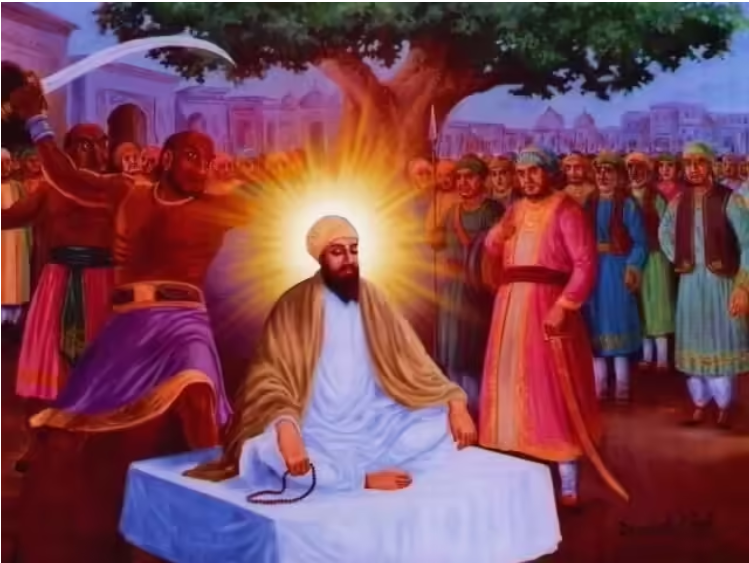
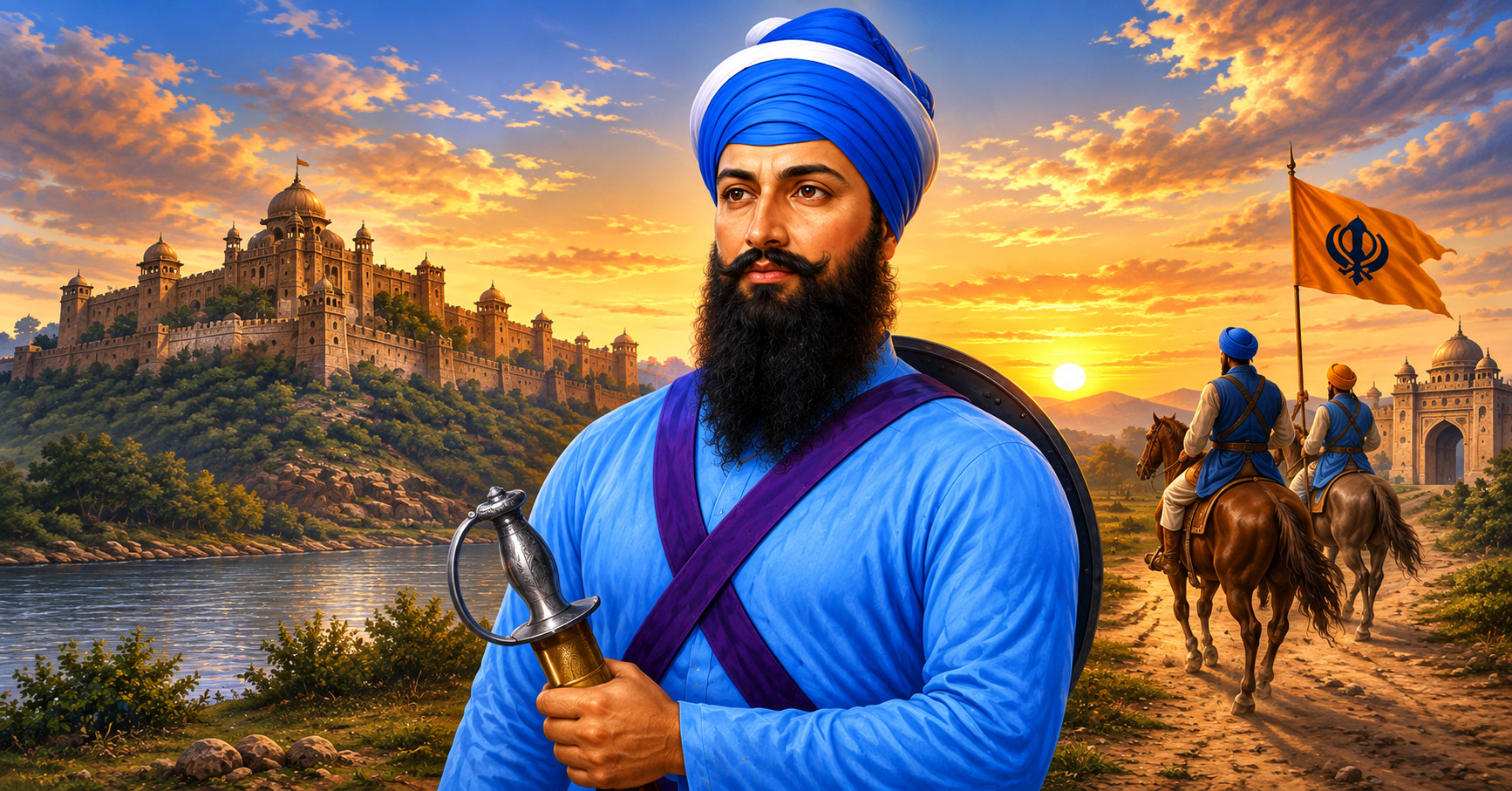
Guru Tegh Bahadur ji | Image Source: The Print
In the 17th century, under Mughal rule, there was immense pressure on Hindus involving forced conversions and atrocities. As part of a strategy to convert the whole of India, the Mughals gave Kashmiri Pandits the ultimatum of "Islam or death." In this hour of crisis, instead of bowing down, Guru Teg Bahadur Ji sacrificed his life to become a shield for the Kashmiri Pandits and Sanatan. Because of this monumental sacrifice, he was honored as "Hind Di Chadar" (The Shield of India). Let us explore this unique and unparalleled martyrdom rooted in his principle, "Give up your head, but not your faith" (Sir deejai, dharam na deejai).
“Hind Di Chadar”—meaning the shield of Hindustan, the protector of India. In the 17th century, the Mughal Emperor Aurangzeb, who took power in 1658, unleashed an era of forced conversions, Janeu, and the tilak across the country. In 1669, under his orders, famous temples like the Kashi Vishwanath Temple and the Keshav Rai Temple were demolished. Aurangzeb believed that by converting Kashmir—the core center of Hinduism—the rest of India would adopt Islam.
To achieve this, he appointed Iftikhar Khan as the Governor of Kashmir in 1671, who escalated atrocities against Kashmiri Pandits to their peak by 1675. The Pandits were subjected to horrific torture, forced to choose between "Islam or death," compelled to pay the Jizya tax, and witnessed the desecration of their idols.
In the summer of 1675, Guru Teg Bahadur had just returned to Anandpur after traveling through the Purvanchal region. Around May 25, 1675, a group of about 500 Kashmiri Pandits, led by Pandit Kirpa Ram, arrived at Anandpur Sahib. Sharing their plight with the Guru, they said, “Guru Ji, Aurangzeb is forcing us to convert to Islam. Our culture and religion are in grave danger. Please save us.”
The Pandits pleaded that, True Emperor (Sache Patshah), there is no one left to save religion in Kashmir. If you do not protect us, Sanatan Dharma will come to an end. Guru Teg Bahadur Ji remained sitting calmly. After a few moments, he looked at the Kashmiri Pandits and said in a solemn voice that this tyranny would only stop when this earth received the sacrifice of a great soul.
While this conversation was taking place, the Guru’s young son, Balak Gobind Rai Ji, was listening to everything. Without a second thought, he said— “Guru Father, who could be greater than you?”
Hearing this, the Guru fell into deep thought. He then told Pandit Kirpa Ram, “Go and tell Aurangzeb that if Guru Teg Bahadur accepts Islam, all the Hindus of Kashmir will also change their religion. But if Guru Teg Bahadur stands firm in his faith, then no Hindu will convert.” He resolved that he would not let any individual be forced to change their religion against their will.
Guru Teg Bahadur Ji left the fort of Anandpur Sahib to go to Delhi and challenge Aurangzeb's religious policy. The date was July 11, 1675, when the Guru publicly decided to leave Anandpur Sahib for Delhi. The Guru was accompanied by his companions Bhai Mati Das, Bhai Sati Das, Bhai Dayala, Bhai Udi, Bhai Gurditta, and a few other Sikhs.
The Mughal administration had already received information that the Guru of the Sikhs was moving toward Delhi. In mid-July, on July 12, 1675, the Mughals arrested the Guru near Malikpur Ranghran through Nur Mohammad Khan Mirza of the police post. Following this, the Guru, along with Diwan Mati Das and Sati Das (sons of Hira Mal Chhibber) and Dayal Das (son of Moti Das), was sent to Sirhind. They remained in the jail of Bassi Pathanan for four months. The Mughals inflicted severe torture on the Guru and his companions to make them accept Islam. Finally, in the month of November, they were brought to Delhi and locked inside an iron cage.
Upon reaching Delhi, the Guru and his companions were imprisoned at Kotwali Chandni Chowk. That very location is situated today opposite Gurdwara Sis Ganj Sahib. For many days, they were subjected to intense mental and physical torture.
Then, on November 11, 1675, when Guru Teg Bahadur and his companions were presented before Aurangzeb, the Emperor asked the Guru: "Why are you sacrificing your life for those who wear the sacred thread (Janeu) and apply the mark (Tilak) on their foreheads?" The Guru replied: "When humanity grows weak, they take refuge in me as their Guru. They came to seek my shelter. I will always stand up for humanity." Aurangzeb flew into a rage and placed three conditions before the Guru.
First, accept Islam. Second, if you are a messenger of God, show a miracle. Third, if you refuse both, be prepared for death. Guru Teg Bahadur Ji replied, “Religion cannot be changed through the fear of the sword. I do not stand here to perform a miracle, but to defend truth and humanity.”
Following this, the Mughal authorities tortured his companions in an attempt to break the Guru's morale. First, Bhai Mati Das Ji was tied between two pillars and sawn alive. Next, Bhai Dayala Ji was martyred by being cast into a cauldron of boiling water. Then, Bhai Sati Das Ji was wrapped in cotton and burnt alive. Yet, Guru Sahib sat completely unwavering.
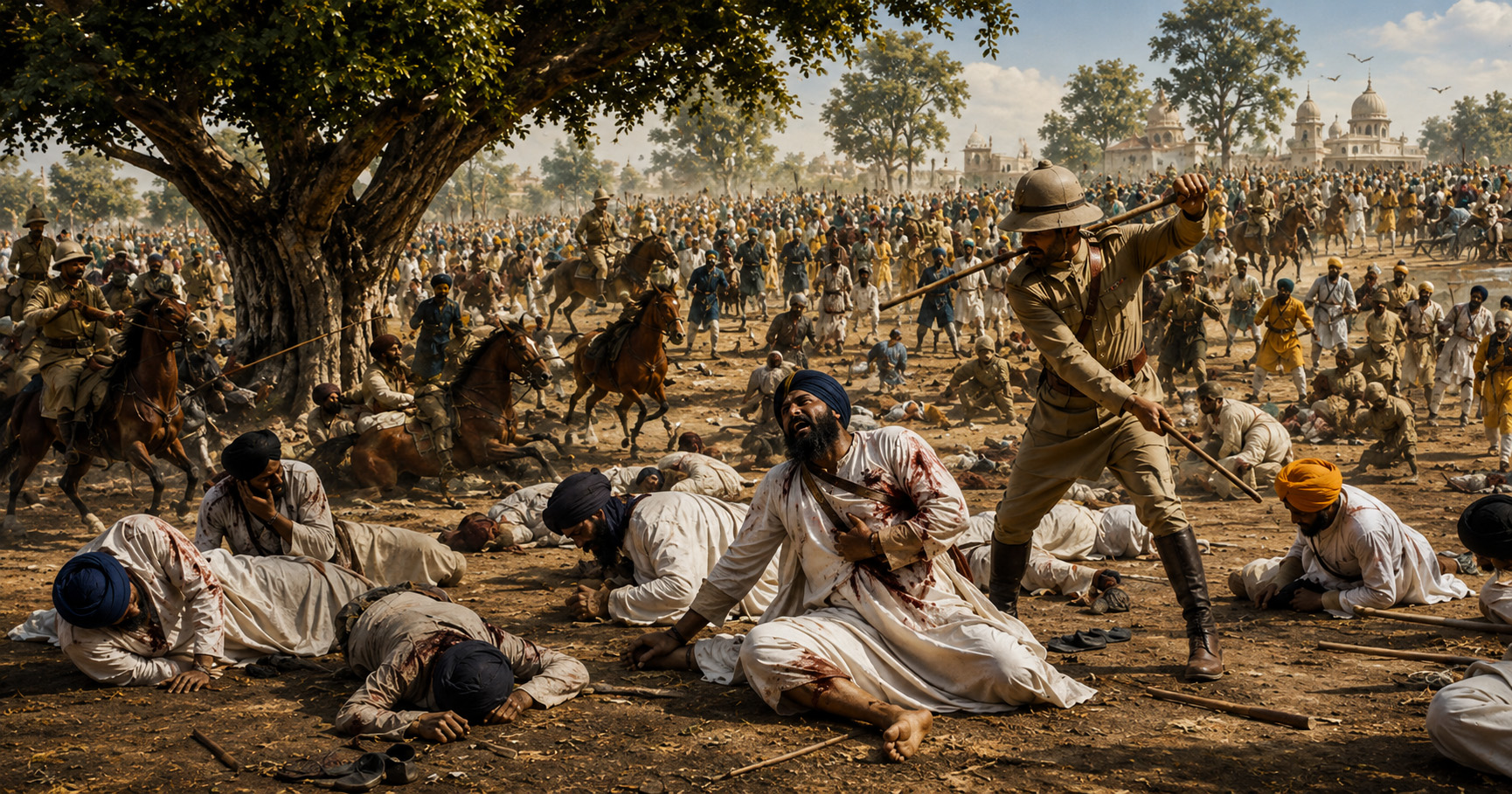
Finally, on the morning of November 24, 1675, the Guru, imprisoned in an iron cage, was brought to the very center of Chandni Chowk, where a massive crowd had gathered. At that spot, where Gurdwara Sis Ganj Sahib stands today, a large banyan tree stood at the time. The Guru was taken out of the iron cage. Qazi Abdul Wahab spoke one last time: “Accept Islam, or show a miracle.”
The Guru replied in a calm voice, “I will do exactly what my Sikhs did. If they stood firm in their faith, how can I back down?” Following this, the Mughals decided to execute Guru Sahib. However, the Guru requested permission to bathe first. He was provided with water from a nearby well. After bathing, he put on clean clothes, sat beneath the banyan tree, and began reciting the Japji Sahib. Then, the executioner Jalaluddin stepped forward. After a moment of silence, his sword struck, and Guru Teg Bahadur Ji's head was severed from his body. The ground of Chandni Chowk turned red with blood. At that very moment, a fierce storm and heavy rain broke out. It felt as though nature itself was expressing silent grief over this martyrdom.
The Mughal soldiers left the Guru's mortal remains right there so that no one would dare to retrieve them. However, Bhai Jaita was present in that very crowd. Taking advantage of the darkness and the storm, he concealed the Guru's sacred head within his garments. On the other hand, Bhai Lakhi Shah Vanjara and his son, Bhai Nagahiya, hid the Guru's body in a bullock cart and managed to take it away from the site.
Mughal guards were stationed everywhere in Delhi. Therefore, Bhai Lakhi Shah Vanjara took the Guru's body to his own house. To avoid any suspicion, he set fire to his own home. The final rites of the Guru were performed inside that burning house. Later, Gurdwara Rakab Ganj Sahib was established at that very location.
Meanwhile, Bhai Jaita reached Anandpur Sahib through the forest routes carrying the Guru's head. On the way, he rested for a night in Taraori (present-day Karnal, Haryana). Later, Gurdwara Sis Ganj Sahib was established there.
When Guru Teg Bahadur's severed head reached Gobind Rai, he exclaimed, 'Jaita, the Guru's son'... There, Guru Teg Bahadur's young son, Guru Gobind Rai, performed the final rites for the sacred head.
In 1699, Guru Gobind Singh established the Khalsa Panth at Anandpur Sahib, immortalizing his father's martyrdom forever. Guru Teg Bahadur Ji sacrificed his life not just for his own faith, but for the religious freedom of all the people of the country; today, history remembers him as “Hind Di Chadar”—meaning the Shield of India, the Protector of India.