2017 Amarnath Yatra Terror Attack: The Heart-Wrenching Story of a Pilgrim Who Survived
Amidst this horrific bloodshed, the bus driver, Salim Sheikh, displayed an extraordinary presence of mind.


Nirmala Thakur, the woman who died in the Amarnath attack | Image Source: Times Of India
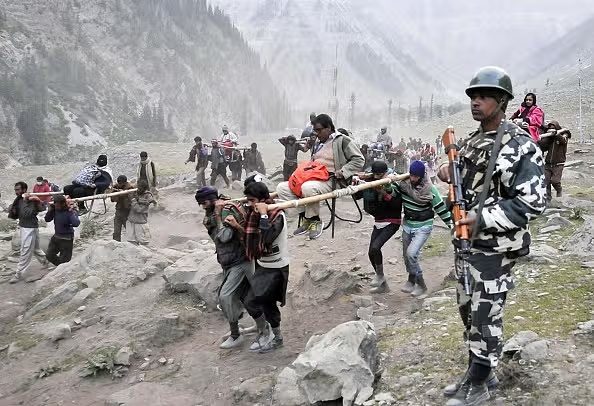
It was past 8:00 PM. Darkness had completely enveloped the Anantnag highway in Jammu and Kashmir. A private bus with a Gujarat registration plate was carrying over 50 pilgrims who were returning after completing their Amarnath Yatra. The exhaustion from days of continuous travel was visible on everyone’s face. However, their hearts were filled with the ultimate bliss of having caught a glimpse of Baba Barfani (Lord Shiva). While some were leaning back in their seats, drifting to sleep, others were softly chanting devotional songs, repeating 'Jai Bholenath'. Everything seemed to be going perfectly peacefully.
But that peace was merely the calm before the storm! Exactly at 8:20 PM, thunderous sounds suddenly shattered the silence, piercing through the dark night. Initially, everyone inside the bus thought someone was bursting firecrackers. But the very next second, the bus windows shattered into countless pieces, piercing their bodies. Those were not firecrackers; it was raining bullets from terrorists. In the pitch darkness, it was impossible to comprehend what was happening outside, but the bus was being fired upon indiscriminately from three sides. The terrorists' main targets were the window seats.
In that very bus, Bhagyamani Patel from the Dahanu area of Maharashtra was sitting alongside her sister-in-law, Nirmala Thakur. While Nirmala occupied the window seat, Bhagyamani sat right next to her. Nirmala, who was sitting by the window, took the direct hit of the bullets. Spurting with blood, she collapsed right then and there into Bhagyamani's lap. Bullets ripped into Bhagyamani's body as well, just inches away. Everyone inside the bus began screaming, crying, and wailing in sheer terror. A holy place of pilgrimage had turned into a living hell in a matter of seconds.
Amidst this horrific bloodshed, the bus driver, Salim Sheikh, displayed an extraordinary presence of mind. To prevent the terrorists from spotting who was inside, he immediately switched off all the bus lights. As soon as the driver turned off the lights, Bhagyamani, despite her agonizing pain, crawled into the empty footspace below, holding her breath to hide. The impact of the bullets blew out the bus tires, but driver Salim realized that if he stopped the bus, everyone would be gunned down. Risking everything as if driving straight into the jaws of death, he accelerated the vehicle even faster.
Those few minutes felt like eras. Fellow passengers were losing their lives right before his eyes, and blood was flowing like a stream. Gripping the steering wheel with sheer nerves, the driver drove for nearly 2 kilometers without stopping, finally reaching an Army camp. The soldiers immediately swung into action, confronted the terrorists, and rushed all the injured to the Anantnag District Hospital. In that brutal attack, 8 people, including Nirmala, lost their lives, while 19 others, including Bhagyamani, were severely injured.
Even while receiving treatment on the hospital bed the next day, the terror in Bhagyamani's eyes and the agony in her heart were painfully evident. More than the pain of her physical wounds, it was the memories of her sister-in-law Nirmala, who had breathed her last right beside her, that left her mentally shattered. "We never imagined that we, who were returning after seeking God's blessings, would be drenched in blood like this. After seeing death so closely... Lord Shiva saved us in the form of our driver," Bhagyamani wept bitterly. That night, which blended devotion, terror, bravery, and absolute grief, remained a dark chapter in the history of the Amarnath Yatra.
The tears of pilgrims like Bhagyamani and the blood of innocent people did not have to wait long for an answer from time. Just a few months after this attack, the Indian Army, through 'Operation All Out', neutralized four terrorists in an encounter, including Abu Ismail—the Lashkar-e-Taiba commander who had masterminded this atrocity. While terrorism can trigger temporary fear, this incident proved that it can never defeat the divine devotion and patriotism rooted deep within the hearts of Indians.