How Rajendra Chola I Crushed Srivijaya Empire to Secure Strait of Malacca in India’s First Overseas Surgical Strike
In 1025 CE, while much of the medieval world was still confined to regional warfare, an Indian emperor launched a naval campaign so ambitious that it altered the balance of power across maritime Asia.

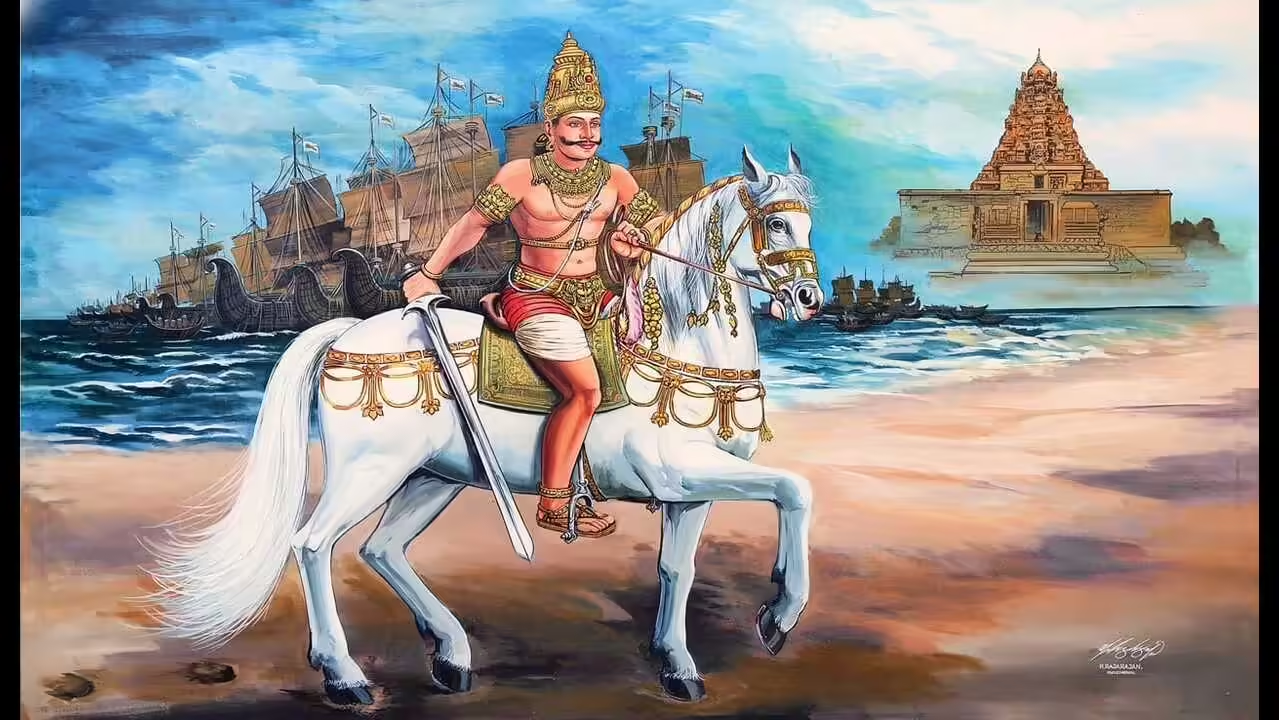
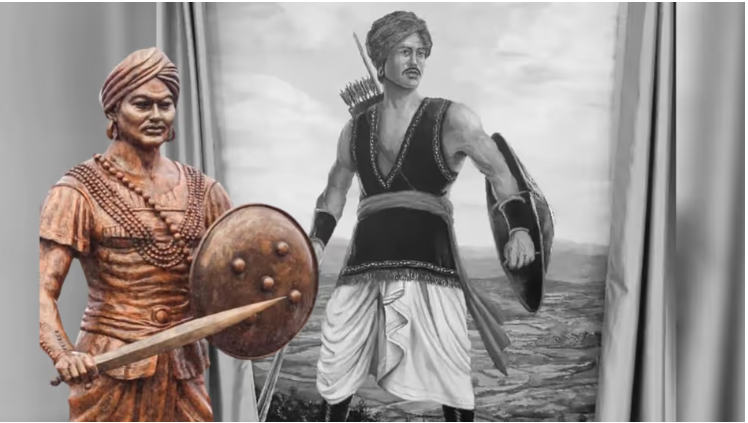
Rajendra Chola I | Image Source: Times Of India
In 1025 CE, while much of the medieval world was still confined to regional warfare, an Indian emperor launched a naval campaign so ambitious that it altered the balance of power across maritime Asia. This was done by none other than the massive Chola fleet, and the architect behind this extraordinary campaign was Rajendra Chola I. He was the powerful Hindu king who transformed the Chola state from a powerful South Indian kingdom into a trans-oceanic maritime force. Advancing silently across the Bay of Bengal, the Chola fleet executed India’s first overseas “surgical strike” to safeguard the Strait of Malacca, the economic nerve centre of Asia, through a sweeping charge against the dictatorial Srivijayan Empire. But why did the Chola King, Rajendra Chola I, launch such a risky overseas expedition to safeguard the Strait of Malacca at all? To know this, continue reading ahead. We begin by explaining the significance of the Strait of Malacca—the route that prompted Rajendra Chola I to move in this direction.
The Artery of Asian Commerce: The Strait of Malacca
The Strait of Malacca is a narrow maritime corridor connecting the Indian Ocean with the South China Sea, making it the single most important trade route in Asia. Ships carrying spices, silk, camphor, ivory, sandalwood, cotton textiles, ceramics, perfumes, horses, and precious stones passed through it in enormous numbers. The economic rise of the Song dynasty in China had only increased the importance of this route, as Chinese demand for luxury goods from India and the wider Indian Ocean world exploded.
However, a massive blockade stood in the Strait of Malacca. At the centre of this commercial system stood the Srivijayan Empire, then led by King Sangrama Vijayatunggavarman (1008 CE to 1025 CE). Based in Sumatra and controlling both the Strait of Malacca and the Sunda Strait, Srivijaya functioned as the “gatekeeper” of maritime Asia. The kingdom controlled critical ports such as Kedah, Palembang, Pannai, and Malayu, allowing it to dominate the movement of ships between India and China.
But this wasn’t it. The Srivijaya Empire had a hegemonic grip over the Strait. According to Chinese records, the Srivijaya Empire charged exorbitant tariffs from foreign ships passing through the Strait, including demands of 20,000 dinars from a merchant ship. Those who refused to pay the taxes risked destruction by the empire’s navy. Not only this, but the Empire sponsored state-sanctioned piracy to ambush independent traders and block the Tamil merchant guilds from trading directly with China. It was owing to this that the Chola Empire rose to defend the Strait of Malacca.
The Maritime Superpower: The Cholas
The legacy of the Cholas, often remembered for their magnificent temples, is not limited to their architectural brilliance. They also stood as one of the most formidable naval powers in medieval Asia. Under Rajaraja Chola I and later Rajendra Chola I, the Cholas built a highly sophisticated maritime infrastructure. Ports such as Nagapattinam became thriving centres of trade and naval administration. The Chola mercantile marine included different classes of vessels such as the sangara, colandia, and kattu-maran. The Cholas also possessed an advanced naval intelligence network. The Cholas had the ottru intelligence corps that monitored maritime activity, while even reformed pirates known as kallarans were employed to watch rogue movements across sea lanes. Most importantly, the Cholas had developed close ties with powerful Tamil merchant guilds such as the Ayyavole Five Hundred and Manigramam. Their prosperity depended upon uninterrupted maritime trade. As Chola commerce increasingly moved eastward toward China, control over the Strait of Malacca became strategically essential.
But the Cholas’ growing commercial ambitions directly collided with Srivijaya’s monopoly over the Asian sea trade. Once flourishing ties between the Cholas and the Srivijaya Empire during the reign of Rajaraja Chola I (985–1014 CE), by the early 11th century, relations had sharply deteriorated. Historical evidence suggests that Srivijaya perceived the expanding Chola presence in the South China Sea as a direct threat to its lucrative intermediary role in Indo-Chinese trade. The Cholas sought direct trade access to Song China. Srivijaya, however, wanted to preserve its status as the indispensable middleman of Asian commerce. Tamil merchant guilds reportedly faced increasing restrictions, tariffs, and harassment in Southeast Asian waters. Some accounts even claim that Srivijaya encouraged sea robbers to target Tamil ships. Thus, Rajendra Chola now faced a strategic choice — either to accept Srivijaya’s maritime dominance or destroy it. He chose the latter.
India’s First-Ever Overseas Surgical Strike
The naval expedition of 1025 CE was not an impulsive raid. It was one of the most carefully planned maritime operations of the medieval world. The Cholas understood that success depended not only on military strength but also on navigation, intelligence, timing, and deception. Rajendra Chola’s fleet departed from the Coromandel Coast using the powerful southwest monsoon winds to rapidly cross the Bay of Bengal. Merchant guilds provided crucial intelligence regarding Srivijayan naval positions, harbour layouts, and trade routes.

Strait of Malacca | Image Source: Facebook/@kabyoshreeneog
Nonetheless, the most remarkable aspect of the operation was King Rajendra’s strategy. Rather than entering through the heavily guarded northern approaches of the Strait of Malacca — where Srivijaya expected any attack to emerge — the Chola fleet sailed toward the western coast of Sumatra. The fleet stopped at Barus, a Tamil-controlled trading outpost, where it quietly replenished supplies before continuing southward. Then came the masterstroke. Instead of attacking through Malacca directly, the Cholas crossed it and entered through the Sunda Strait from the south. This maneuver allowed the Chola fleet to strike Palembang, the Srivijayan capital, from an unexpected direction.
The attack achieved total surprise. The Thanjavur inscriptions vividly describe King Rajendra dispatching “many ships in the midst of the rolling sea” and capturing the Srivijaya Empire King, Sangrama Vijayatunggavarman, together with “the large heap of treasures” accumulated by them, including the Vidhyadara Torana, the jeweled 'war gate' of Srivijaya, adorned with great splendor. Once Palembang fell, the Chola fleet launched a rapid campaign across the archipelago, targeting key maritime centres almost simultaneously. Fourteen major ports were attacked in succession. However, it must be noted here that the Cholas did not attempt to occupy Southeast Asia permanently; instead, they destroyed the monopoly that had restricted Indian commercial access to China.
The impact of the Chola campaign was enormous. Srivijaya’s control over the Strait of Malacca weakened dramatically, opening the way for Tamil merchant guilds to expand their commercial presence across Southeast Asia and southern China. The Cholas emerged as the dominant maritime power of the Bay of Bengal, and historians later went on to describe this period as the era when the Bay of Bengal effectively became a “Chola Lake.”
The Significance of the Chola Surgical Strike Today
A thousand years later, King Rajendra Chola I’s campaign remains astonishingly relevant. Today, the Strait of Malacca continues to be one of the world’s most important maritime chokepoints. Much of global trade, including energy shipments and East Asian commerce, still passes through this narrow corridor. Modern geopolitical concepts such as the Indo-Pacific strategy, freedom of navigation, and maritime security all revolve around the same principle that Rajendra Chola I recognized in the 11th century.
His campaign also challenges long-standing colonial stereotypes that portrayed India as “a civilization lacking naval ambition” or maritime strategy. Long before European empires entered the Indian Ocean, especially Portuguese Vasco Da Gama, the Cholas had already demonstrated the ability to project power across oceans, conduct coordinated transoceanic warfare, protect overseas trade networks, and dominate maritime chokepoints. Rajendra Chola I, born on July 26, 971 CE, did not merely attack an empire; he reshaped the balance of power across maritime Asia. And in doing so, he became one of the earliest rulers in Indian history to launch a surgical strike outside India to save the subcontinent’s interests and demonstrate India’s maritime prowess.