July 21, 1984: When the Separatists Destroyed the Bhakra Canal Dam & Indian Army's 72-Hour Battle to Save It
Within just three days, panic spread across Haryana’s Sirsa and Hisar districts and Rajasthan’s Sri Ganganagar region. Paddy and cotton crops began drying up.

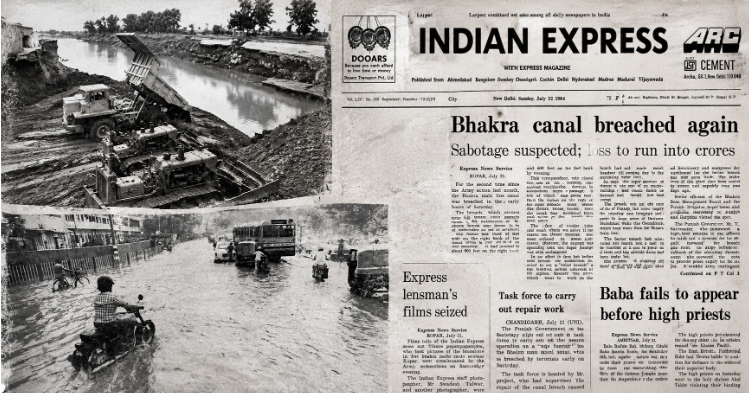
News clipping of the destruction of the Bhakra Canal Dam | Image Source: Indian Express
The conspiracy to blow up the Budki siphon of the Bhakra Main Line (BML) Canal was not a sudden act of sabotage. It was a carefully planned strategic strike by separatist extremists. After Operation Blue Star in June 1984, the separatist leadership had been badly shaken following the death of Jarnail Singh Bhindranwale and the clearing of terrorists from the Golden Temple complex. However, their handlers based in Pakistan and several top commanders hiding across the border were desperate to take revenge against the Indian government.
The extremists understood that defeating the Indian Army in direct combat was impossible. So they adopted a new strategy — attacking India’s lifelines. Railways, power stations, communication systems, and finally one of India’s most important irrigation arteries: the Bhakra Main Line Canal. The plot mainly involved remnants of Babbar Khalsa International and the Sikh Students Federation.
Punjab in 1984 was already living under the shadow of fear, violence, and militancy. Barely six weeks had passed since Operation Blue Star. In secret meetings near the Pakistan border and in terrorists' hideouts across Punjab, extremist groups discussed a new form of “resource warfare”, turning water itself into a weapon. The mastermind behind this strategy was Talwinder Singh Parmar.
The terrorists selected the Budki Nala siphon near Ropar. A siphon is a structure where a canal passes over a seasonal river through a raised concrete system. The militants believed that if they destroyed this structure, the canal water would collapse into the river below, making restoration extremely difficult.
But their real objective was far more dangerous than simply damaging a canal. If the Bhakra canal remained shut for a long period, Haryana and Rajasthan would face a severe water crisis. The extremists hoped this would trigger tensions between states, provoke farmers, and create internal conflict across northern India. Their goal was to weaken India from within.
In the early weeks of July 1984, terrorists disguised themselves as ordinary farmers and secretly surveyed the area. The local operation was assigned to extremist commander Gurbaksh Singh. The terrorists studied the weakest points of the structure, the timing of the security patrols, and where explosives could cause maximum destruction.
Then came the night of July 21, 1984. Under the cover of darkness and curfew silence, four to five armed extremists reached the concrete pillars of the siphon. They planted explosives deep inside the structure and attached timers. Around 4 AM, while the region was asleep, a massive explosion shook the ground near Ropar.
The blast was so powerful that the heavy concrete structure collapsed like a pack of cards. A breach nearly 200 feet wide and 30 feet deep tore through the canal wall. Water flowing at 12,000 cusecs surged into nearby villages and agricultural fields.
According to officials, the canal breach significantly reduced water supply to Chandigarh, a city with a population of nearly 500,000 at the time. Within just three days, panic spread across Haryana’s Sirsa and Hisar districts and Rajasthan’s Sri Ganganagar region. Paddy and cotton crops began drying up. Had the canal remained damaged longer, farms in Haryana and Rajasthan could have been devastated, while parts of Punjab risked flooding. The extremists believed such a crisis would ignite anger between states.
The Bhakra Main Line Canal supplied drinking water and irrigation to more than 1,500 villages across Punjab, Haryana, Rajasthan, and Chandigarh. Officials estimated that crops worth nearly 50 million dollars could have been destroyed if the canal remained shut.
Rumors soon began spreading across villages: “Punjab has stopped Haryana’s water.” Tensions slowly began rising. But the people remained calm. The real challenge now was restoring the canal. As news of the attack reached Delhi, the central government treated it as a national emergency. For the first 48 hours, repair work barely progressed because the local administration was overwhelmed. The task was finally handed over to the Indian Army’s Engineering Corps — including the Bombay and Bengal Sappers — along with top engineers from the Bhakra Beas Management Board.
The Army transformed the repair operation into a wartime mission. This was no ordinary repair job. The water current was extremely powerful. The surrounding land had turned into a swamp. Heavy machinery kept sinking into the mud. There was also constant fear of another terrorist attack. Soldiers and engineers worked standing waist-deep in water.
Still, they did not retreat. Floodlights illuminated the site through the night. Thousands of sandbags were used. Special machinery was rushed in. Essential supplies arrived through railway lines. Army personnel and BBMB engineers reportedly worked continuously for 48 to 72 hours, often without food or rest. Villagers across Punjab organized langars for the soldiers and laborers working at the site.
Within days, the Army and engineers successfully sealed the breach temporarily and gradually restored the water supply. Haryana, Rajasthan, Chandigarh, and Punjab finally breathed a sigh of relief. The extremists had hoped the canal attack would divide India. Instead, it united the country even more strongly.
Farmers in Haryana showed patience. People in Rajasthan shared water resources. And the Indian Army proved that it not only defends India’s borders — it also protects the nation’s lifelines. The broken Bhakra canal of 1984 still stands as a reminder that no matter how large the crisis becomes, India does not break easily. And when the Indian Army and the people stand together, those who seek to divide the nation ultimately fail.



.jpg)