The Untold Story of How India's National Emblem Was Unearthed
When India approached independence in the 1940s, the country needed symbols that could express its identity, heritage, and aspirations. The Lion Capital of Ashoka offered precisely that.

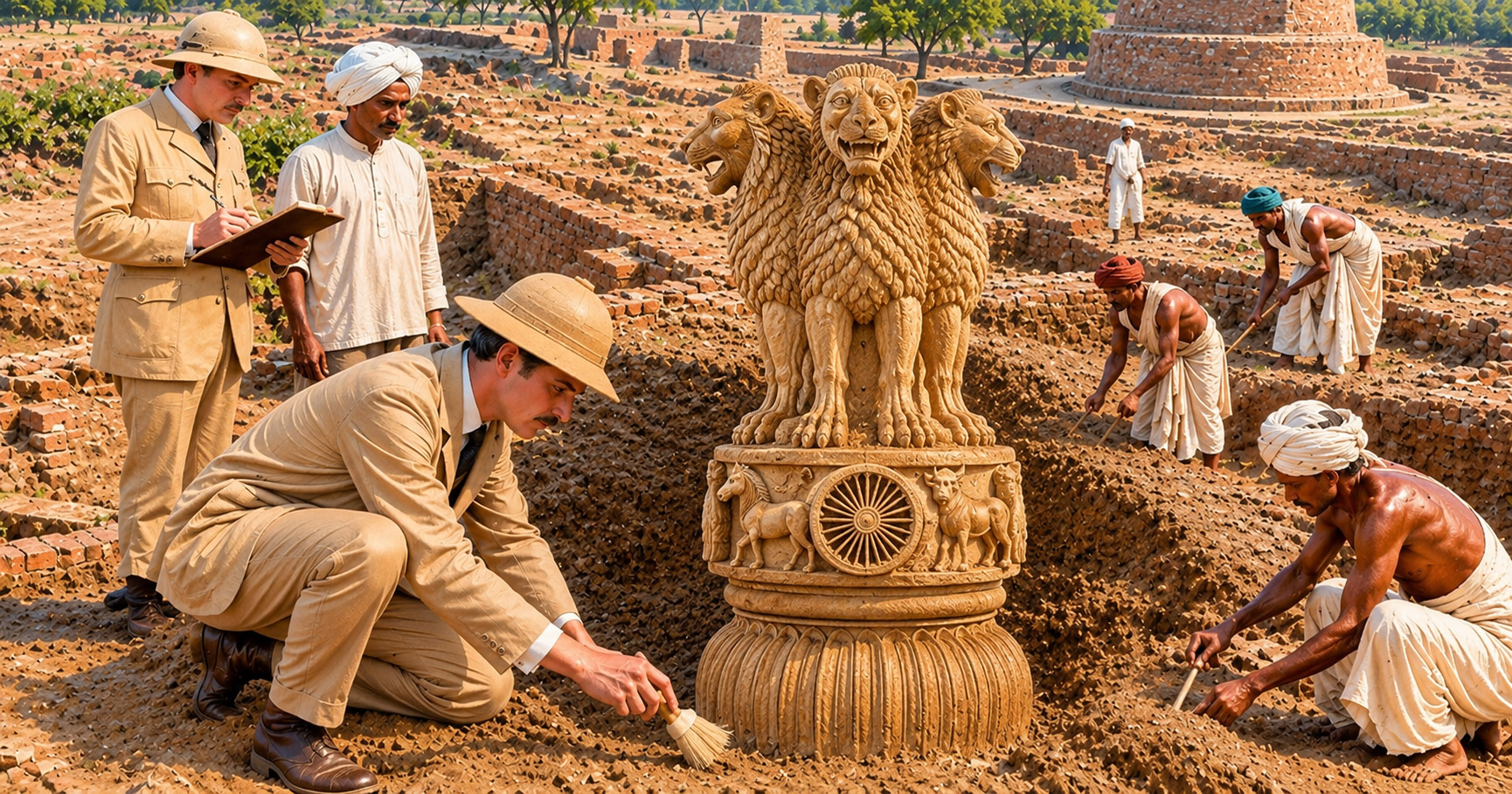
The Lion Capital of Ashoka unearthed by a German engineer | This image is AI-generated
What if I told you that the man who unearthed one of India's most recognisable national symbols was neither an Indian archaeologist nor a celebrated historian, but a German-born engineer working under British rule?
Today, millions of Indians see his discovery every single day. It appears on government documents, official seals, currency-related designs, and public institutions across the country. Yet, very few people know the name of the man who brought it back into the limelight. His name was Friedrich Oscar Oertel. And the story of how he unearthed India's National Emblem is nothing short of fascinating.
German Engineer Friedrich Oscar Oertel | Image Source: The Better India
The story takes us back to the early 20th century, when Oertel was working as a civil engineer in British India. But Oertel had an interest that went far beyond roads and buildings. His travels through Burma and Ceylon, today's Myanmar and Sri Lanka, had sparked a deep fascination with Buddhist art and architecture. And that fascination would eventually lead him to one of the most important archaeological discoveries in Indian history.
At the time, Oertel was stationed in Benares, now Varanasi. Just a short distance away lay Sarnath, one of Buddhism's most sacred sites. It was here that Gautama Buddha delivered his first sermon after attaining enlightenment, setting the Wheel of Dhamma in motion. For Oertel, Sarnath was more than an ancient religious site. It was a place where centuries of history lay buried beneath the earth.
In 1903, Oertel secured permission to excavate Sarnath, with support from Sir John Marshall, the Director-General of the Archaeological Survey of India. The government sanctioned approximately £400 for the work, and around 200 labourers were employed. He even persuaded local authorities to construct an approach road.
Finally, in December 1904, the excavation began. For nearly four months, workers carefully dug through the ancient ruins. They uncovered a major Buddhist monastery, explored the Jagat Singh Stupa, and retrieved hundreds of sculptural and architectural remains. The excavation also yielded 41 inscriptions, some dating back to the third century BCE.
Then, in March 1905, while excavating near the ancient structures at Sarnath, Oertel's team encountered fragments of an extraordinary stone sculpture. As the earth was gradually cleared away, more pieces emerged, revealing a magnificent work of ancient Indian craftsmanship. It was the Lion Capital of Emperor Ashoka.
Carved from polished Chunar sandstone, the approximately seven-foot-tall capital featured four magnificent lions standing back-to-back. Beneath them was an intricately carved abacus decorated with an elephant, a horse, a bull, and a lion, with Dharma Chakras separating the figures. The craftsmanship was extraordinary. Even after centuries underground, the sculpture retained its remarkable detail and finish.
Oertel immediately recognised the importance of the discovery. On March 15, 1905, he reported it to John Marshall. The find would go on to be celebrated as one of the finest achievements of ancient Indian sculpture.
Oertel later presented his findings at an international conference in Copenhagen in 1908. Meanwhile, the discoveries were preserved, and the Lion Capital was eventually housed in the Sarnath Museum. Oertel had uncovered a masterpiece of ancient Indian civilisation. However, he could hardly have imagined that it would one day become the face of an independent nation.
When India approached independence in the 1940s, the country needed symbols that could express its identity, heritage, and aspirations. The Lion Capital of Ashoka offered precisely that. Ashoka's legacy represented not merely imperial power, but also moral responsibility, peace, and ethical governance. The four lions symbolised power, courage, confidence, and pride, while the Dharma Chakra reflected the principles of righteousness and the teachings of Buddha.
The National Emblem of India | Image Source: The National Portal of India
On January 26, 1950, when India became a republic, the Lion Capital of Sarnath was adopted as the State Emblem of India. The official representation simplified certain details of the original sculpture. Only three lions are visible from the front, while the fourth remains hidden behind them. The lotus beneath the original capital was omitted, and the words Satyameva Jayate, meaning "Truth Alone Triumphs", were inscribed below the emblem. The motto comes from the Mundaka Upanishad.
And so, a sculpture unearthed by a German-born engineer during British rule became a defining symbol of the world's largest democracy. Today, the four lions stand proudly on government buildings, official documents, and national institutions. Their image represents a nation of more than a billion people.