Kargil War 1999: How India’s ‘Operation Safed Sagar’ Crushed Pakistan’s Mountain Positions at 18,000 Feet
This was “Operation Safed Sagar”, the Indian Air Force’s campaign in the air during the Kargil War, was a critical campaign, owing to which India’s Kargil victory of July 26, 1999, was possible.

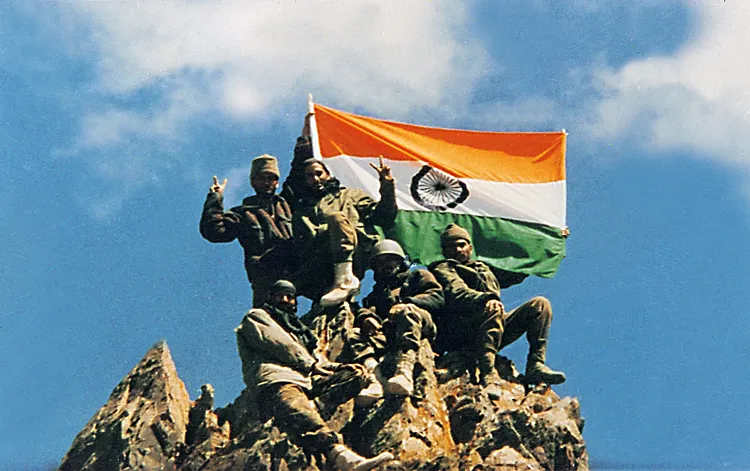
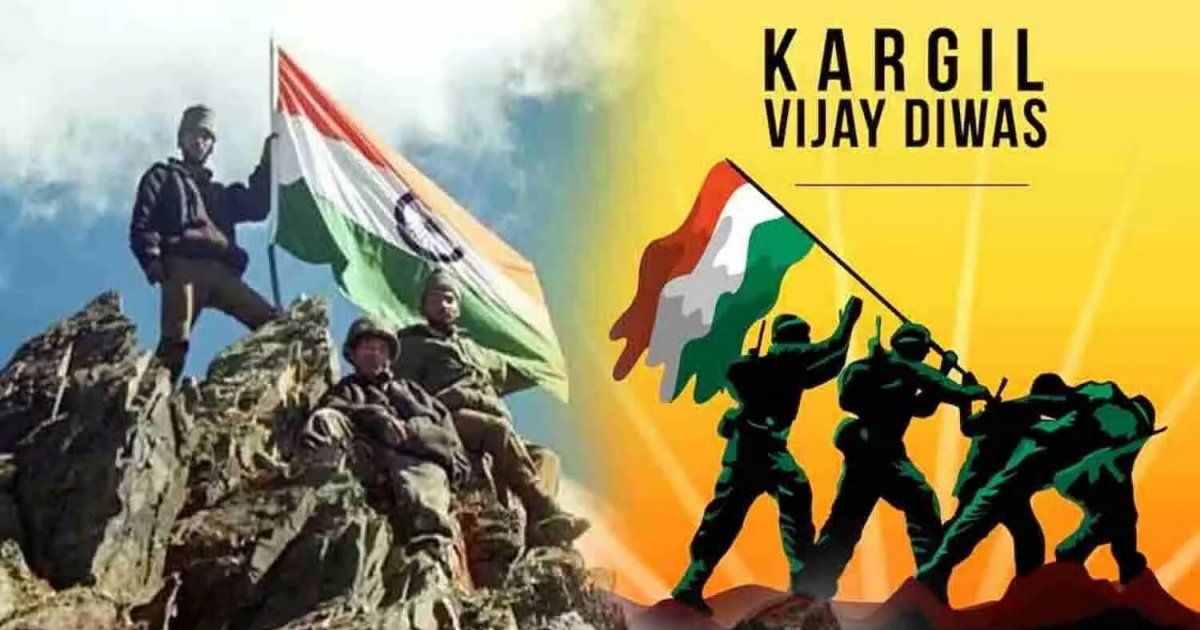
The Indian troop’s victory in Kargil War | Image Source: IIMUN
In the summer of 1999, the Indian Air Force was tasked to do the impossible — help the Indian Army in its war against Pakistan in Kargil. The atmosphere stood at odds. The enemy positions were at an altitude of 18,000 feet, a point where even breathing becomes difficult, helicopters struggle in thin air, bomb trajectories become unpredictable because of mountain winds, and it becomes difficult to distinguish enemy bunkers in snow-covered rocks. Yet, the IAF did the impossible and critically supported the Indian Army to win the 1999 Kargil War — all without even crossing the Line of Control (LoC). This was “Operation Safed Sagar”, the Indian Air Force’s campaign in the air during the Kargil War, was a critical campaign, owing to which India’s Kargil victory of July 26, 1999, was possible. The operation later went on to become one of the most difficult and transformative operations in the history of the Indian Air Force.
A Prelude to the War
It all began in February 1999, when Prime Minister Atal Bihari Vajpayee travelled to Lahore in Pakistan in a historic peace initiative, where the Lahore Declaration was signed between Indian PM Vajpayee and Pakistani Prime Minister Nawaz Sharif to ensure peace, stability, and a commitment to reduce tensions between the two nuclear neighbours. However, behind the peace accord, a totally different story was unfolding. Senior leaders of the Pakistan Army, led by General Pervez Musharraf and Lieutenant General Mohammed Aziz, were already preparing a covert military operation in the Kargil sector, wherein the Pakistani troops had crossed the Line of Control and slowly occupied strategic heights overlooking Kargil, Drass, and Batalik. The Pakistani army occupied the heights above National Highway 1A, the crucial road connecting Srinagar to Leh, threatening India’s lifeline to Ladakh and the Siachen Glacier. The occupation of the highway also hampered Indian troop movement and logistics in the region.
The timing of the infiltration was carefully chosen. Every winter, up until early 1999, forces on both sides abandoned positions at altitudes between 14,000 and 18,000 feet from November to April. This was done because temperatures plummeted past -40°C, coupled with heavy snow and massive avalanches. Pakistani intruders exploited this gap and quietly entrenched themselves in fortified positions on the Indian side of the Line of Control. The Indian patrols finally discovered the intrusion in May 1999, and the scale of the situation stunned New Delhi because it was not merely an occupation. Instead, the enemy was heavily armed, well-supplied, and dominating mountain heights. The high altitude gave the enemy an advantage, while the Indian troops stood in an extremely challenging situation. The climb up the hill was steep and exposed to constant machine-gun and mortar fire.
The War that the Army Could Not Fight Alone
Before the IAF’s involvement, during the initial phase, the army itself tried to attack the enemy and reclaim the positions. However, it suffered heavy casualties. On May 11, 1999, the Indian Army formally approached the Indian Air Force and requested air support to help turn the tide of the battle. But deploying air power was not an easy decision. There were fears in New Delhi that the use of fighter aircraft and attack helicopters could escalate the conflict into a full-scale war between two nuclear-armed nations. For several days, the government weighed the risks carefully. Finally, on May 25, the Cabinet Committee on Security approved the use of air power, but on one critical condition: The Indian Air Force would not cross the Line of Control.
Area of operation for the 1999 Kargil War | Image Source: Carnegie Endowment
Nonetheless, it must be noted that before the official approval came, the Indian Air Force had already begun the preparations for an impending war. They understood that the situation was critical; thus, the IAF had already begun reconnaissance sorties over the Kargil heights in the early days of May. Jaguar fighters equipped with long-range oblique photography systems began gathering target information. Canberra PR57 reconnaissance aircraft and MiG-25R spy planes were pressed into service to photograph enemy positions and logistics routes. The Canberra missions provided some of the first photographic proof of Pakistani intrusion into Indian territory. Simultaneously, the IAF rapidly moved aircraft into the Kashmir Valley, establishing quick-reaction alert facilities at Srinagar and Avantipur. Meanwhile, IAF pilots also began practicing air-to-ground strikes at Himalayan altitudes.
Indian Air Force’s “Operation Safed Sagar”
Finally, on May 26, 1999, the Indian Air Force’s “Operation Safed Sagar” began — the IAF’s critical support to the Indian Army in the 1999 Kargil War. At 6:30 AM, IAF’s MiG-21s, MiG-27MLs, and MiG-23BN fighters launched the first wave of strikes against enemy positions and supply lines. Above them, MiG-29 fighters flew Combat Air Patrol missions to protect strike aircraft from any potential Pakistani aerial response. But the opening days were costly.
On May 27, Flight Lieutenant Kambampati Nachiketa’s MiG-27 developed mechanical trouble during combat operations, forcing him to eject behind enemy lines. As efforts began to locate him, Squadron Leader Ajay Ahuja’s MiG-21 was hit and shot down. The next day brought another tragedy. On May 28, a formation of four Mi-17 helicopters known as the “Nubra Formation” was tasked with attacking Point 5140 near Tololing. Wing Commander Anil Kumar Sinha led the mission. During the attack, one of the helicopters flown by Flight Lieutenant Subramaniam Muhilan was struck. Despite desperate efforts to control the aircraft, the helicopter crashed, with the entire crew martyred. Seeing the losses, the IAF rapidly changed its tactics. Attack helicopters were withdrawn from highly vulnerable roles, and strike profiles were altered. Greater emphasis was placed on reconnaissance, coordination with ground troops, and precision targeting. Slowly, the Indian Air Force began mastering the impossible battlefield.
Indian Air Force’s aircraft over the Himalayan ridgelines during Operation Safed Sagar | Image Source: Carnegie Endowment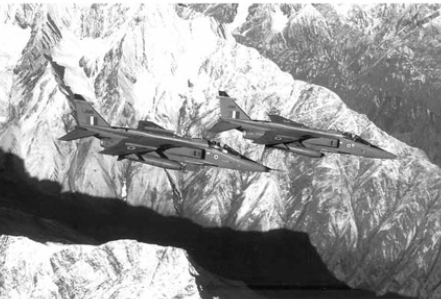
One of the most decisive moments came at Muntho Dhalo. There, the Pakistan Army had developed a major logistics and supply base inside a bowl-shaped valley at Muntho Dhalo. Hidden from easy detection, it had become a critical hub supporting Pakistani intruders across the sector. On June 16 and 17, Indian Air Force MiG-27s and Mirage-2000 fighters launched devastating strikes on the camp that ripped through ammunition stocks, bunkers, and supply dumps. Later strikes ensured that Pakistan could not rebuild or reuse the base effectively. The balance of the war began shifting towards India’s side. Mirage-2000 aircraft armed with laser-guided bombs carried out precision strikes against key enemy positions, including Tiger Hill. On June 24, laser-guided bombs were used to devastating effect against Pakistani positions. Further strikes destroyed enemy camps, logistics centres, and bunkers across Mushkoh Valley, Tololing, and nearby sectors.
Pre and post-strike images of Muntho Dhalo | Image Source: Carnegie Endowment
By the time air operations ended on July 12, 1999, Operation Safed Sagar had become one of the largest and most complex air campaigns ever undertaken by the Indian Air Force. The IAF flew nearly 550 strike missions, over 150 reconnaissance missions, and more than 500 escort flights during the campaign. Its helicopters flew over 2,185 sorties, logging nearly 925 flying hours in casualty evacuation, troop transport, and logistics support missions. Behind every mission were pilots flying through narrow valleys surrounded by enemy-held peaks, technicians working around the clock in difficult conditions, and soldiers on the ground coordinating targets under fire.
Why the IAF’s Involvement Mattered?
The Indian troop’s victory in Kargil War | Image Source: IIMUN
Operation Safed Sagar changed the Kargil War — and it changed the Indian Air Force. It was the first time that India had used combat air power in high mountain warfare above 15,000 feet. Yet, the IAF adapted with remarkable speed. Its strikes destroyed Pakistani supply lines, weakened fortified positions, isolated enemy troops on mountain peaks, and helped the Indian Army reclaim critical territory one point at a time. Most importantly, Operation Safed Sagar demonstrated the power of coordinated joint warfare between the Army and the Air Force. Operation Safed Sagar proved to the world that even at 18,000 feet, one of the harshest battlefields, victory was possible through courage, precision, and relentless determination.