How 'Amrita Bazar Patrika' Exposed the British Plot to Annex Jammu and Kashmir in 1889?
In the year 1889, a journalist associated with the 'Amrita Bazar Patrika' managed to obtain fragments of a secret letter that had been discarded in the waste-paper basket of the Viceroy's office in Calcutta.

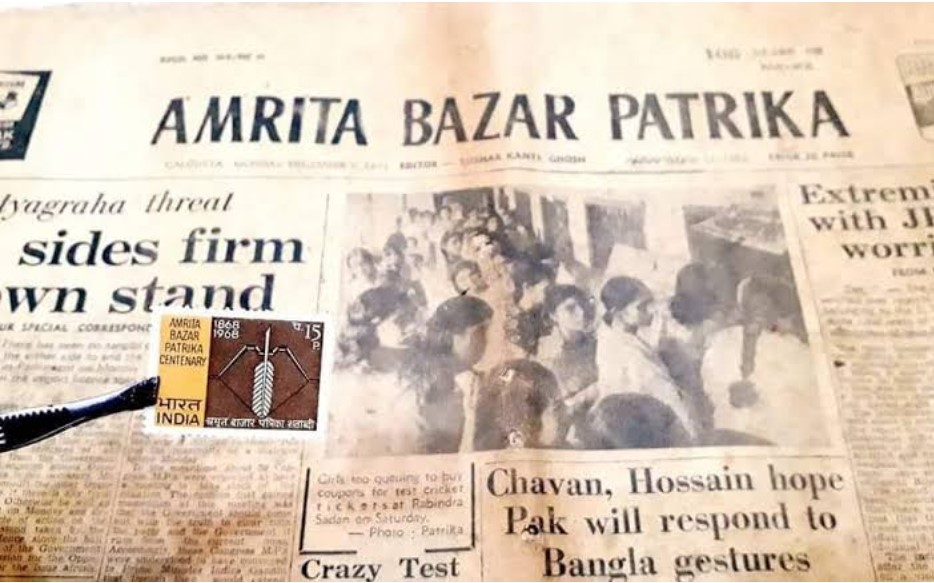
Amrita Bazar Patrika newspaper | Image Source: Facebook/@Old Calcutta
What if a newspaper, in an age when there were no television, cameras, and certainly no social media, managed to uncover a secret plan being discussed inside the highest offices of the British Raj? More than a century ago, that is precisely what the Amrita Bazar Patrika, a fiercely anti-colonial nationalist newspaper, did. In October 1889, the newspaper published a first-page full text of a secret letter, exposing a British plot to depose the Dogra King of Jammu and Kashmir, and annex their territory. The publication caused a political storm, becoming one of the most remarkable episodes of the greatest investigative scoops in the history of Indian journalism.
The story dates back to 1846. On March 16 that year, the Treaty of Amritsar was signed between the British Government and Maharaja Gulab Singh of Jammu, establishing that Jammu and Kashmir was a princely state under British paramountcy. Four decades later, by 1889, however, the relationship between the Dogra ruler and the British had become increasingly strained. British officials accused Maharaja Pratap Singh, the third Maharaja of Jammu and Kashmir, of misgovernance. But the truth was something entirely different. The British wanted to gain control over Jammu and Kashmir owing to its geographical position. At the time, Britain was involved in a major rivalry with the Russian Empire over influence and control in Central Asia. And J&K lay at the northern edge of the Indian subcontinent, close to Central Asia and China. This made Jammu & Kashmir, especially its northern frontier, strategically crucial to the British. Thus, in order to gain larger control over J&K, the British made several attempts.
By 1889, the British had effectively established a Council of Regency, a puppet governing body imposed by the British Empire on Jammu and Kashmir in 1889 to strip Maharaja Pratap Singh of his absolute administrative powers. While to the world, this British intervention was presented as an administrative measure needed to improve governance. But suspicions remained that something much larger was taking place. And this is where the Amrita Bazar Patrika entered the story.
In the year 1889, a journalist associated with the Amrita Bazar Patrika managed to obtain fragments of a secret letter that had been discarded in the waste-paper basket of the Viceroy's office in Calcutta. The journalist carefully retrieved the torn pieces and painstakingly assembled them. What emerged from the reconstructed document was explosive. The letter was a confidential diplomatic exchange involving Viceroy Lord Lansdowne and Sir John Gorst, the Under-Secretary of State for India in London. Its contents shed light on the British government's thinking about Jammu and Kashmir and its intentions behind virtually annexing the princely state. On October 1889, the Amrita Bazar Patrika published the full text of the leaked letter. Suddenly, what had been discussed behind closed doors was in the public domain, and as expected, the exposé led to a political disaster.
The most immediate impact of the exposé was that it gave Maharaja Pratap Singh evidence to challenge the British government's actions against him. With the published text of the confidential letter in hand, the Maharaja protested against the loss of his powers and travelled to London to lobby British authorities for the restoration of his position. The controversy put the British government's intentions towards Jammu and Kashmir under intense scrutiny and complicated its plans for exercising greater control over the state.
As we mark National Press Day, this is not a story merely about a torn piece of paper pulled from a waste bin, but about how the Amrita Bazar Patrika took a secret buried within the colonial administration and placed it before the public. The episode became a landmark in the history of investigative journalism in India—and a reminder that, even under an immensely powerful colonial state, the press could sometimes force hidden decisions into the light.
Disclaimer: The precise identity of the 'Amrita Bazar Patrika' journalist remains unknown, as revealing the person's identity at the time could have exposed the journalist to extremely serious consequences.