Battle of Saragarhi: Sepoy Gurmukh Singh, the Young Sikh Warrior, Who Fought to the End at Battle
Defending the forts was the Saragarhi outpost, manned exclusively by 21 Sikh soldiers of the 36th Sikhs Regiment, under the command of Havildar Ishar Singh.

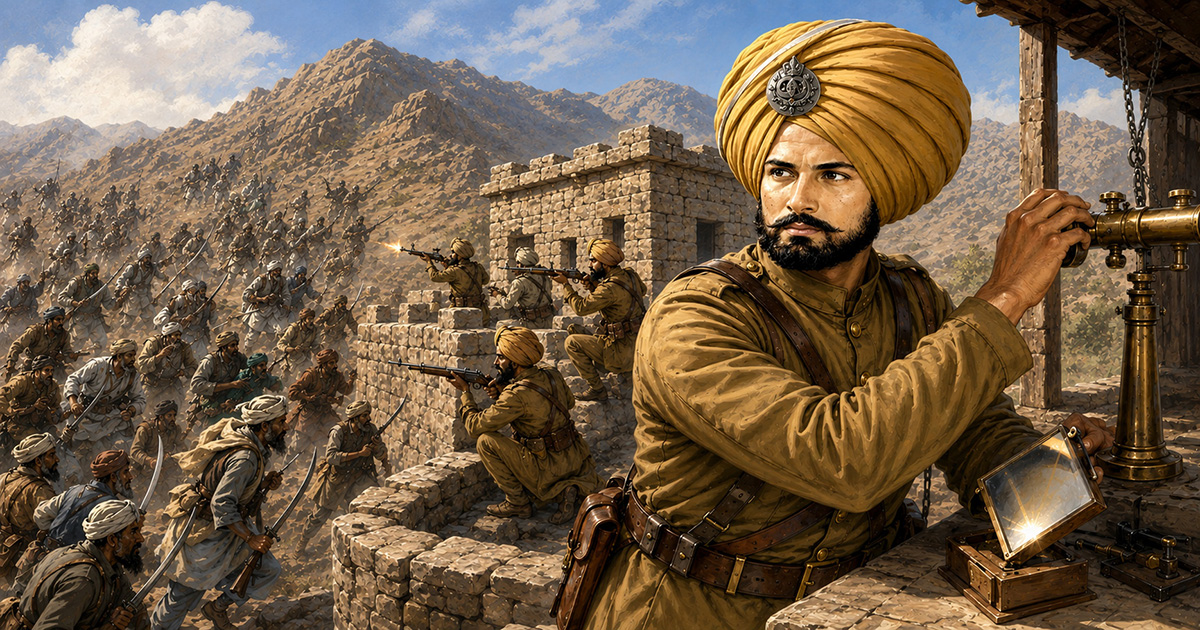
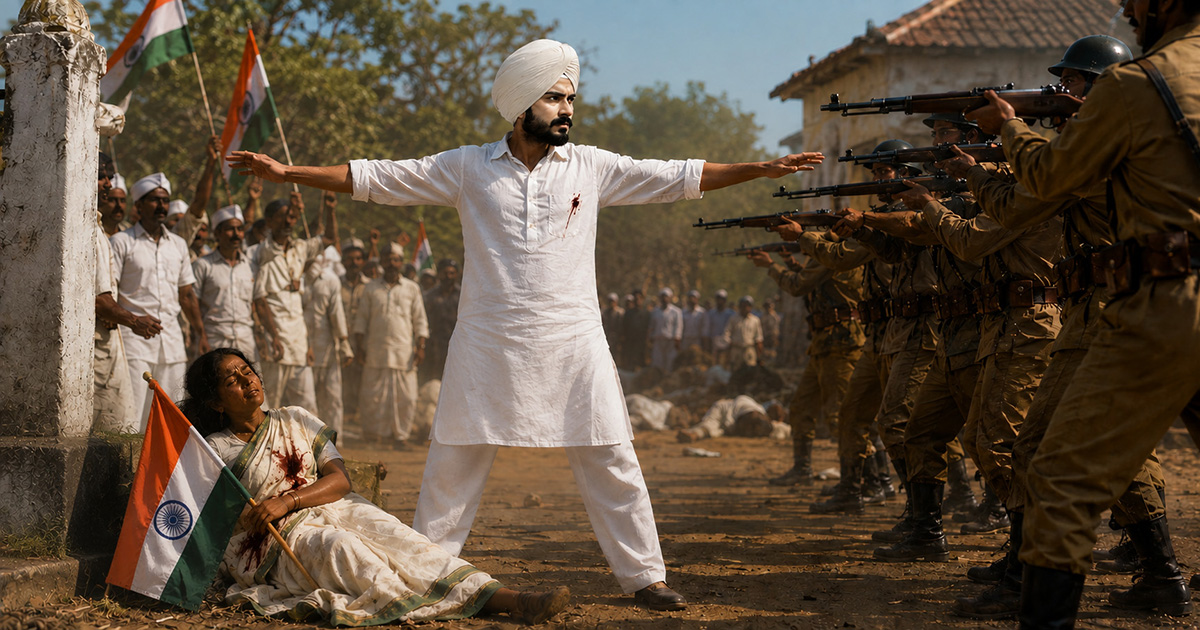
Sepoy Gurmukh Singh in the battle of Saragarhi | This image is AI-generated
The morning of September 12, 1897, began like any other for 19-year-old Sepoy Gurmukh Singh. Standing atop the signaling tower of the tiny stone outpost of Saragarhi, nestled in the rugged Samana Hills of present-day Pakistan, the young Sikh scanned the horizon through his heliograph. His duty was simple yet critical to relay messages between Fort Lockhart and Fort Gulistan, two British frontier forts, originally built by Maharaja Ranjit Singh, which could not communicate directly because a massive mountain ridge blocked their line of sight. Defending the forts was the Saragarhi outpost, manned exclusively by 21 Sikh soldiers of the 36th Sikhs Regiment, under the command of Havildar Ishar Singh. Standing atop the signaling tower, Gurmukh noticed that nearly 10,000 Afghan Islamic tribesmen had surrounded the isolated ridge and were advancing towards Saragarhi.
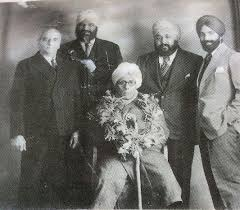
In the 1890s, the British had imposed a Durand Line that had divided Pashtun tribal territories to stop Russia from coming towards the northern frontiers of Asia. Thus, the Islamic tribesmen, encouraged by Russia, rallied against the British and attacked the British-controlled Saragarhi outpost. Without wasting a second, Gurmukh turned to his heliograph and flashed an urgent message to Fort Lockhart. "Enemy approaching in strength. Prepare for siege." The commanding officer, Lieutenant Colonel John Haughton, replied: "Unable to send immediate help. Hold your position." The twenty-one Sikh soldiers stationed at Saragarhi would have to stand alone. The attackers called upon the defenders to surrender. The answer came not in fear, but in faith. "Jo Bole So Nihal, Sat Sri Akal!" The Battle of Saragarhi had begun. Real photo of Saragarhi Fort’s bravehearts | Image Source: prashantb.wordpress
Led by Havildar Ishar Singh, the Sikh defenders unleashed disciplined rifle fire from their Martini-Henry rifles, inflicting devastating casualties. Yet for every attacker who fell, more appeared over the hills. Throughout the battle, Gurmukh never abandoned his post. While bullets struck the walls around him, he continued flashing updates to Fort Lockhart, allowing the British command to witness the battle almost in real time. As the hours passed, the attackers changed tactics. Thick smoke engulfed the fort. Hidden behind the smoke, miners breached a section of the wall, allowing thousands of fighters to pour inside. The Sikhs fought hand-to-hand to save the British, but could not hold out much longer. One by one, they fell. Havildar Ishar Singh made a final stand so that his comrades could continue resisting inside the inner blockhouse.
By late afternoon, twenty Sikh soldiers had been martyred. Only Gurmukh Singh remained. Eventually, flames now climbed the wooden supports beneath his signaling tower. Yet he did not abandon his duty. He transmitted one final message to Fort Lockhart: "This is my last signal. Permission to pick up my rifle." Permission was granted. Gurmukh laid aside the heliograph, picked up his Martini-Henry rifle, and defended the tower until the very end, reportedly killing around twenty attackers before the burning structure collapsed around him. All twenty-one Sikh defenders perished that day. But their sacrifice achieved what seemed impossible. By holding Saragarhi for hours against overwhelming odds, they delayed the advance of the attackers long enough for Fort Lockhart and Fort Gulistan to strengthen their defences.
The frontier British forts survived because twenty-one Sikhs refused to abandon their post. And therein lies the greatest irony of Saragarhi. These Sikh soldiers were fighting under the flag of the very Empire that had dismantled their own kingdom only decades earlier. In 1849, the British annexed Punjab. Lahore was occupied, the Sikh treasury was emptied, the famed Koh-i-Noor was taken away, and Punjab was brought under colonial rule. Heavy taxation and political restructuring transformed one of India's most powerful kingdoms into another province of the British Empire. An illustrated pic of Sepoy Gurmukh Singh | Image Source: prashantb.wordpress
The British were well aware of the military strength of the Sikhs. Major-General Sir Henry Lawrence once remarked: "The Sikhs are a proud, independent and turbulent race... We must break the neck of this military class, or they will break ours." The Empire succeeded in breaking the Sikh kingdom. But it could never break the Sikh spirit. This was greatly seen in the Battle of Saragarhi. Because when the Empire's frontier came under attack, it was Sikh soldiers who stood to defend it. Not because they had forgotten what had happened to Punjab. But because, for the Khalsa, duty once accepted was sacred. The Sikhs kept their word even to an Empire that had once broken theirs. For his extraordinary courage, Queen Victoria posthumously awarded Sepoy Gurmukh Singh the Indian Order of Merit, then the highest gallantry award available to Indian soldiers, on January 20, 1898.