The Warrior Who Fought Till His Last Breath: Lt. Colonel Ardeshir Tarapore and the Battle of Phillora
In August 1965, Pakistan launched "Operation Gibraltar" to infiltrate Jammu and Kashmir, which pushed the tension between the two countries to its peak.

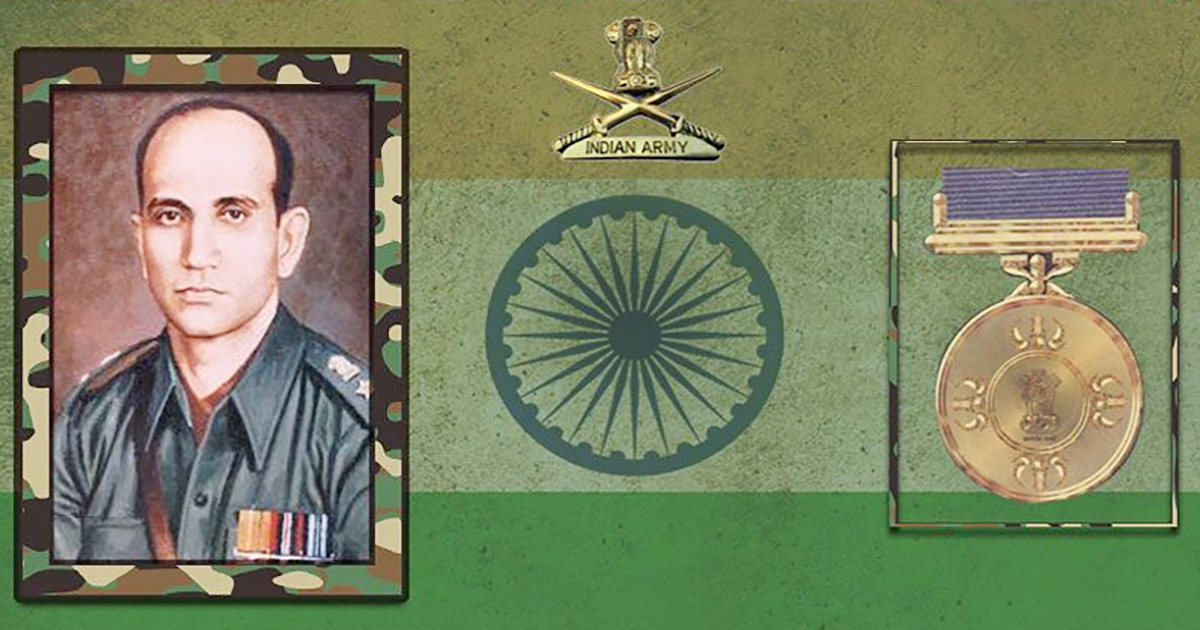
Lieutenant Colonel Ardeshir Tarapore
During the September 1965 Indo-Pakistani War, the 'Battle of Phillora' was fought as a historic tank battle in the Sialkot sector. In this war, Pakistan possessed American 'M48 Patton' tanks, which were more modern than India's 'Centurion' tanks; however, the bravehearts of the Indian Army completely shattered the sinister designs of Pakistan, which was dreaming of victory based on this technological strength. The moment this war is mentioned, the very first name that comes to mind is that of Lieutenant Colonel Tarapore, who displayed the pinnacle of bravery and, despite being severely injured, refused to back down, fighting till his last breath to finally hoist the tricolor on the soil of Phillora. This is the immortal saga of the indomitable courage of Colonel Tarapore and his regiment.
In August 1965, Pakistan launched "Operation Gibraltar" to infiltrate Jammu and Kashmir, which pushed the tension between the two countries to its peak. This military conflict, which began in the border areas, later transformed into a full-scale Indo-Pak war in September 1965. During this war, the highly crucial responsibility of hoisting India's victory flag on 'Phillora' in Pakistan's Sialkot sector was entrusted to the 'Poona Horse' regiment, under the leadership of Lieutenant Colonel Ardeshir Burzorji Tarapore.
The Commencement of the Mission
As planned, on September 11, 1965, Lieutenant Colonel Ardeshir advanced towards Phillora with his tanks. As a preparation for capturing Phillora, the 'C Squadron' of the 'Poona Horse', along with the 5/9 Gorkha Rifles, took control of 'Libbe' village. Buoyed by this success, the commander of the 'C Squadron', along with the Gorkha Rifles, took a major decision to launch a direct assault on Phillora. While planning this attack, Colonel Tarapore dispatched 'B Squadron' to encircle Phillora village from the northwest and deployed 'A Squadron' to protect the Libbe road. In this mission, Colonel Tarapore himself advanced in his tank and joined 'A Squadron'. However, just as the Indian forces were attacking Phillora, the enemy's heavy armored vehicles coming from Wazirwali launched a sudden counter-attack.
In this battle, Colonel Tarapore himself destroyed two of Pakistan's 'Patton tanks'. During this action, a shell fragment injured his hand, yet he refused to leave the battlefield. Bandaging his hand, he continued to lead the 'Poona Horse' with absolute fearlessness. Inspired by his valor, his unit also fought day and night, and finally, on September 13, 1965, Phillora was captured. In this entire war, he performed the unprecedented feat of single-handedly destroying as many as 60 enemy tanks. This victory proved to be a crucial milestone for the Indian Army, but Lieutenant Colonel Tarapore's victorious chariot was not going to stop here.
The Ultimate Sacrifice
After capturing Phillora, Colonel Tarapore turned his regiment towards 'Wazirali' on September 14, and despite being severely injured, he captured the post. Maintaining this victorious momentum, they completely routed the enemy by the morning of September 16, establishing the Indian Army's dominance over 'Jassoran' and 'Batur-Dograndi'. However, at 5:20 PM on the very same day, while the assault was ongoing at Jassoran, Colonel Tarapore stepped out of his tank to get some fresh air and have tea. At that exact moment, an enemy artillery shell landed very close to his tank. Due to that massive and fierce explosion, Colonel Tarapore and two soldiers of the 9 Dogra Regiment attained immediate martyrdom on the battlefield.
Who was Colonel Tarapore?
Colonel Ardeshir Tarapore (born: August 18, 1923, in Mumbai) was a Parsi son of India, belonging to the lineage of Ratanjiba, who had served in Chhatrapati Shivaji Maharaj's army. Possessing a sportsman's spirit, Ardeshir was an outstanding military officer and a deeply family-oriented man. For his unmatched bravery, exceptional leadership, and supreme sacrifice during the 1965 Indo-Pakistan War, he was posthumously awarded the 'Param Vir Chakra', the nation's highest gallantry award. Furthermore, in accordance with his final wishes, his last rites were performed right on the battlefield.