How Bhausaheb Rangari Sparked a Revolution in the Name of Lord Ganesha That Kept the British Awake at Night?
After the Revolt of 1857, the British adopted a policy of severe repression across India. Public gatherings and political activities came under strict surveillance.

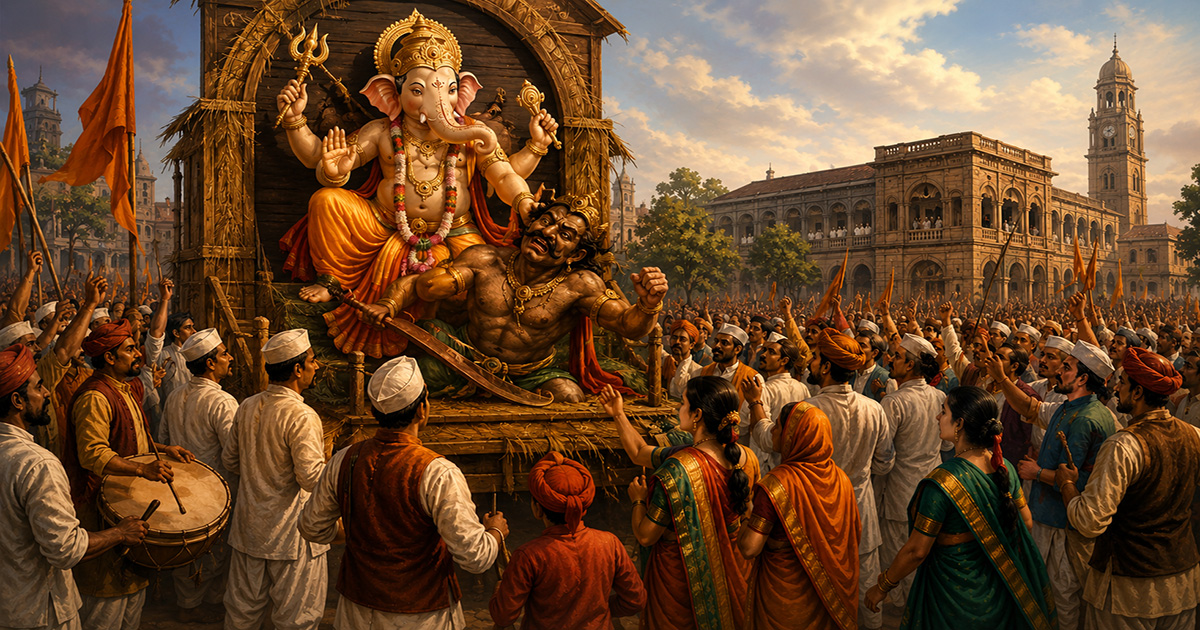
Sarvajanik Ganeshotsav | This image is AI-generated
The British were not always challenged with swords. At times, even a religious festival became the most powerful weapon against them. The beginning of the public Ganesh festival (Sarvajanik Ganeshotsav) in Maharashtra during India's freedom struggle was one such revolutionary plan. The man behind it was Shrimant Bhausaheb Rangari (Bhau Laxman Jawale). He transformed the Ganesh festival from a religious celebration into a movement for national awakening.
After the Revolt of 1857, the British adopted a policy of severe repression across India. Public gatherings and political activities came under strict surveillance. During this period, Bhausaheb Rangari, who lived in the Shalukar Bol area of Pune, was deeply concerned about the condition of the nation. He believed that a society divided by caste, class, and social discrimination could never challenge foreign rule. Therefore, he searched for a platform that was religious, social, and at the same time would not arouse British suspicion. This farsighted vision was about to mark the beginning of a new chapter in Indian history.
In 1892, his close friend Sardar Krishnaji Kashinath, popularly known as Nanasaheb Khasgiwale, returned from Gwalior. When Bhausaheb visited him, Nanasaheb told him about the Ganesh festival celebrated in the Gwalior royal court. Bhausaheb saw in the festival the perfect medium to give shape to an idea that had been growing in his mind for years. He convened a meeting at his residence.
Among those present were Maharshi Annasaheb Patwardhan, Ganpatrao Ghotawadekar, Dagdusheth Halwai, Lakhusheth Dantale, and several other prominent citizens—a total of eleven leading personalities. It was in this meeting that a historic decision was taken. The Ganesh festival would no longer remain confined to royal courts and private homes. Instead, it would become a festival of the entire society.
Acting on this decision, on Anant Chaturdashi in 1892, Bhausaheb Rangari established three public Ganesh pandals in Pune. During the festival, public Ganesh processions were taken out from three different locations across the city. For the first time, people from every section of Hindu society participated in the procession. The event became a powerful symbol of social equality and collective unity.
However, Bhausaheb Rangari's objective extended far beyond worship alone. Inside the pandal, he installed a unique idol of Lord Ganesha, depicting the deity slaying a demon. Made from wood, straw, and clay, the environmentally friendly idol was completely different from traditional Ganesh idols. It symbolised not only the victory of good over evil but also the end of foreign domination.
From the platform of the Ganesh festival, messages of national awakening, Swadeshi, social harmony, and freedom began reaching the people. While the British imposed restrictions on political meetings, thousands of people gathered in the name of a religious festival to discuss the future of the nation and society. This was Bhausaheb's greatest revolutionary strategy.
The impact of Bhausaheb Rangari's initiative became visible very quickly. On 26 September 1893, Lokmanya Bal Gangadhar Tilak, writing in his newspaper Kesari, praised this new tradition and wrote: "We must thank those gentlemen who have undertaken this work this year."
The following year, in 1894, Tilak himself installed a public Ganesh idol at Vinchurkar Wada and, through his writings and public outreach, expanded the movement across Maharashtra and eventually throughout India. In the years that followed, the public Ganesh festival became an influential platform for numerous revolutionaries, social reformers, and nationalist leaders, from where the message of India's freedom reached people across the country.
Today, the Sarvajanik Ganeshotsav has become an integral part of India's cultural identity. However, the nationalist objective behind its origin remains equally significant. Shrimant Bhausaheb Rangari demonstrated that culture could become the most powerful force for uniting society. He brought the Ganesh festival out of the confines of private homes and transformed it into a movement for national awakening, giving fresh momentum to India's freedom struggle.
For this reason, Bhausaheb Rangari's contribution to the history of the public Ganesh festival is not merely the beginning of a tradition. It represents a revolutionary initiative in cultural nationalism and social unity, the echoes of which can still be felt during every Ganesh festival today.