Hijli Detention Camp to IIT Kharagpur: How a British Detention Camp Became India’s First IIT?
The story behind the establishment of India's first Indian Institute of Technology (IIT) is a fascinating one. It is deeply rooted in the struggles of India's freedom movement.

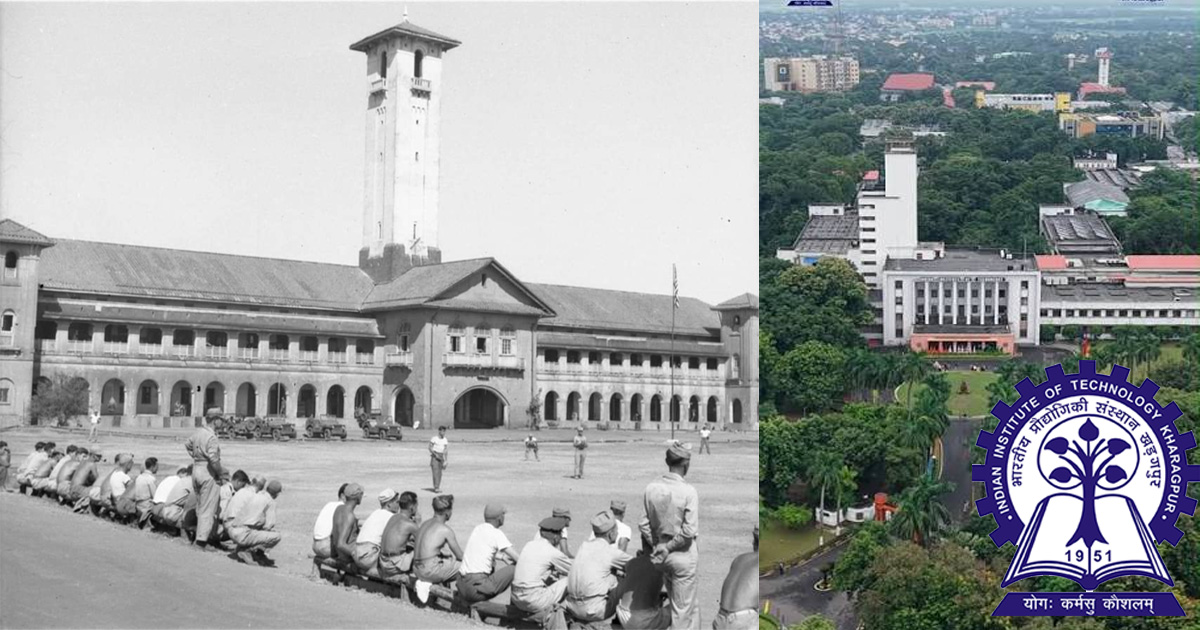
From Hijli Detention Camp to IIT Kharagpur | Image Source: IIT Kharagpur Foundation; Wikipedia
The story behind the establishment of India's first Indian Institute of Technology (IIT) is a fascinating one. It is deeply rooted in the struggles of India's freedom movement. The very place where the British colonial government once persecuted India's brave revolutionaries and unsuccessfully tried to silence their voices. It later became the birthplace of the nation's finest engineers. The building that once echoed with the clanking of the chains of freedom fighters began, just a few years later, to shape the dreams of future engineers. This is not merely the story of the establishment of an IIT, but also the historic transformation of a symbol of colonial oppression into one of the greatest centres of nation-building. That is why the history of IIT Kharagpur cannot be separated from India's freedom movement.
The story of IIT Kharagpur begins in 1930. By then, Bengal had become one of the principal centres of revolutionary activities against British rule. A large number of young men had joined the armed revolutionary movement. For the British, suppressing these revolutionaries had become an enormous challenge. After the revolutionaries captured the Chittagong Armoury, the British administration was deeply alarmed. Instead of keeping arrested revolutionaries in ordinary prisons, they planned to confine them in highly secure locations so they could be isolated from revolutionary organisations. As a result, special detention camps were established. One of them was the Hijli Detention Camp, set up in 1930, about 150 kilometres from Kolkata.
The British detained a large number of revolutionaries at Hijli, where they were subjected to severe brutality by the British police.
On 16 September 1931, British police shot dead two detained revolutionaries—Santosh Kumar Mitra and Tarakeswar Sengupta—inside the Hijli Detention Camp.
The incident shocked the entire nation. Netaji Subhas Chandra Bose personally travelled to Hijli to receive the bodies of the martyrs, while Gurudev Rabindranath Tagore, along with several other national leaders, strongly condemned this act of brutality by the British government.
The camp was subsequently closed in 1937, but it was reopened in 1940. However, following widespread protests, the British were ultimately forced to shut down the Hijli Detention Camp in 1942. During the Second World War, the camp was then taken over by the United States Air Force. Times changed.
When India attained independence in 1947, the country faced the enormous challenge of building a modern and self-reliant nation. To achieve this, there was an urgent need for higher technical education.
As part of this vision, in 1950, the historic building of the former Hijli Detention Camp was selected to house the country's first technical institute. In August 1951, the first academic session commenced with 224 students and 42 faculty members. Classes were held, laboratories were established, and administrative offices functioned in the very same building where freedom fighters had once been imprisoned.
Thus, India's first IIT began its journey from a former detention camp—an example that is considered extremely rare even in world history. At that time, the institution was known simply as the Technical Institute. In March 1952, the then Prime Minister Jawaharlal Nehru laid the foundation stone of a new campus, which was built adjacent to the Hijli building.
Later, on 15 September 1956, Parliament passed the Indian Institute of Technology (Kharagpur) Act, following which the Technical Institute was officially renamed the Indian Institute of Technology, Kharagpur (IIT Kharagpur). Today, IIT Kharagpur is recognised as one of India's finest technical institutions. The history of IIT Kharagpur stands as powerful proof that a nation can transform even its suffering into strength.
The Hijli Detention Camp was once a symbol of oppression, injustice, and colonial rule. Independent India transformed that very building into a centre of knowledge, research, and innovation. Perhaps that is the institution's greatest identity. Its foundation rests not merely upon bricks and stones, but upon the struggle and sacrifice of the freedom fighters who dreamed of an independent India. That is why the country's first IIT is not merely an institution of technical education—it is also a living symbol of India's historic journey from colonial subjugation to self-reliance.