Every Vote Matters: How Election Officials Trek 40 Kms Through Arunachal for Malogam’s Single Voter
Why would a team of election officials endure such a journey? To ensure that one woman in the remote village of Malogam, in Arunachal Pradesh's Anjaw district, can exercise her constitutional right to vote: Sokela Tayang.

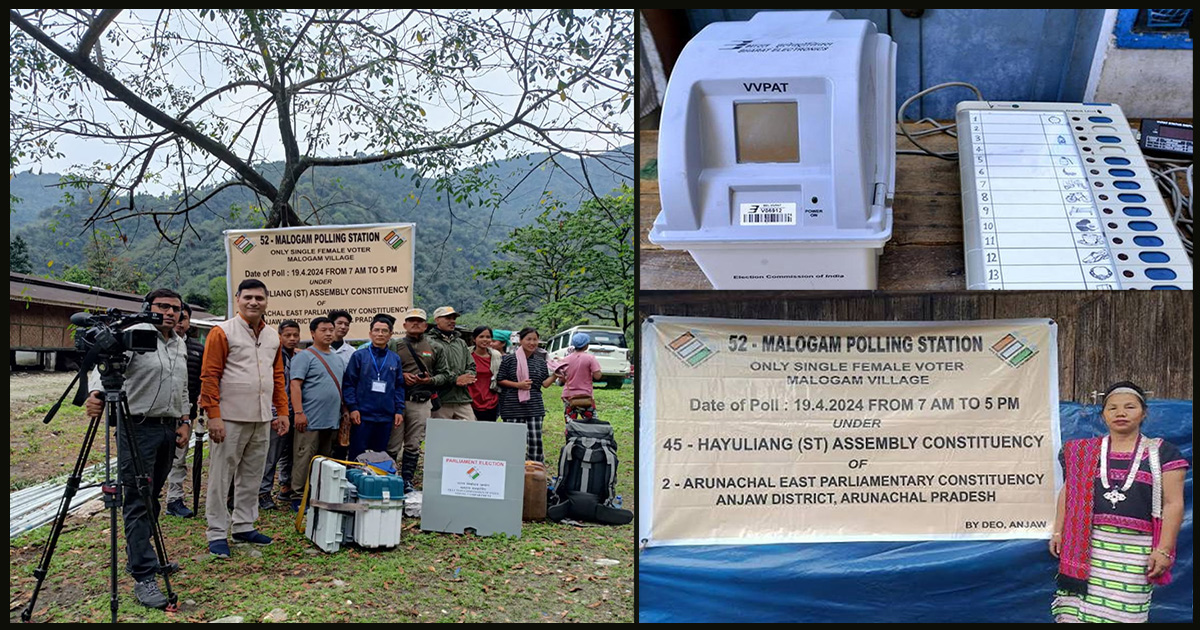
Election officials with Sokela Tayang in Arunachal Pradesh | Image Source: News 18 and The Hindu
An Electronic Voting Machine strapped to his back, election officer Gammar Bam carefully navigates a narrow mountain trail in the remotest reaches of Arunachal Pradesh. Behind him, his polling team follows, carrying election supplies through dense forests. Why would a team of election officials endure such a journey? To ensure that one woman in the remote village of Malogam, in Arunachal Pradesh's Anjaw district, can exercise her constitutional right to vote: Sokela Tayang. That is the quiet, extraordinary beauty of Indian democracy.
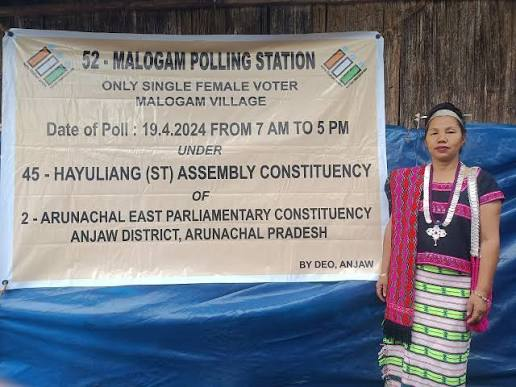
Malogam’s single voter, Sokela Tayang | Image Source: Facebook
The polling journey begins in Malogam at Hawai, the headquarters of Anjaw district, Arunachal Pradesh, where Bam and his team set off on a mission spanning four days, covering nearly 40 kilometres. On the first day, the first leg is by road, over the mountain routes and shaky bridges through the Eastern Himalayas. But eventually, the roads disappear. What follows is a demanding trek through dense forests, slippery mountain paths, and rugged cliffs. By dusk, they reach a modest hut where they halt for the night. There is no electricity, no toilet, and no mobile network. After a simple meal of rice and lentils, the officials spread out on a bamboo floor built above a chicken pen, knowing that polling day would begin long before sunrise.
At 5 a.m., while most of the country is still asleep, the team conducts the mandatory mock poll. Yes, even at a place with a single voter, because the Election Commission rules require 50 test votes to be cast before polling begins to ensure that the Electronic Voting Machine is functioning properly. By 7 a.m., the polling booth is officially open, and thus begins the wait for Sokela Tayang. Nearly an hour and a half later, their patience is rewarded when, at around 8:30 a.m., Sokela Tayang walks into the polling station to cast her vote.
An election official verifies her identity. Another marks her finger with indelible ink. She steps behind the voting compartment, presses the button on the Electronic Voting Machine, and within moments, the machine lets out its familiar beep. All of it takes less than two minutes. Yet the polling station does not close afterward. As required under Election Commission rules, it remains open until 5 p.m. Officials complete a detailed 67-point checklist, seal the voting machines, finish the statutory paperwork, and only then begin the long journey back through the mountains.
Sokela Tayang has been voting in general elections since 2004. At the time, Malogam still had several families. By the 2014 elections, however, only two registered voters remained—Sokela and her husband, Janelum Tayang. After he transferred his voter registration to another polling station, Sokela became the village's sole registered voter. She has remained the only elector in Malogam through the 2019 and 2024 general elections. Although Sokela Tayang spends much of her time away from Malogam, she has never considered changing her voter registration. She now lives for extended periods in Wakro, in Arunachal Pradesh's Lohit district, where she looks after her farmland and stays close to her children while they pursue their college education. Yet, when election season arrives, Tayang makes the journey back to Malogam. For her, the village is more than just a place on the electoral roll—it is her ancestral home. Determined to preserve that connection, she has repeatedly chosen not to transfer her voter registration to another polling station. Instead, she returns to Malogam to cast her vote.

Election officials with Sokela Tayang at a temporary polling setup in Malogam | Image Source: The Washington Post
At first glance, dedicating an entire polling station to one voter may seem excessive. But this is precisely the principle that underpins India's electoral process. The Election Commission of India operates on a simple philosophy: "No Voter to Be Left Behind." It seeks to ensure that every eligible citizen can vote, regardless of where they live. If geography prevents easy access, the polling station moves closer to the voter—not the other way around. This is the scale of the world's largest democratic exercise—not merely in numbers, but in commitment.
As the world observes International Democracy Day (September 15), the story of Malogam serves as a quiet reminder that democracy is not measured only by crowded polling booths or record voter turnouts. It is measured by a nation's willingness to ensure that even a single citizen, living in one of its most remote corners, is never denied the right to vote. Because in India, no vote is considered too small, and no voter is too distant.