When Guru Nanak Dev Ji Refused to Name a City After Himself & Dedicated It to 'Kartar' Instead
Around 1521–22 CE, Guru Nanak Dev Ji chose a place on the right bank of the Ravi River, in what is now the Narowal region of Pakistan.

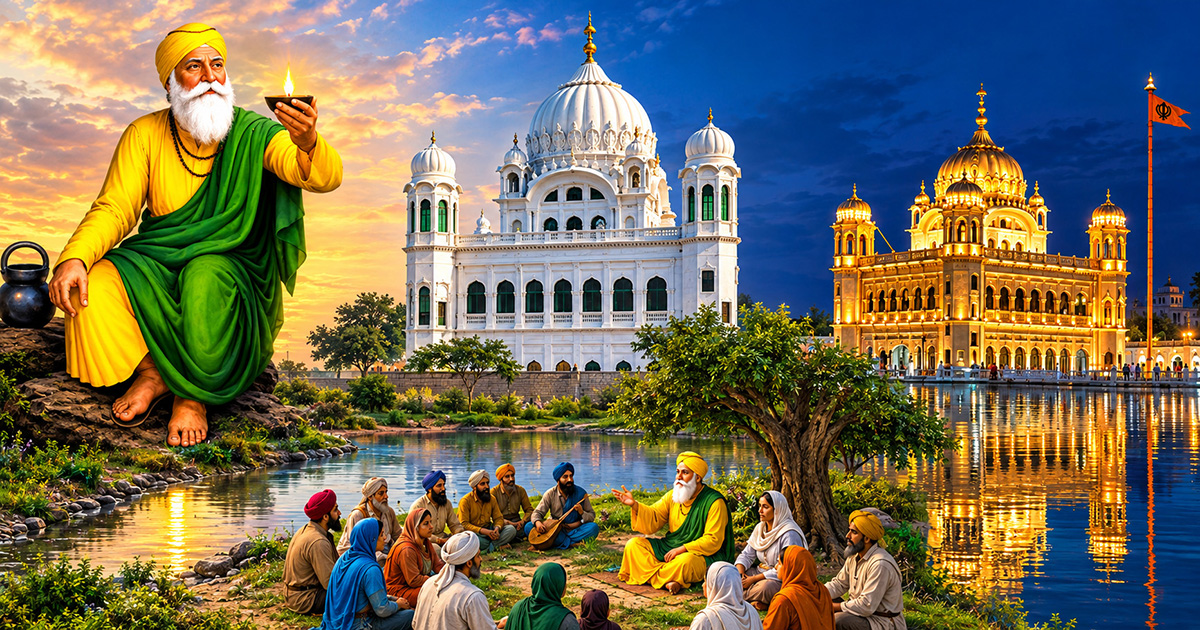
The city of Kartarpur | This image is AI-generated
Punjab, 16th century. It was the time when Guru Nanak Dev Ji decided to spend the final 18 years of his life at Kartarpur (now in Narowal district, Pakistan). According to historians, Guru Nanak Dev Ji undertook four major Udasis or spiritual journeys between 1499 and 1521–22. During these journeys, he travelled not only across the Indian subcontinent but also to Tibet, Sri Lanka, Mecca, Medina, and Baghdad. After completing these long journeys, he decided that he would no longer live in a royal palace or an ashram, but instead spend his life as an ordinary farmer.
Around 1521–22 CE, Guru Nanak Dev Ji chose a place on the right bank of the Ravi River, in what is now the Narowal region of Pakistan. The influential landlord and revenue officer of that region, Karori Mal, also known as Duni Chand, owned vast stretches of agricultural land around the Ravi. When Karori Mal heard that a fakir had set up camp near his land and that every day hundreds of people—Hindus, Muslims, traders, farmers, and people from every caste and community—were gathering to listen to his teachings, his pride was deeply hurt.
He decided that he would personally go and remove the saint from the area. He mounted his horse and set out from his house. Suddenly, the horse slipped, and he fell to the ground. Although he survived the fall, he had to return home. A few days later, he tried again. This time, while on the way, darkness suddenly descended before his eyes. His horse also refused to move forward. Strangely, the moment he turned back, his eyesight returned to normal.
The people accompanying him said, "Chaudhary, if you wish to visit a saint, go with humility, not with authority." These incidents shook Karori Mal to his very core. For the first time, he realised that he was perhaps not going to meet an ordinary person, but a great spiritual master whose power was far above worldly position and wealth.
The next time, he removed his shoes, abandoned his pride, and walked barefoot to Pakhoke, where Guru Nanak Dev Ji was staying in the company of his sangat. Upon meeting the Guru, Karori Mal said, "Baba Ji, all these fields, as far as the eye can see, belong to me." Guru Ji asked, "Karoriya, before you, who owned these fields?" He replied, "Baba Ji, before me, these fields belonged to my father." Guru Ji then asked, "And Karoriya, before your father, who was their owner?"
Karoriya became slightly anxious because he felt that Guru Ji was testing him. He thought carefully before replying, "Baba Ji, before my father, these fields belonged to my grandfather." Guru Ji then asked, "Karoriya Ji, tell me, where are they now?" (referring to his father and grandfather). Karoriya replied, "Baba Ji, they have left this world."
At that moment, he realised that the fields were not truly his, because one day he too would leave this world. Understanding the Guru's profound message, Karoriya respectfully bowed at Guru Ji's feet and requested permission to remain in his company for some time. He said, "Sachche Patshah! If you permit, I dedicate these more than 100 acres of my fertile land forever at the feet of you and your sangat. Please allow a new town to be established here."
Guru Ji accepted his request. But the most important chapter was yet to come. Karoriya then said, "Guru Ji, let this town be named 'Nanakpur,' so that future generations may remember your name." Guru Nanak Dev Ji replied, "The true Master of this world is not any human being—it is only Kartar. If a town is to be established, it shall also bear His name. This entire creation belongs only to that One Supreme Being—'Kartar' (the Creator of the Universe)." Thus, the town came to be known as 'Kartarpur'—the City of Kartar, the abode of the Creator.
With this thought, in 1522, the foundation of the town of Kartarpur was laid on the banks of the Ravi River. After this, Karori Mal, also known as Bhai Duni Chand, built a dharamshala and a house for Guru Nanak Dev Ji. Guru Ji started a small farm, which he ploughed and cultivated with his own hands. During the final years of his life, in his sixties and seventies, he personally worked in the fields and demonstrated the dignity and importance of honest labour.
Kartarpur did not remain merely a village. It became the first Sikh commune (ideal community). Here, Guru Nanak Dev Ji himself ploughed the fields and practised farming with his own hands. On 22 September 1539, Guru Nanak Dev Ji merged with the Eternal Light (Jyoti Jot) at Kartarpur. Thus, Kartarpur became not merely the place where he lived, but a living symbol of his teachings and philosophy.