Major Onkar Singh Kalkat: The Indian Officer Who Exposed Pakistan's 1947 'Operation Gulmarg'
This is a story of a daring escape across a Partition-ravaged landscape and an attempt to warn India's leaders of an impending attack on Jammu and Kashmir, then an independent princely state under Maharaja Hari Singh.

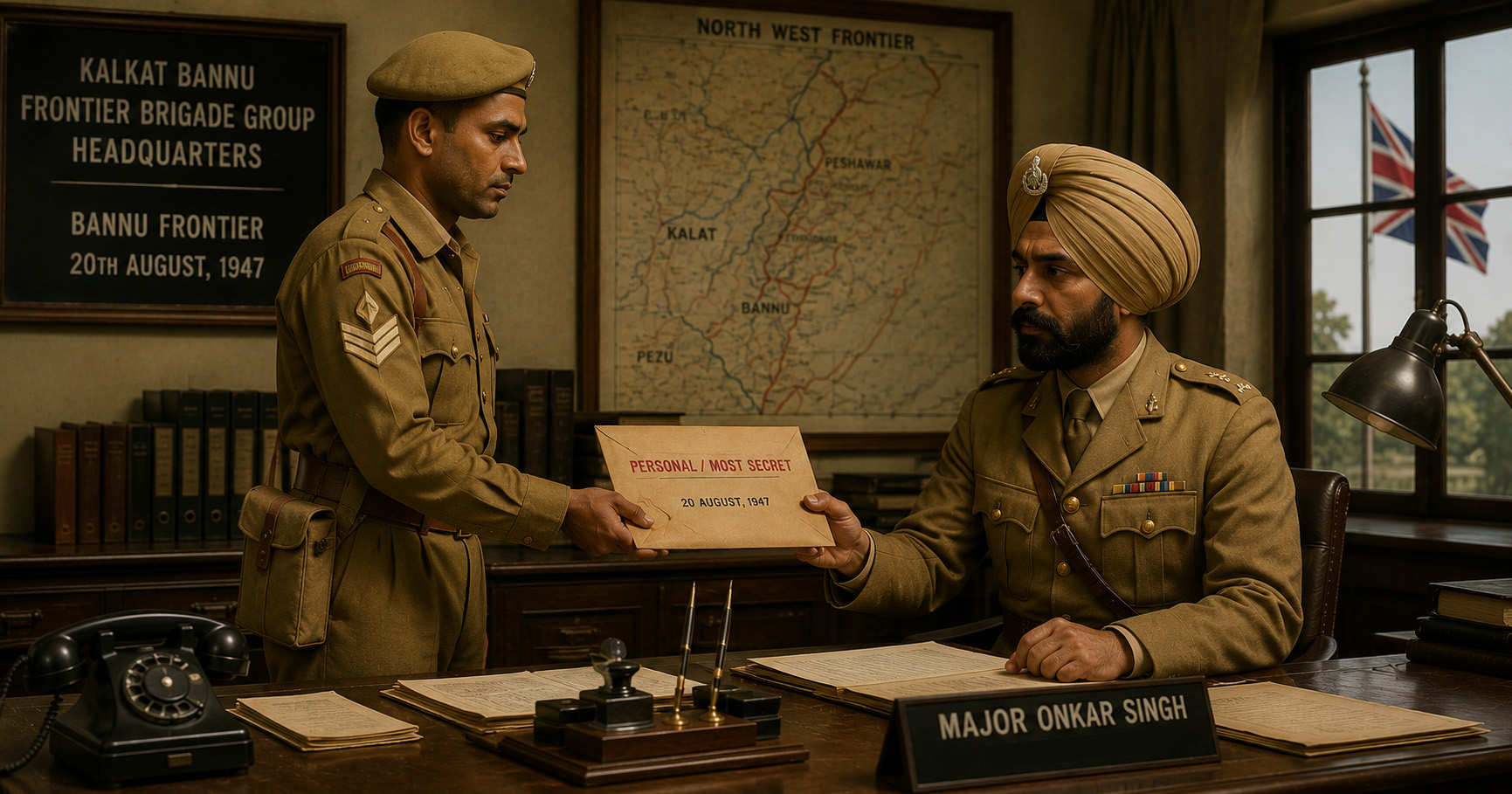
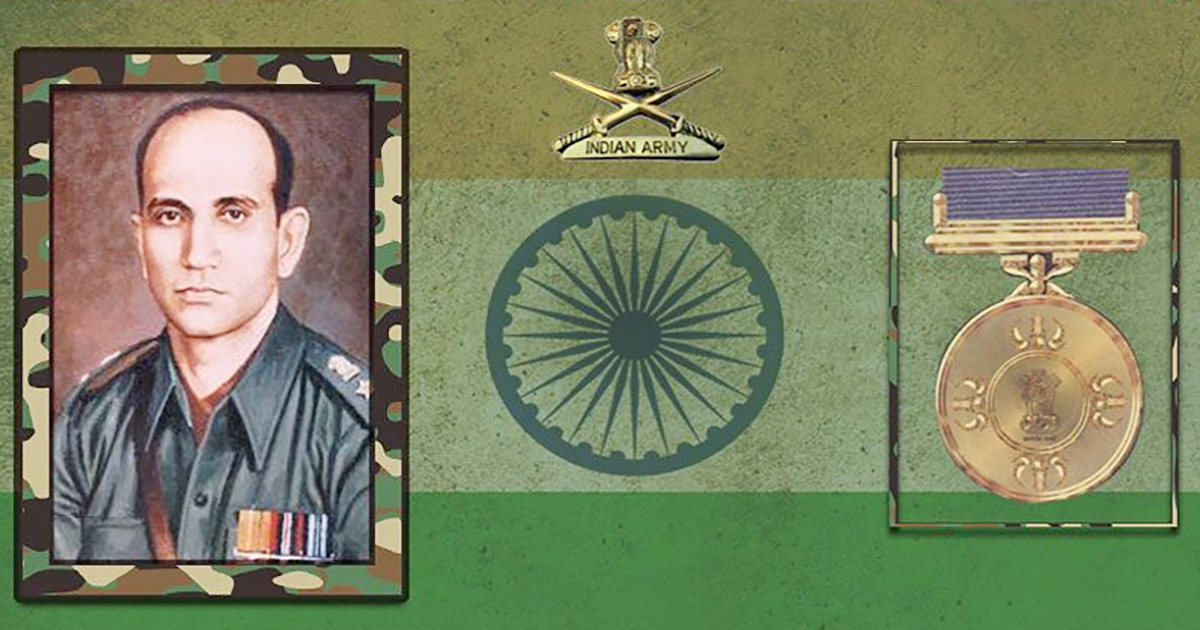
Major Onkar Singh Kalkat | This image is AI-generated
In the year 1947, amid the chaos of Partition, far away in the frontier town of Bannu in the North-West Frontier Province (present-day Pakistan), an Indian Army officer stumbled upon a secret letter detailing a blueprint for the invasion of Jammu and Kashmir, Operation Gulmarg. His name was Major Onkar Singh Kalkat. What followed was a story of a daring escape across a Partition-ravaged landscape, and an attempt to warn India's leaders of an impending attack on Jammu and Kashmir, then an independent princely state under Maharaja Hari Singh.
In 1947, Kalkat was serving as Brigade Major at the Headquarters of the Bannu Frontier Brigade Group. His commanding officer, Brigadier C.P. Murray, a British officer, was away on an official tour. On August 20, 1947, only five days after India's independence, a demi-official letter, marked “personal/top secret,” arrived carrying a confidential dispatch addressed to Murray. As per the customs, Kalkat was authorized to open official correspondence in his commander's absence. The letter that Kalkat thought of as just a routine military letter soon turned into one of the most explosive discoveries of a Pakistan-British conspiracy.
General Sir Frank Messervy, the Commander-in-Chief of the Pakistan Army, had sent the letter. Attached to it was a document titled "Operation Gulmarg"—a detailed blueprint for the invasion and capture of the princely state of Jammu and Kashmir. The plan was astonishing in its scale. Pakistan intended to raise around twenty tribal lashkars, each consisting of roughly a thousand Pashtun tribesmen. These forces would be armed, supplied, guided, and covertly commanded by officers of the Pakistan Army. The operation was reportedly coordinated by Major General Akbar Khan, who operated under the pseudonym "General Tariq." According to the document, the tribal columns were to invade Jammu and Kashmir, seize key towns, advance through Muzaffarabad toward Srinagar, and force the state's accession to Pakistan. The planned date of the invasion, as per the letter, was October 20, 1947.
Pakistan Army's attack map | Image Source: Jammu & Kashmir Now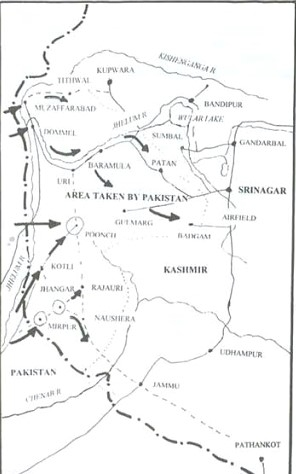
Upon reading the explosive letter, Kalkat understood that Pakistan was preparing a coordinated military operation to annex Jammu and Kashmir disguised as a “tribal uprising”. When Brigadier Murray returned to Bannu on August 21, Kalkat informed him of what he had found. Murray was reportedly alarmed and was aware that the letter could place Kalkat's life in danger. "Do not breathe a word about it to anybody, or else you will never be allowed to leave Pakistan alive,” Murray had told Kalkat.
Somehow, the Pakistani authorities became aware that Kalkat had knowledge of sensitive military plans and feared that he might pass the information to India. Hence, Kalkat was effectively placed under house arrest. However, a kind British Base Communication Officer helped him in planning an escape. Amid the chaotic atmosphere during partition, disguised, he successfully slipped out unnoticed and managed to board a goods train heading toward India. He eventually reached Ambala on October 18, 1947. From Ambala, he again boarded a train to reach Delhi so that he could inform the top military personnel there. Upon reaching Delhi, he met Defence Minister Sardar Baldev Singh, Brigadier Kalwant Singh, and Colonel P.N. Thapar the next day, October 19. He explained to them all the details of Operation Gulmarg. But the response was deeply disappointing. The Indian officials dismissed Kalkat’s revelation, saying that Pakistan couldn't hatch such a plan, while others viewed it as exaggerated. Kalkat's evidence failed to trigger any major preventive action.
A couple of days later came the day of invasion. On October 22, 1947, tribal forces supported by Pakistan and the British crossed into Jammu and Kashmir exactly as Kalkat had warned. They advanced through Muzaffarabad, overwhelmed local defenses, and moved toward Srinagar. They orchestrated atrocities and looting against the civilians. What Kalkat had warned the Indian officials was unfolding on the ground.
Precursor to Pakistan’s invasion of Jammu & Kashmir | Image Source: Bhaskar
Facing the collapse of his state, Jammu and Kashmir, Maharaja Hari Singh signed the Instrument of Accession on October 26, legally acceding Jammu and Kashmir to India. Only after the accession was signed, India lawfully deployed its armed forces into the state. The following day, Indian troops were airlifted into Srinagar in a dramatic operation that prevented the city from falling to the invading forces. When Prime Minister Jawaharlal Nehru learned that Major Kalkat had warned officials weeks earlier, he was furious that the information had not been taken more seriously. By then, however, the opportunity for preventive action had passed, and the rest remains history.
Indian troops in Jammu & Kashmir after the signing of Instrument of accession | Image Source: Jammu & Kashmir Now
Today, nearly eight decades later, the consequences of those events continue to shape the geopolitics of South Asia. Yet amid the larger story, the courage of Major Onkar Singh Kalkat remains a remarkable chapter. He was the officer who uncovered Pakistan's secret plan, dared to expose it, and stood as one of the earliest witnesses to a Pakistan-British conspiracy whose echoes are still heard across the region. Had his revelations been taken seriously, history would have been starkly different.