Durgadas Rathore and the 30-Year Struggle Against Aurangzeb That Saved Marwar
Whenever a Hindu king died, Aurangzeb stole the kingdom, banned temples, forced jizya tax, and crushed the land. But Marwar had Durgadas Rathore. A man who became Marwar’s greatest defender.

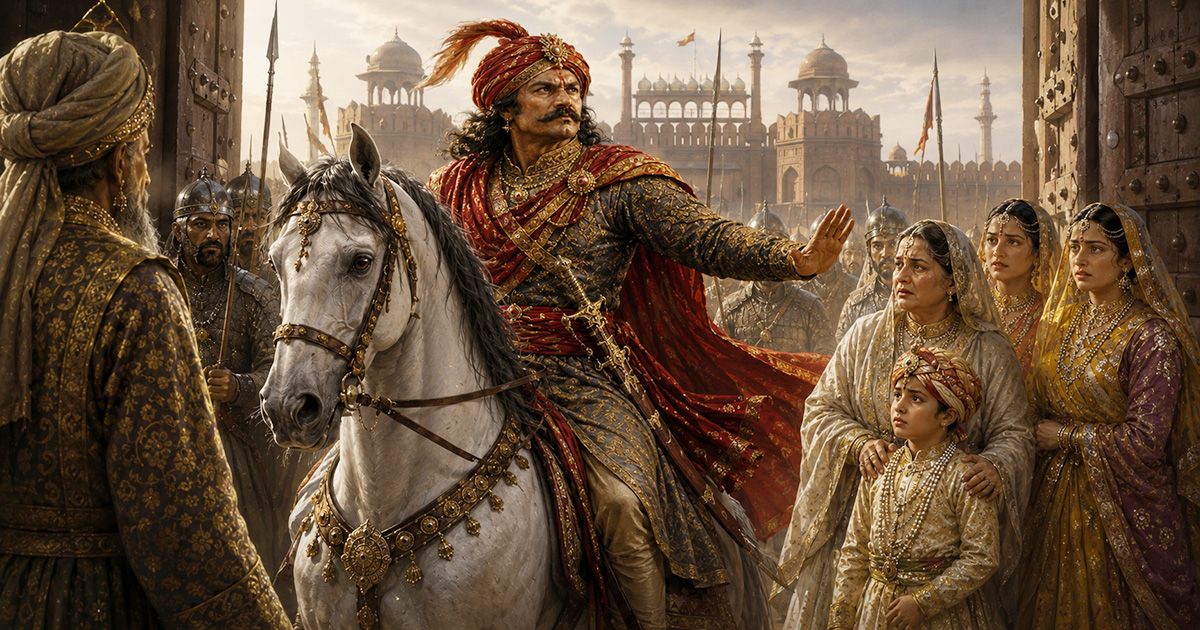
Durgadas Rathore, the man who saved Marwar | This image is AI-generated
Tragedy struck in Marwar when Maharaja Jaswant Singh died in 1678. Seizing an opportunity, Aurangzeb acted immediately. Without waiting for the kingdom to choose an heir, he occupied Jodhpur and annexed Marwar into the Mughal Empire. To him, Marwar was no longer a kingdom; it was a conquered province. This was Aurangzeb's cruelty: whenever a Hindu king died, he stole the kingdom, banned temples, forced jizya tax, and crushed the land. But Marwar had Durgadas Rathore. A man who became Marwar’s greatest defender.
Born on August 13, 1638, in Salwa village, he was the son of Askaran Rathore, a minister in Jaswant Singh’s court. Raised in the royal durbar, Durgadas was trained in warfare, diplomacy, and the Rajput code of honor from an early age. By 1658, he was already serving as a commander under Jaswant Singh, participating in Mughal campaigns in the Deccan and earning a reputation for courage and leadership.
A few months after Jaswant Singh died, his queen gave birth to a baby boy, Prince Ajit Singh. He was the true king of Marwar. His very existence threatened Aurangzeb’s plans and demanded that the young prince be granted the kingdom only if he was taken into Mughal custody, converted to Islam, and raised within the imperial harem under the emperor's supervision. To the Rajputs, this was more than politics; it was an assault on their faith, honor, and identity. He sought to extinguish Marwar’s independence by controlling its future king before he could even speak. Refusing to submit, Durgadas Rathore became the shield between Aurangzeb and the baby Prince. In 1679, he launched one of the most daring rescue missions: the Rathore Rebellion, 1679–1707. He rode to Delhi, the heart of Aurangzeb's empire, where the widowed queens and the infant Prince were being held under strict Mughal surveillance.
Inside a heavily guarded mansion, a loyal noblewoman, Bagheli Rani, made the ultimate sacrifice. She exchanged Prince Ajit Singh with her own infant daughter, who the Mughals later killed. Meanwhile, the widowed queens cut their hair, wore armor, and dressed like men. At night, Durgadas took them out of Delhi. When the Mughals found out, guards unleashed a fierce hunt. Rajput warriors fought to the death in Delhi’s streets, blocking gates and sacrificing themselves. Out of 300, only seven people escaped. Durgadas was one of them, with baby Ajit Singh safe in his arms. Aurangzeb was furious, sent thousands of soldiers and spies across Marwar to find one child. They burned Marwar’s villages and tortured people. Yet Durgadas consistently stayed one step ahead. He did not hide Ajit Singh in a royal fort. He took him to the Aravalli Hills. There, with the help of Bhil tribes and common people, he kept the prince safe.
Durgadas Rathore carries baby prince Ajit Singh safely away from the Mughals | This image is AI-generated
From these rugged mountains, Durgadas and his Rajput warriors waged a relentless guerrilla campaign. For 28 years, Durgadas fought Aurangzeb. They attacked Mughal camps at night and disappeared before sunrise, stopped tax money from reaching Delhi, and freed Marwar’s people from jizya. Every general Aurangzeb sent to Marwar came back defeated. Year after year, the conflict drained Mughal resources and morale. Durgadas united Rajput resistance, preserved the loyalty of Marwar’s people, and ensured that the rightful heir remained alive.
His struggle was not merely military; it was a fight to preserve the identity, honor, and independence of Marwar against an emperor determined to erase them. But it was Aurangzeb who lost sleep. He wasted his army, his gold, and his life chasing Durgadas. This was not just war. This was a fight for faith. Aurangzeb wanted Ajit Singh to read the Quran. Durgadas made sure he learned the Bhagavad Gita.
Nearly three decades later, in 1707, Aurangzeb died, and the Mughal Empire fell. Recognizing the moment, Durgadas attacked, and the Mughals were thrown out of Marwar, and Ajit Singh was finally restored to the throne of his ancestors.
The child whom Aurangzeb had sought to control, convert, and erase became Maharaja of Marwar. For Durgadas Rathore, the victory was more than political; it was the fulfillment of a promise made nearly thirty years earlier, and a testament to the determination of a people who refused to surrender their kingdom, their faith, or their identity. His last words to Ajit Singh were: “Marwar is yours now. Never bow again.”