Madan Lal Dhingra’s Defiant Trial in London: When He Challenged British Rule in Court in 1909
What Madan Lal Dhingra said in defense of Curzon Wyllie’s assassination made it clear that it was not Dhingra who stood accused in the dock—it was the imperial British regime itself.

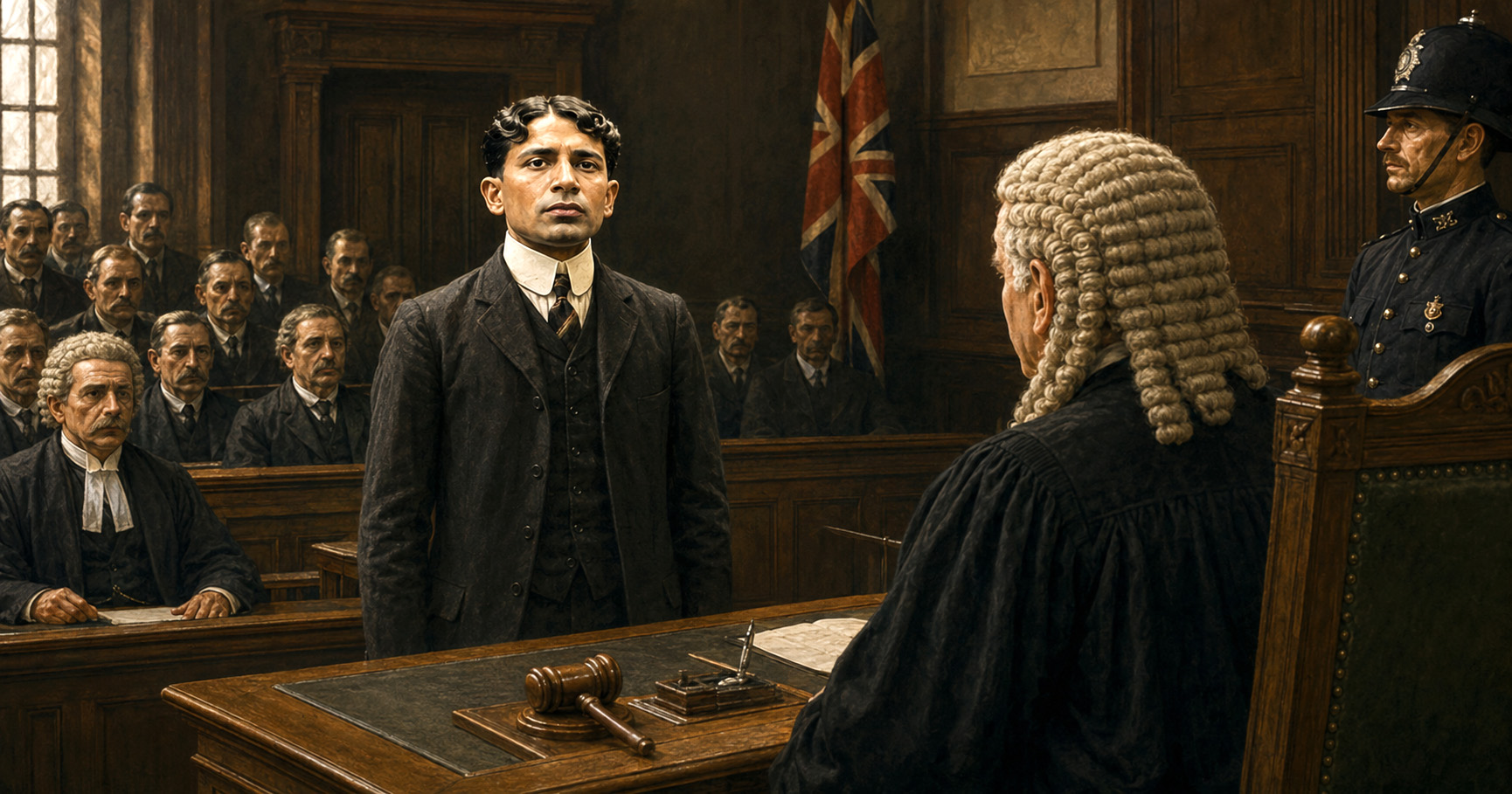
Madan Lal Dhingra's defiance in the British court | This image is AI-generated
That day, silence hung heavily over the courtroom in London. Seated before him were some of the most powerful judges of the British Empire. British officials filled the room, and standing in the dock was a 25-year-old Indian youth. He was being tried for the assassination of Sir William Hutt Curzon Wyllie, a senior British military officer and political aide. The British authorities were confident that the young man would bow before the court, express remorse for his actions, and plead for mercy to save himself from punishment. But what happened in the next few minutes shook the foundations of the British Empire. Instead of offering a defense, the young man challenged the very legitimacy of British justice. That young man was none other than the great Indian revolutionary, Madan Lal Dhingra. What he said in defense of Curzon Wyllie’s assassination made it clear that it was not Dhingra who stood accused in the dock—it was the imperial British regime itself.
The incident took place in July 1909. During a gathering at London’s Imperial Institute, Madan Lal Dhingra shot and killed Sir William Hutt Curzon Wyllie. He was immediately arrested and brought before the court. As soon as the judge read out the charge of “wilful murder,” Dhingra interrupted and declared: “That term does not apply to me. I have committed no crime. What I have done was an act of patriotism and justice.”
The judges repeatedly asked him to answer according to legal procedure, but Dhingra’s perspective was entirely different. He stated clearly that he did not recognize British law and regarded the proceedings as part of a political struggle. According to him, this was not a case of personal crime but a symbol of resistance against India’s enslavement.
Dhingra was so steadfast in his convictions that he refused to appoint a lawyer for his defense. He stated that although every accused person had the right to legal representation under British law, he would not exercise that right because he did not recognize British authority in any form.
He believed that expecting justice from a government that had enslaved India was meaningless. That is why he neither cross-examined witnesses, nor challenged the prosecution’s arguments, nor presented any legal defense to avoid punishment. His only aim was to convey his message to the world.
When the court finally gave him an opportunity to make a statement, Dhingra delivered a speech that immortalized him in the history of India’s revolutionary movement. He declared: “No British court has any right to arrest me, imprison me, or sentence me to death.”
It was a direct challenge to the legitimacy of British rule. Dhingra argued that if it was considered patriotic for an Englishman to fight against German occupation of Britain, then it was even more patriotic for an Indian to fight against British occupation of India. He accused the British Empire of economically exploiting India, executing revolutionaries, and committing atrocities against the Indian people. Exposing what he described as the brutality of British rule, he stated that the British were responsible for the deaths of millions of Indians and extracted enormous wealth from the country every year. He made it clear that he had not come to beg for mercy. He had come to prove the justice of his cause.
The impact of his statement was so powerful that the British government subsequently restricted the publication of reports related to his trial. Eventually, the court found him guilty. Only the final formalities remained.
The court clerk asked whether he had any reason why the death sentence should not be pronounced against him. This was the moment when Madan Lal Dhingra delivered his greatest challenge to British law.
In a fearless voice, he replied: “I have repeatedly told you that I do not recognize the authority of this court. You may do whatever you wish. I have no objection. You may sentence me to death.”
Those present in the courtroom were stunned. Here stood a man facing certain death, yet completely unshaken in his convictions. Dhingra’s final words in court were: “Today the English may be powerful, but one day the turn of Indians will come.”
The court then sentenced him to death. Yet even after the verdict was announced, there was no trace of fear on Madan Lal Dhingra’s face. As he was led out of the courtroom, he proudly declared: “Thank you. I am honored to lay down my life for my motherland.”
These were not merely the final words of a revolutionary; they were the voice of enslaved India itself. Madan Lal Dhingra never attempted to prove his innocence because his goal was not to escape punishment. His purpose was to tell the world that the revolutionaries fighting for India’s freedom did not regard British rule or British law as legitimate. Standing in a courtroom in London—the very heart of the British Empire—he challenged the British judicial system with extraordinary courage. That defiance ensured that his name would be remembered forever in the history of India’s struggle for independence.