India’s First Judicial Execution: Raja Nandakumar’s ‘Judicial Murder’ & the Bloody Game of the British
In March 1775, Nandakumar presented documentary evidence before the Supreme Council of Calcutta. He accused Hastings of accepting a bribe of approximately ₹3,54,105.

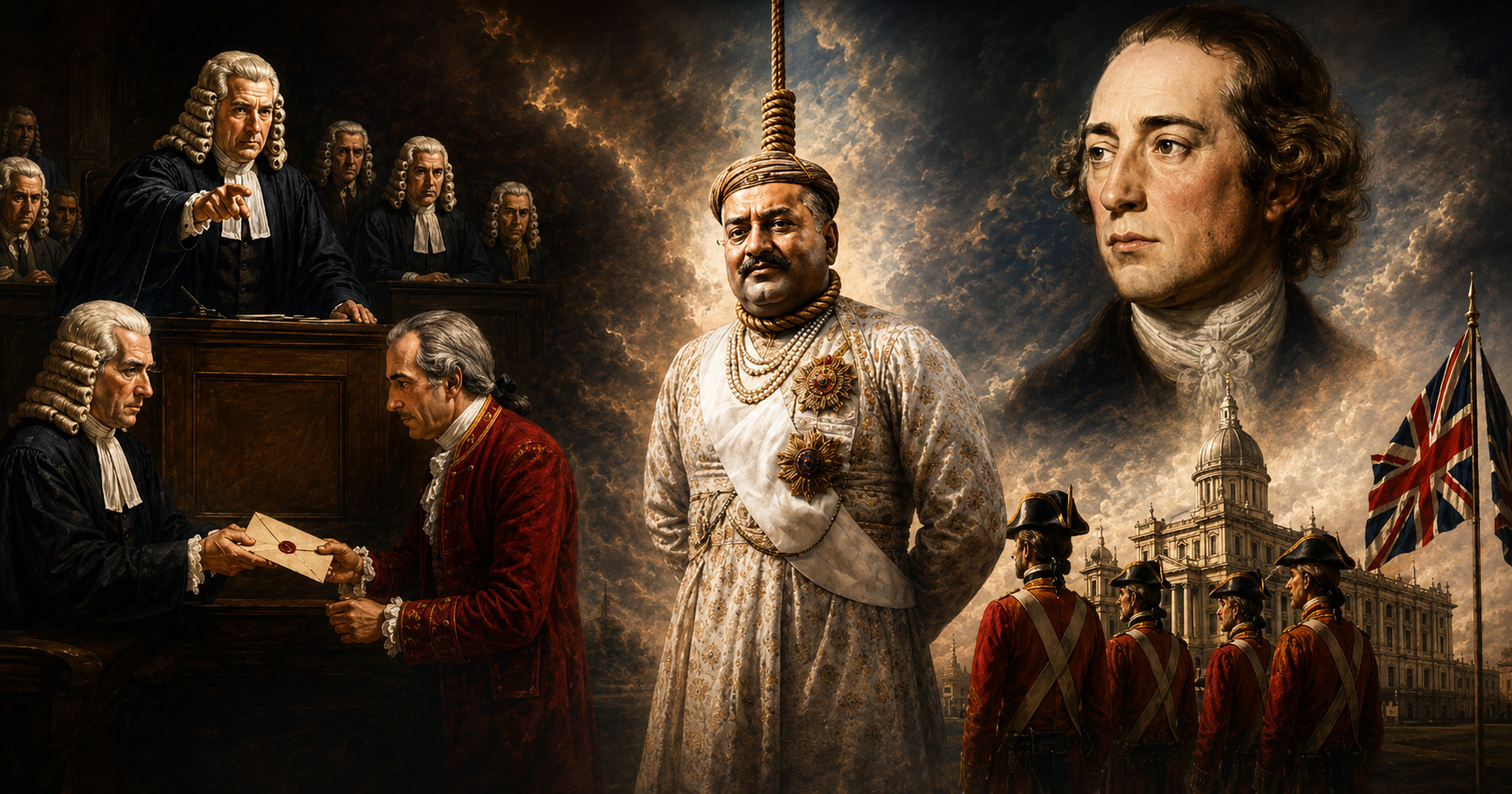
Maharaja Nandakumar | This image is AI-generated
The year was 1775. A massive crowd had gathered in Calcutta. A respected Indian official was about to be hanged. His crime was neither murder, robbery, nor treason. His greatest offense was exposing the corruption of the most powerful man in British India, Governor-General Warren Hastings. Raja Nandakumar was an influential administrator and revenue officer in Bengal. He had worked with the East India Company for years and had closely observed Bengal’s politics. In 1774, when Warren Hastings became the first Governor-General of British India under the Regulating Act, few could have imagined that within months, serious allegations of bribery would emerge against him.
In March 1775, Nandakumar presented documentary evidence before the Supreme Council of Calcutta. He accused Hastings of accepting a bribe of approximately ₹3,54,105 from Munni Begum, the widow of Mir Jafar, Nawab of Bengal. In return, Munni Begum had allegedly been appointed guardian of the Nawab’s minor heir, Mubarak-ud-Daula. At the time, this position was not merely honorary—it carried significant control over Bengal’s royal treasury and administrative appointments.
Members of the Council, including Philip Francis and General Clavering, took the allegations seriously. An inquiry was launched, and Hastings was even fined. For the first time, it appeared that the most powerful official in British India might lose his position because of corruption charges. But then the course of events changed dramatically. Hastings turned to the court of his old friend, Sir Elijah Impey, the Chief Justice of the Supreme Court of Calcutta. At that moment, an old case was suddenly revived. A man named Mohan Prasad, a wealthy local merchant, accused Nandakumar of forging a document in 1765. The case was nearly ten years old and had attracted little attention. However, as soon as Nandakumar produced evidence against Hastings, the forgotten accusation resurfaced in court.
The trial was conducted before an all-English jury. Nandakumar was prosecuted under Britain’s Forgery Act of 1728. The defense arguments received little consideration. Ultimately, the twelve English jurors found him guilty and sentenced him to death by hanging.
On the morning of 5 August 1775, Raja Nandakumar was hanged in Calcutta. He became the first Indian to be executed by order of a British court. Along with him, it seemed that the corruption charges against Hastings were also dropped. The investigation into the Governor-General gradually faded away.
But the story did not end there. Years later, when Warren Hastings returned to England, impeachment proceedings were initiated against him in the British Parliament. Leaders such as Edmund Burke and Charles James Fox raised the Nandakumar case and described it as a clear case of “Judicial Murder.” Historians also questioned why a ten-year-old forgery case had been reopened precisely when Nandakumar exposed the Governor-General’s corruption.
Another important figure in the background of this story was Mir Jafar. It was the same Mir Jafar who had betrayed Nawab Siraj-ud-Daulah during the Battle of Plassey and helped the British gain control over Bengal. His betrayal strengthened the foundations of the British Empire in India, and nearly two decades later, corruption allegations connected to his family placed Maharaja Nandakumar directly in the crosshairs of British authority.
The execution of 5 August 1775 was not merely the death of one individual. It was a moment that demonstrated how, under colonial rule, courts could sometimes become instruments of political power. That is why Maharaja Nandakumar’s death is remembered in Indian history not simply as a judicial verdict, but as a “Judicial Murder.”