The Battle of Haifa: When 600 Indian Horsemen Cavalry Defeated Ottoman Empire in 1918
On September 23rd, 1918, the force advancing towards Haifa possessed a weapon that modern warfare had begun to regard as obsolete—horses, swords, and long lances.

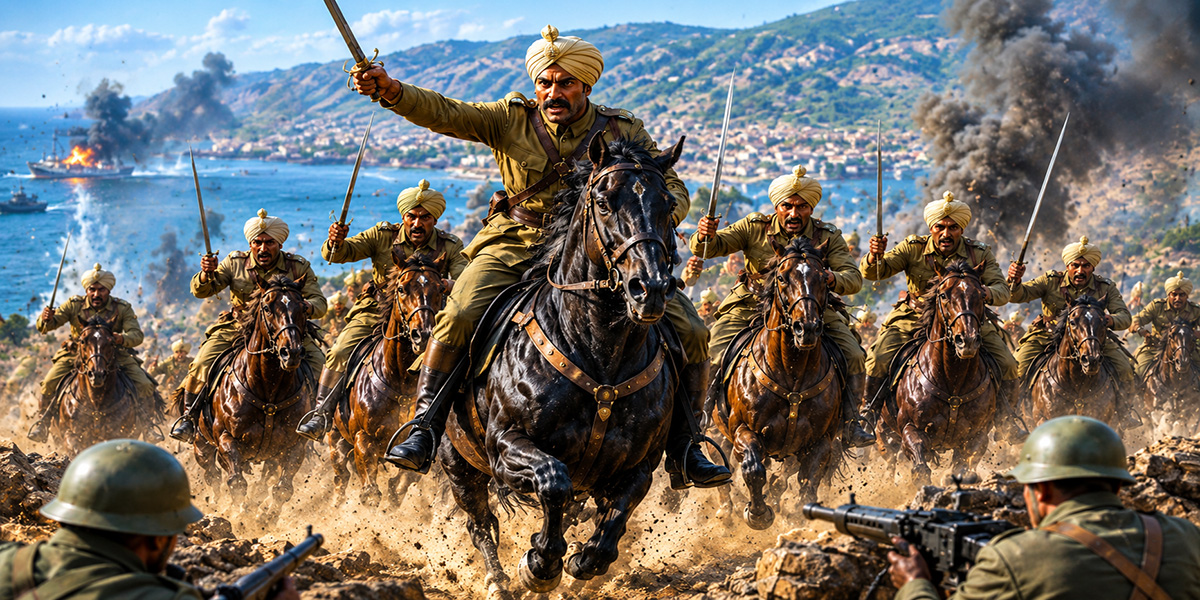
Battle of Haifa | This image is AI-generated
The First World War was in its final stages. In Palestine, the Ottoman Empire's forces were steadily retreating, but Haifa remained a formidable military challenge. The city was protected by the Kishon River in front, the heights of Mount Carmel behind it, and strong enemy artillery, machine guns, and defensive positions in between. Earlier attempts by British armoured cars and infantry units had failed to achieve a decisive breakthrough in the area.
However, on September 23rd, 1918, the force advancing towards Haifa possessed a weapon that modern warfare had begun to regard as obsolete—horses, swords, and long lances. Riding them were the Jodhpur Lancers and the Mysore Lancers of India. Within just a few hours, they proved that, with the right terrain, speed, and courage, cavalry could still defeat an enemy armed with machine guns and artillery.
The operation to capture Haifa was assigned to the 5th Cavalry Division. Its 15th Imperial Service Cavalry Brigade comprised the Jodhpur, Mysore, and Hyderabad Lancers. However, on September 23rd, the Hyderabad Lancers were positioned about 50–60 kilometres behind the main action. As a result, the decisive assault on Haifa was carried out primarily by the Jodhpur Lancers, while the Mysore Lancers provided crucial fire support and advanced from another direction.
Haifa's geography made the battle exceptionally difficult. The area between the Kishon River and Mount Carmel was protected by enemy artillery and machine guns. The Indian cavalry had to advance across open ground against troops equipped with modern weapons. The Ottoman forces possessed field artillery and machine guns, while the Indian cavalrymen relied mainly on traditional weapons—long lances and swords.
Yet the Indian commanders turned this apparent disadvantage into their greatest strength. Their objective was not to advance slowly under enemy fire but to attack with such speed and from such directions that the enemy would be unable to make effective use of its heavy artillery and machine guns.
The Jodhpur Lancers entered the battle with around 300 horses, while the Mysore Lancers deployed about 250 horses on the hills overlooking the city. In total, more than 600 horses of the 15th Imperial Service Cavalry Brigade were engaged in the Haifa operation. As part of the plan, a squadron of the Mysore Lancers climbed the difficult slopes of Mount Carmel to attack the Austrian field gun battery positioned there. They were supported by a squadron of the Sherwood Rangers Yeomanry and artillery units. Their objective was clear: to silence the guns firing upon the advancing Indian cavalry from the heights.
The Mysore troops advanced along the difficult route and captured the elevated position. This action weakened a crucial element of Haifa's defensive system and opened the way for the advance of the Jodhpur Lancers. Meanwhile, the Jodhpur Lancers launched the main assault. Their objective was to break through the enemy's rearguard position that blocked the road to Haifa.
This was not a conventional cavalry charge. The Indian soldiers had to cross a railway line, move through the difficult terrain surrounding the river, and advance under machine-gun and artillery fire. The marshy and sandy ground near the river also slowed the horses. When the direct route was blocked, the Lancers altered their course and turned towards the lower slopes of Mount Carmel.
This was the moment when the mobility of the cavalry proved decisive. Instead of becoming trapped in a fixed direction, they continuously adjusted their formation and route according to the terrain as they advanced. The assault by the Jodhpur Lancers was even more remarkable because they were facing an enemy equipped almost entirely with modern weapons. Machine guns targeted both the horses and the cavalrymen.
Artillery shells rained down from the heights. Yet the Lancers never lost their momentum. The greatest strength of cavalry lies in its speed and shock effect. When mounted troops advance rapidly in a well-organised formation, the distance between them and the enemy closes so quickly that machine-gun crews and artillery batteries often have very little time to respond effectively.
That is precisely what happened at Haifa. The Indian cavalry did not allow the enemy enough time to maintain sustained long-range fire and instead forced its way directly into the defensive positions. Throughout the operation, coordination and battlefield formation were the most important factors. The Mysore Lancers did far more than merely provide support from the rear—they played a vital role in suppressing the enemy artillery positioned on the heights.
At the same time, the Jodhpur Lancers used speed and shock to spearhead the main assault. The artillery on the heights was targeted first, followed by the attack on the principal defensive line, and finally a rapid advance into the city itself. The assault was therefore not a single mass of cavalry charging in one direction, but a carefully coordinated operation in which different units performed different roles—one neutralised the enemy's artillery, another broke through the main defensive line, and a third advanced swiftly into the city once the breakthrough had been achieved.
After the Jodhpur Lancers entered the city, the Mysore Lancers, who had until then been providing fire support, mounted their horses and followed them into Haifa. In this way, the operations of both Indian regiments merged seamlessly. Together, the two regiments captured approximately 1,350 German and Ottoman soldiers.
They also seized a large number of artillery guns and machine guns. According to available military records, on the Indian side, 8 soldiers were martyred, and 34 were wounded, while 60 horses were killed and 83 were wounded. The Battle of Haifa was won by the Indian cavalry in a single day. The victory was especially significant because warfare was changing rapidly during that period.
Machine guns, artillery, and armoured vehicles were becoming dominant on the battlefield, while the importance of cavalry was steadily declining. Despite this, the Indian Lancers secured victory through their speed, sound strategy, understanding of the terrain, and outstanding coordination. They denied the enemy the opportunity to fight on its own terms.
Where armoured cars and infantry had stalled before the enemy's strong defensive positions, the Indian cavalry advanced with extraordinary speed and changed the course of the battle through sheer momentum. The victory at Haifa on 23 September 1918 proved that even against an enemy equipped with modern weapons, traditional military arms could still achieve decisive success—provided they were led with courage, fought in disciplined formations, and launched their attack at the right moment.
At Haifa, the Indian Lancers did not merely capture a city. They secured their place in military history at a time when the world had begun to believe that the age of the horse and the lance had come to an end.