National Defence Academy's Sudan Connection: Why Sudan Gifted £100,000 to India After World War II?
On October 6, 1949, when the foundation stone of the National Defence Academy was laid in Khadakwasla, Pune, it marked the beginning of what would become the world's first tri-service military academy.

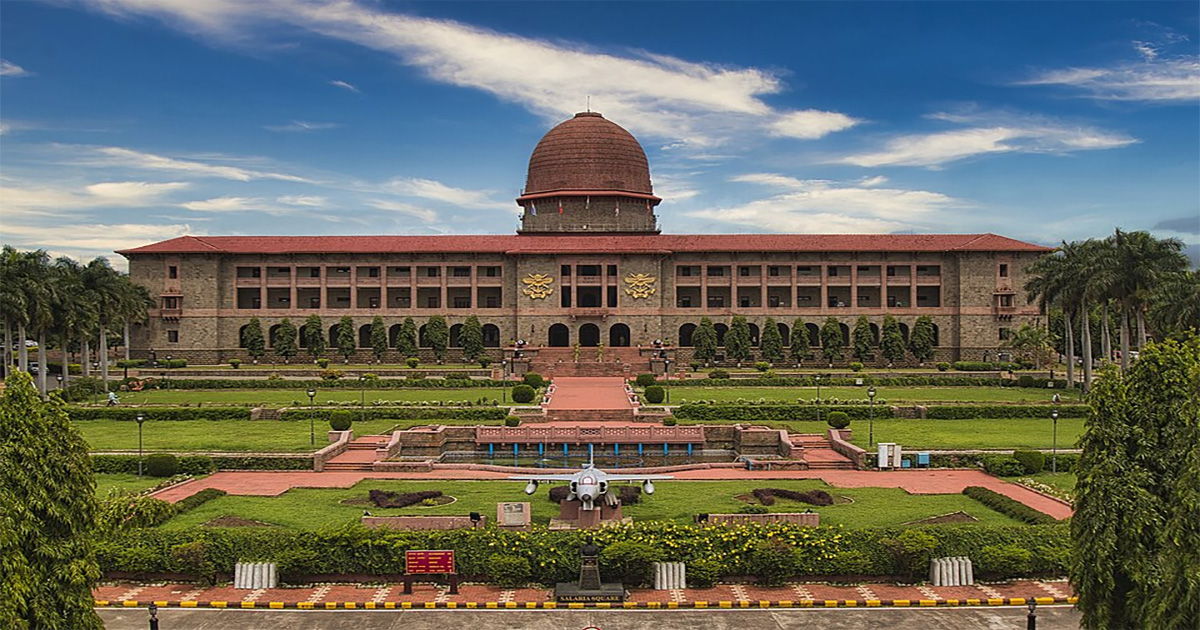
The National Defense Academy's Sudan Block | This image is AI-generated
On October 6, 1949, when the foundation stone of the National Defence Academy was laid in Khadakwasla, Pune, it marked the beginning of what would become the world's first tri-service military academy. But only a few know that the academy has a Sudanese connection, a country nearly 4,000 kilometres away from India. So, how did an African nation become linked to India's military academy? The connection goes back to the year 1941.
The National Defence Academy Sudan Block | Image Source: Wikimedia Commons
During World War 2, Axis powers (prominently Germany, Italy, & Japan) threatened British-controlled territories across East Africa, including Sudan. Italian forces launched offensives towards Sudan. At the time, Sudan held strategic importance as it formed a gateway to Egypt and the Red Sea, which were used as supply routes to India and the wider British Empire. Hence, the British had to defend it, and for this, the British relied heavily on the Indian Army—the largest volunteer army in the world.
The 4th and 5th Indian Infantry Divisions, along with supporting units, were deployed to Sudan. Indian engineers worked under harsh desert conditions to construct roads, clear minefields and lay railway tracks that enabled Allied forces to maintain momentum across difficult terrain. Indian troops reinforced the Sudan Defence Force, defended Port Sudan, halted the Italian advance at border towns such as Gallabat and Gedaref, and eventually launched a massive counteroffensive that drove the Italians out of Sudan and into Eritrea, a city to the east of Sudan. One of the fiercest battles of the campaign unfolded at Keren, Eritrea. For nearly two months, between February and March 1941, Indian soldiers fought uphill against heavily fortified Italian positions, which military historians regard as one of the hardest-fought battles.
Throughout the entire East African Campaign, more than 4,800 Indian soldiers had been killed or wounded, underscoring the scale of India's contribution to securing Sudan and defeating Italy in East Africa.
Indian troops defend Sudan against Italy in World War 2 | Image Source: India Today
The courage displayed by Indian troops did not go unnoticed by the Sudanese authorities. In 1941, the Government of Sudan presented £100,000 (approximately ₹14 lakh at the time) to Lord Linlithgow, the then-Viceroy of India. The donation was intended to build a war memorial honouring the sacrifices made by Indian soldiers during the liberation and defence of Sudan.
Following the Partition of India in 1947, the donated amount was divided between India and Pakistan, wherein approximately £70,000 (approximately ₹9.33 lakh) remained with India, while £30,000 (approximately ₹4 lakh) was allocated to Pakistan.
Since India, at that time, was working towards creating a joint military academy where future officers of the Army, Navy and Air Force could be trained together, the country decided to use the donated amount for the same. Rather than building a separate war memorial, the government chose to incorporate the donation for creating the same—the National Defence Academy. India used its share of the donated funds to construct the NDA's central administrative building, naming it the Sudan Block to ensure that the wartime bond between India and Sudan would remain permanently etched into the NDA's identity. The rest of the construction was financed through contributions from Indian states and the Ministry of Defence. The academy's overall construction eventually cost about ₹6.45 crore.
Today, the Sudan Block houses the Commandant's office, administrative headquarters, academic sections and ceremonial halls. It is the academy's most recognisable landmark and serves as the symbolic heart of the institution, appearing prominently during passing-out parades and official ceremonies. Every year, on October 6, the establishment of the National Defence Academy is remembered as a milestone in India's military history. Yet hidden within its grand campus is an extraordinary international story. The National Defence Academy’s Sudan Block is not merely an administrative building. It is a living memorial born from the courage of Indian soldiers who fought thousands of kilometres from home, a symbol of gratitude from a nation they helped defend, and a lasting reminder that acts of sacrifice on distant battlefields can forge friendships that endure for generations.