Swachh Bharat Mission: Food in Exchange for Waste, How Ambikapur’s ‘Garbage Café’ Brought Cleanliness and Dignity Together
The process inside the ‘Garbage Café’ is very simple. Plastic is brought in, weighed, and once the required quantity is reached, a full meal or breakfast is provided in exchange.

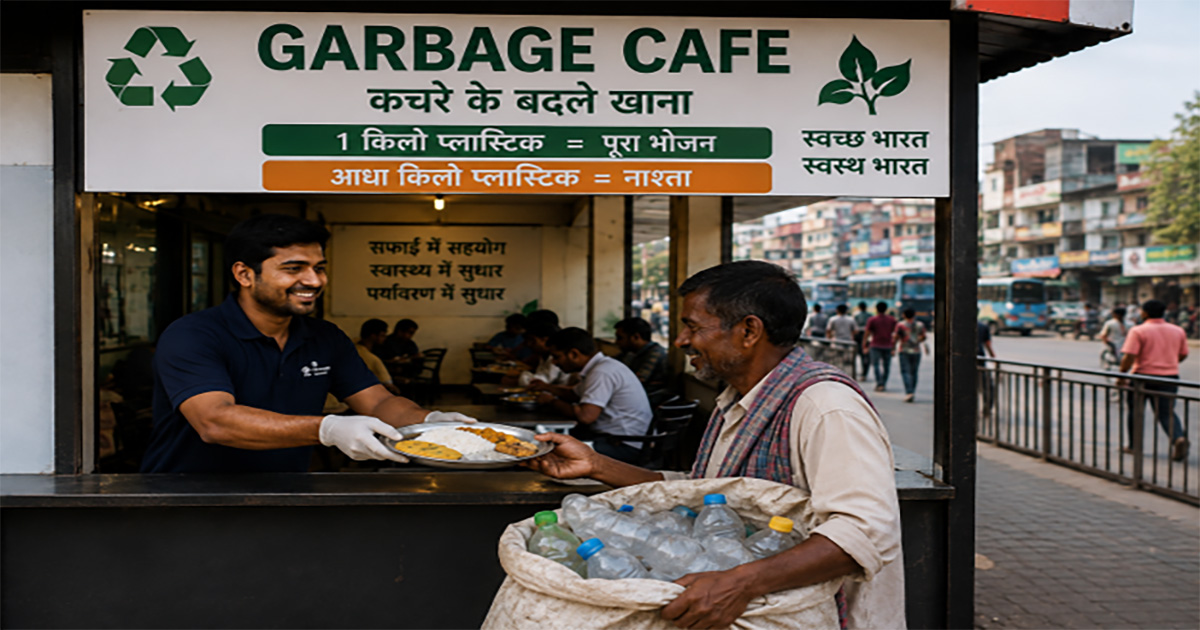
Garbage Cafe | This image is AI-generated
The roads around the bus stand in Ambikapur, in Chhattisgarh’s Surguja district, come alive with activity as soon as morning arrives. Amid the movement of buses and passengers, the bustle of shops, and small and large things scattered along the roadside, plastic waste could also be seen. But in the middle of this crowd, a café called the ‘Garbage Café’ came up, where no one has to return hungry even if they do not have money in their pocket. All that is needed is the very thing brought along as waste, something that people usually consider useless and throw onto the road or into drains. Here, bringing one kilogram of plastic gets a person a full meal, while half a kilogram of plastic is exchanged for breakfast. Gradually, this scene began to appear on the streets of Ambikapur. Some people would collect plastic from their homes, some would pick up waste lying along the roadside, and some waste pickers would bring a part of their day’s collection to the café.
The process inside the ‘Garbage Café’ is very simple. Plastic is brought in, weighed, and once the required quantity is reached, a full meal or breakfast is provided in exchange. The plastic that, just a little while earlier, no one wanted to touch had now become a means of reaching a plate of food. But the story does not end with the plate. The clean and segregated plastic collected at the café is then sent to the Plastic Granule Unit of the city’s Solid and Liquid Resource Management Centre, where it is included in the recycling process. In other words, the waste picked up from the streets is returning to the chain of use once again. A full plate of food in exchange for one kilogram of plastic gave people a small incentive to bring waste to the right place, and gradually plastic began disappearing from public spaces.
Behind this entire arrangement is a model of Ambikapur Municipal Corporation in which cleanliness and social assistance have not been seen separately. The café has been established near Pratiksha Bus Stand at a place where a large number of people can easily reach it. The responsibility for operating it was given to an agency, which pays a one-time premium and monthly rent through the Expression of Interest process. The café has a total of ten tables. Of these, eight tables are used by the agency for its regular business activities, while two tables are reserved for those who come to eat after bringing plastic. In this way, the café continues to receive regular income and the Municipal Corporation receives revenue, while the same place also continues to address the city’s waste problem. Without putting any additional financial burden on cleanliness, this model gradually made its own way forward.
Then the figures from this small experiment began to emerge, making its story even bigger. According to the official data of Ambikapur Municipal Corporation, from the year 2019 to June 2026, a total of 24,296 people have deposited 20,077 kilograms of plastic waste through this café and received food in return. Looking at the figures year by year, in 2019, 2,832 individuals deposited 2,555 kg; in 2020, 5,185 individuals deposited 4,015 kg; in 2021, 1,845 individuals deposited 1,825 kg; in 2022, 3,410 individuals deposited 2,920 kg; in 2023, 4,187 individuals deposited 3,285 kg; in 2024, 3,029 individuals deposited 2,555 kg; in 2025, 2,825 individuals deposited 2,174 kg; and from January to June 2026, 983 individuals have already deposited 748 kg of plastic waste. This has reduced waste in public places and brought an unprecedented improvement in the cleanliness and appearance of the city.
Perhaps the most human scene in this story is when a needy person, instead of counting money, watches the weight of the plastic they have brought. There are no coins in their hands, but they are not empty-handed either. The sack of waste, which someone might have considered useless only a short while earlier, now becomes the basis of their meal. A plate of food arrives before them, and at the same time, some more plastic is removed from the city. Here, the difference between the person receiving help and the person providing help becomes somewhat blurred, because the person receiving food is also playing a role in keeping the city clean. That is the most distinctive aspect of this model: the needy person does not merely receive charity; they receive dignity in exchange for their contribution. Ordinary citizens get a way to dispose of waste, the city gets cleanliness, and the plastic moves towards recycling. A small transaction begins to create benefits for several people at the same time.
The story of Ambikapur is connected to an approach in which cleanliness is not limited to merely sweeping, but becomes an effort to turn waste into a resource. Under the Swachh Bharat Mission–Urban 2.0, such local innovations encourage cities to find local solutions to their waste-management problems. In Ambikapur, plastic was picked up from the street, reached the café, was converted into food, and then moved towards recycling. This very process puts the idea of a circular economy into practice, in which something considered useless is made useful again.