How Swami Sivananda Inspired APJ Abdul Kalam After His Failure?
A.P.J. Kalam reached Dehradun and enthusiastically participated in the selection process for the pilot in the Indian Air Force. However, destiny had something else in store; he missed the final selection by just one rank.

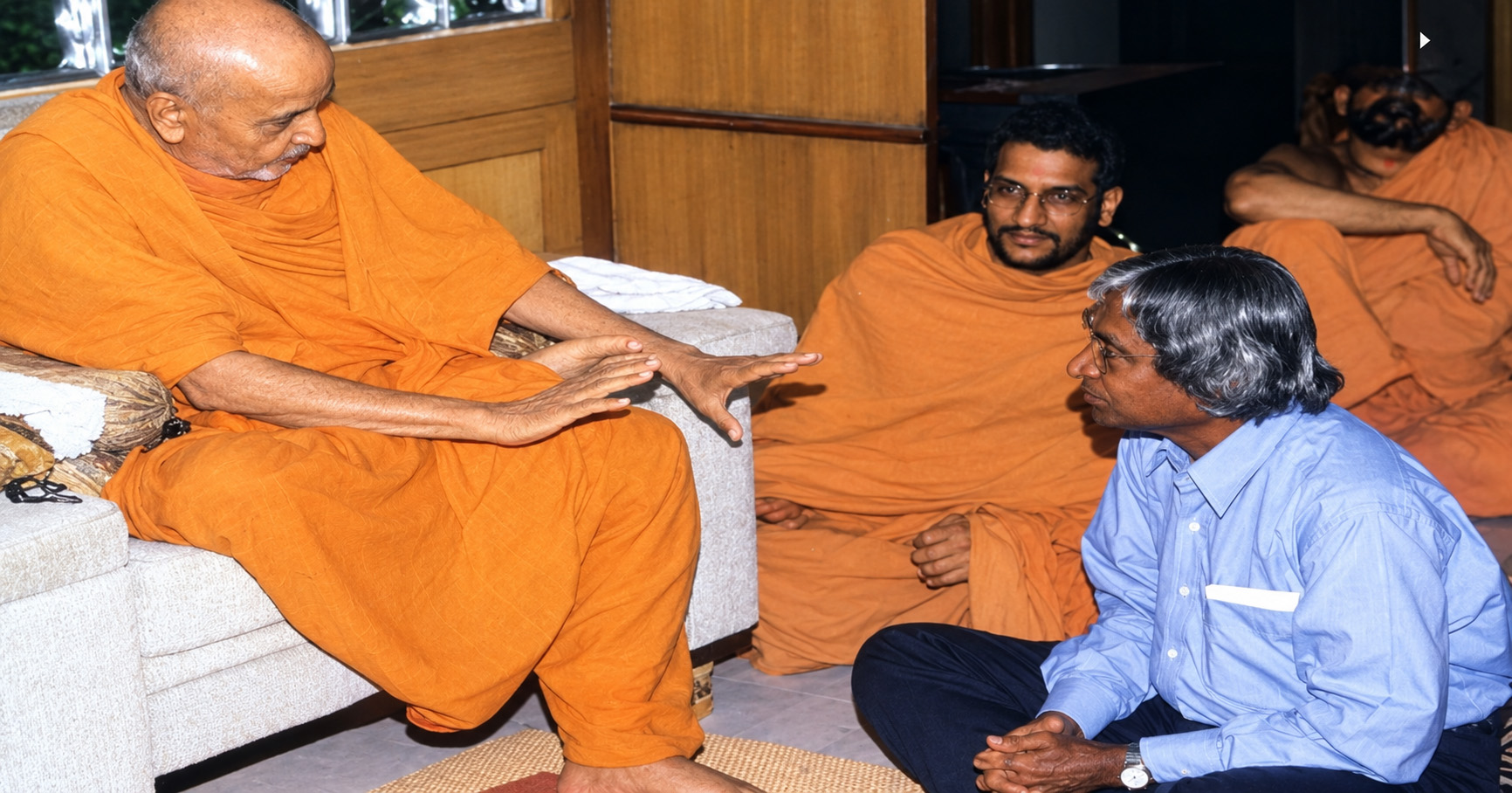
A.P.J. Abdul Kalam's meeting with Swami Sivananda | Image Source: Amar Ujala
It was 1957. A.P.J. Abdul Kalam had a big dream in his mind—to become a pilot in the Indian Air Force. After completing his education in Aeronautical Engineering, he applied to become a pilot in the Indian Air Force. And within some time, he was also called for an interview by the Air Force Selection Board in Dehradun. This was a very important stage in his life. Hoping to become a pilot, Kalam reached Dehradun and enthusiastically participated in the selection process. However, destiny had something else in store; he missed the final selection by just one rank, and on that very day, his cherished dream seemed to shatter in an instant. In Kalam’s own recollection, this was a moment of deep disappointment.
After leaving Dehradun, many questions were running through his mind. The dream he had worked towards for so many years was now not going to be fulfilled. What he should do next, where he should go, and what direction his life would take—he had no answers to these questions at that moment. On his way back to Delhi, he decided to go to Rishikesh. There was no grand plan behind that journey; he was setting out with the restlessness in his mind. In those days of 1957, Rishikesh was not a place of tourism for him, but a place he had reached to have a conversation with himself.
After reaching Rishikesh, Kalam took a bath in the Ganga. After that, he walked towards the Sivananda Ashram, situated on a nearby hill. As he entered the ashram, the pain of failure was still lingering in his mind. However, as soon as he entered, he felt intense vibrations there. He saw that many sages were sitting around him in a state of meditation. He had read that sages are people who know things through intuition. And so, in a state of despair, he began seeking answers to the doubts that were troubling him.
It was there that he met Swami Sivananda of the ‘Divine Life Society’. Kalam has clearly written a beautiful account of this entire meeting in his autobiography, Wings of Fire. While describing Swami’s personality, he said, “I was impressed by his charming, almost childlike smile and his gracious nature. I introduced myself to Swamiji. My Muslim name evoked no reaction in his mind. Before I could say anything further, he asked me the reason for my sorrow. He gave no explanation as to how he knew that I was sad, and I did not ask.”
Kalam then told Swamiji his story—the dream of becoming a pilot in the Indian Air Force, the selection process in Dehradun, and the opportunity he missed because he stood ninth in the final list. It deeply troubled him that eight candidates had been selected and he had stood ninth. The defeat in his mind was not merely about not being selected; he felt that the very life he had imagined for himself had now slipped out of his hands. In that state, he was sitting before Swami Sivananda.
However, during this meeting, Swami Sivananda gave Kalam a new perspective on looking at failure. Referring to the Gita, he gave him the valuable mantra, “Defeat the tendency towards defeat,” and asked him to surrender himself to the will of God. He told Kalam to forget this failure, as it was necessary to lead him towards his true destined path, and guided him to accept his fate and move forward in search of the true purpose of his future existence. The thought that “This failure is not the end” took root in Kalam’s mind through that meeting. The valuable guidance of Swamiji, along with the copy of the Bhagavad Gita and the financial assistance he gave Kalam while bidding him farewell, completely dispelled the disappointment in Kalam’s mind.
Kalam’s dream of becoming a pilot was missed by just one rank in the Air Force selection; but perhaps that very one rank changed the course of his life. The failure in Dehradun brought him to Rishikesh, and that meeting with Swami Sivananda transformed the disappointment in his heart into a new hope. That day, he did not get the sky he had wanted, but he certainly gained an understanding of which direction he should fly in the future.
Looking at everything that happened later in his life, the significance of that one meeting becomes even more apparent. Later, because of his significant contribution to missile development, he came to be known as the ‘Missile Man of India’ in the 1990s, and on 25 July 2002, he became the 11th President of India. This proves that even if one dream remains unfulfilled, life can bring us an even greater future.