How Swami Ramanand Tirtha Used Education to Challenge the Nizam’s Rule in Hyderabad?
Even out of his monthly salary of ₹50, a large portion went toward his students’ fees and needs. He supported himself through alms received from five households.

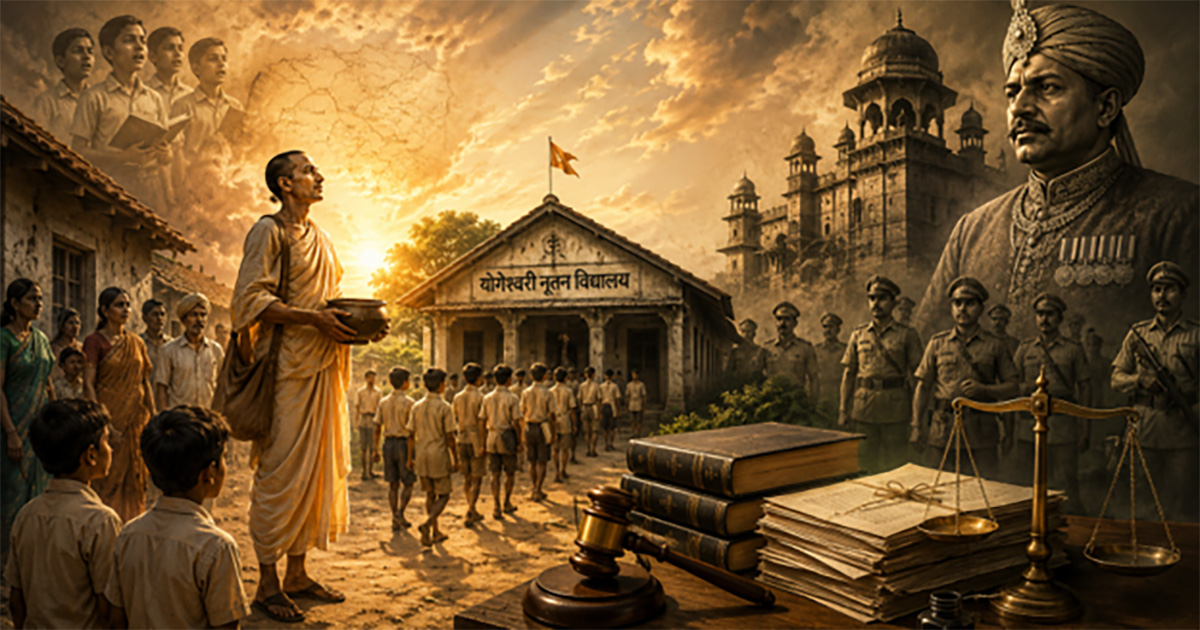
Yogeshwari Nutan Vidyalaya: When Swami Ramanand Tirtha Used Education to Challenge the Nizam | This image is AI-generated
On the morning of June 9, 1929, the doors of a new school opened in the village of Hipparga, Marathwada. The rooms were simple, and resources were limited, but for the teacher who taught there, education meant much more than books and examinations. While teaching in the classroom, he would also speak to his students about freedom, self-respect, and patriotism. Even out of his monthly salary of ₹50, a large portion went toward his students’ fees and needs. He supported himself through alms received from five households. During his six years as the headmaster of the National School, one thought grew increasingly stronger in his mind—if Hyderabad State was to be transformed, the minds of its youth would first have to be prepared.
In 1932, he renounced worldly life and came to be known as Ramanand Tirtha. At that time, Hyderabad was ruled by the seventh Nizam, Mir Osman Ali Khan. Government control over education in the state was strict, and opening a new private school was not easy. The avenues for higher education were already limited for students speaking Marathi, Telugu, and Kannada. It was during this period, in early 1935, that Swami Ramanand Tirtha arrived in Ambajogai.
The Yogeshwari Nutan Vidyalaya, established there in 1918, was functioning, but permission to open the eighth grade was still pending. If children wanted to continue their education after the seventh grade, they had to go to Hipparga, Gulbarga, or Hyderabad. Swamiji did not try to open a new branch. He knew that the Nizam’s government could immediately stop it. Instead, he decided to strengthen the existing school. Narayanrao Joshi, Babasaheb Paranjape, Acharya G. Dho. Deshpande, Baburao Kanade, Dr. Devisingh Chauhan, and Keshavrao Kurdurkar stood by him. They then began going from house to house and speaking with parents.
On 5 May 1935, the day of Akshaya Tritiya, the eighth grade was finally started at the school. On the very first day, 86 children arrived. By the end of the second month, the number had risen to 275. In July 1936, the ninth grade was also opened, and the school had around 500 students.
Now the problem was no longer simply running the classes. The Nizam administration refused to recognise the eighth and ninth grades. The education and future of hundreds of children had become dependent on a government order. Instead of taking to the streets, Swamiji began the fight within the files and rules of the administration. Applications were submitted. Meetings were held with officials. Educational rules and laws were examined in detail. His journeys from Ambajogai to Hyderabad continued. On one occasion, he told his colleagues, “I did not establish this institution to provide a livelihood for four people. For me, this institution is a task given by God, and it will remain my companion until my last breath.”
Then, in November 1937, Syed Akbar Ali, the Special Inspecting Officer of the Hyderabad Education Department, arrived in Ambajogai. He visited the classrooms, questioned the teachers, and examined the children.
The people at the school knew that this was not merely a routine inspection—the future of the school’s entire struggle was hidden in that examination. The officer returned. For several weeks, there was no news. Then, in December 1937, an official letter arrived. The eighth and ninth grades had been granted recognition. The permission for which they had been struggling for years had finally come with the government’s official seal.
For Swami Ramanand Tirtha, this was not merely the recognition of two classes. He had demonstrated that when one door is closed, it is always possible to look for another door. Standing up to the Nizam’s authority, he used the rules of the very administrative system that had been designed to restrict him.
The Yogeshwari Nutan Vidyalaya gradually became an institution remembered as a school of national consciousness. Many students who passed through its doors later became associated with the Hyderabad Liberation Movement.
This victory was not merely the victory of a school. It was the victory of the idea that an authoritarian government does not always have to be challenged on the streets; sometimes, it can also be challenged from within its own administrative system.
The Yogeshwari Nutan Vidyalaya later became known as a “school that nurtured the spirit of nationalism.” Many activists who played an active role in the Hyderabad Liberation Movement emerged from this very institution. This small administrative victory achieved in Ambajogai eventually became the foundation for a much larger political movement in the years that followed.
Swami Ramanand Tirtha had proved that changing history does not always require an army. Sometimes, all it takes is a school, a few teachers, hundreds of students, and the right strategy.
.jpg)