Swami Rama Tirtha: The Indian Guru Who Helped Indian Students Study in America 120 Years Ago
Swami Rama Tirtha noticed that Indian students struggle to gain access to affordable education. So, he decided this must change.

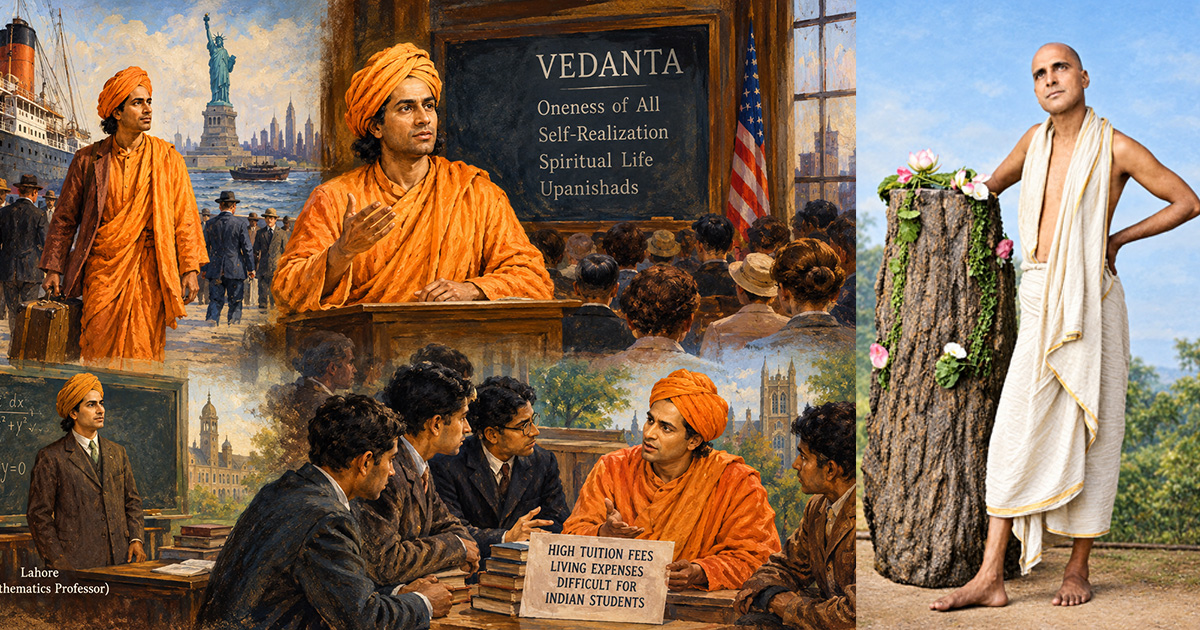
Swami Rama Tirtha | This image is AI-generated
In 1902, an Indian guru landed in the United States of America as a preacher of Vedanta, an ancient Indian philosophy based on the Upanishads. His name was Swami Rama Tirtha, a former mathematics professor from Lahore, Punjab (present-day Pakistan). He had left the profession to become a sannyasi. America was very different from the land Swami Ji had left behind, but he quickly found his feet there. Across America, Swami Ji gave lectures full of his views on Advaita Vedanta, spiritual values and self-realization. But as he wandered, Swami Ji began to notice something else: Indian students’ struggles to gain access to affordable education. For those who wanted to study at American colleges, the tuition fees and general expenses in America could be too much to bear.
Being a professor himself, he understood the value of education. Thus, in 1903, Swami Ji initiated talks about the struggles of Indian students in America as he travelled to places such as San Francisco, Portland, and Oregon. Swami Ji started asking various sympathetic individuals in San Francisco, where he had been staying for about 2 months, rallying the cause for contributions. He didn't want Indian students to come to America merely for the sake of gaining degrees, but to pick up the scientific, technical, and practical knowledge that India needed. He thought that India needed young people trained in science, technology, engineering, agriculture, and other practical fields. He especially encouraged the agricultural and industrial training of young Indians so they could take this valuable knowledge back to their villages, farms, and industries and become more productive and improve the lives of their fellow Indians. Swami Ji felt that education could make Indians more self-reliant and break the cycle of social injustice that left so many disadvantaged.
By 1903-1904, Swami Ji's appeals had evolved into a call to action. In Portland, funds had been raised to establish a program to bring Indian university graduates to American institutions to further their studies. Swami Ji now wanted to take his appeal to a higher level by establishing an organization that could help Indian students in a more systematic way. Hence, in 1904, he, along with his American supporters, established the Rama Society in Portland. The organization provided scholarships and financial aid to poor Indian students, raising funds to support their studies and connecting them to American colleges. For the Indian students, such an initiative meant everything. They were living in a foreign land, and although the Indian community in America was gradually growing, it remained a small and largely isolated group. Swami Rama Tirtha | Image Source: Exotic India Art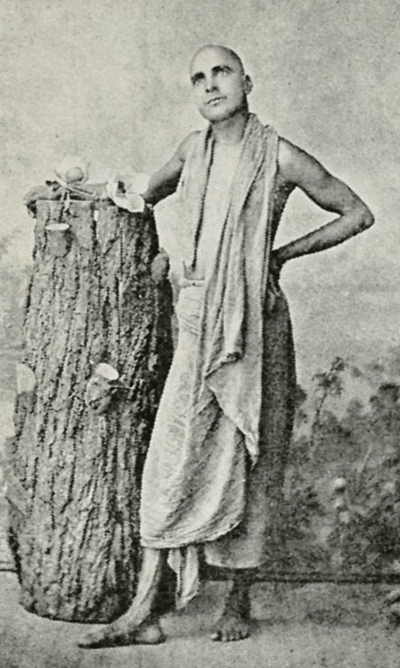
The efforts made by Swami ji were described in an article, The Hindu in America, written by Girindra Mukerji, an Indian student at the University of California. Mukerji recalled that Swami Rama Tirtha’s efforts were aimed at improving the lives of Indian students and encouraging them to unite in their pursuit of higher education. He also noted that the organization in Portland encouraged Indian students to study agriculture, a field Swami Ji believed could benefit both the students and their homeland. Mukerji himself became an example of this vision. He studied agriculture at the University of California and shared information about American colleges with Indian students who wished to pursue higher education.
For Mukerji, Swami Ji’s initiative was more than an effort to help students secure an education. It created a support network for the first generation of Indian students in America—young people who could learn from one another, share resources, and acquire practical knowledge that they could eventually take back to India. Mukerji was himself among these young Indians striving to build a future through education.
Although Swami Rama Tirtha had left America in 1904, the idea he had planted continued to grow among the students he had inspired. Even after he died in 1906, the initiative to support Indian students was carried forward by other young Indians. What had begun with a spiritual teacher introducing Americans to Vedanta had evolved into something far more practical: a growing network that helped Indian students access education, support one another, and acquire knowledge they could put to use in their homeland.