93 Days, Three Terrorists, & One Mission: Inside India’s Operation Mahadev—Manhunt That Avenged Pahalgam Attack

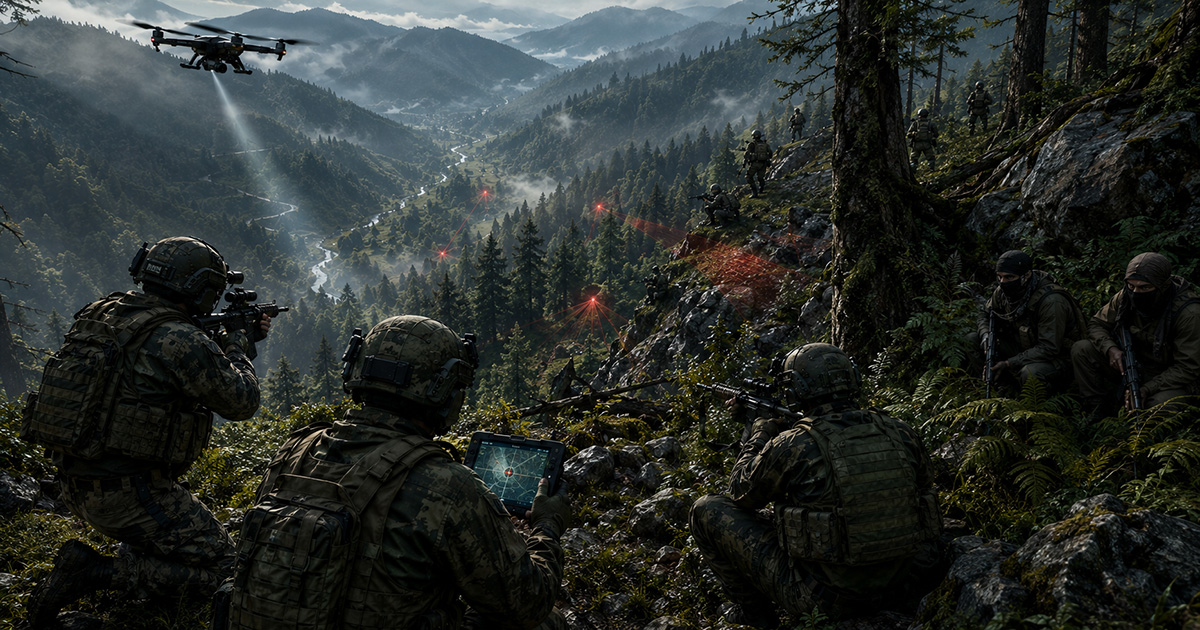
Operation Sindoor | This image is AI-generated
A year ago, on April 22, 2025, the serene meadows of Baisaran valley, located in Pahalgam, Jammu and Kashmir, were turned into a site of horror when 26 innocent lives were lost following the brutal terror attack by the Pakistan-backed terrorists. It was a targeted attack—first Hindu men were singled out, and then they were shot at point-blank range in front of their wives, children, and families. But India did not forget, and it did not forgive. In the weeks that followed, a determined and methodical response began to take shape, culminating in a high-precision counter-terror operation named Operation Mahadev, ensuring that those responsible were hunted down and brought to justice. Today, we break down how the entire operation unfolded and how the perpetrators of the brutal attack were brought to justice.
The site of Pahalgam terror attack | Image Source: Frontline
The First Crucial 48 Hours
Within hours of the attack, security forces moved swiftly to the site of the incident. The day after the attack, a high-level security meeting was convened, bringing together the Indian Army, CRPF, and Jammu and Kashmir Police. The objective of the meeting was clear: The attackers must not escape the country. With that, initial investigations began.
Eyewitness accounts from survivors were combined with technical intelligence inputs to reconstruct the sequence of events. Within a short span, the attackers were identified as three Pakistani terrorists—Suleiman (also known as Faizal Jat), Hamza Afghani, and Jibran. All three were linked to Lashkar-e-Taiba, a terror outfit long associated with cross-border terrorism in India. Suleiman, an ‘A’ category commander, was identified as the mastermind behind the Pahalgam attack. The others were also hardened operatives, involved in previous acts of violence. With identities confirmed, the strategy shifted to containment.
Three terrorists had been killed and ammunition was recovered during the gunfight | Image Source: NDTV
Security forces sealed likely escape routes across the Kashmir Valley, ensuring that the terrorists could not slip across the border into Pakistan.
Hunting Down the Terrorists Begins
The real chase began a month after the attack, on May 22, 2025, when the first credible intelligence input emerged. The Intelligence Bureau received human intelligence (HUMINT) indicating a terrorist presence in the Dachigam region. Over 1,000 individuals, including locals, pony operators, and even tourists, were questioned for more than 3,000 hours. From that point onward, Operation Mahadev evolved into a relentless, multi-layered manhunt. With this, technical intelligence (TECHINT) also worked simultaneously. Advanced surveillance tools such as drones, electro-optical sensors, thermal imaging systems, and satellite tracking were deployed extensively. Even encrypted communications using Chinese-origin radio devices were intercepted, helping to narrow down the terrorists’ movements. In the meantime, the National Investigation Agency (NIA) arrested local collaborators who had provided shelter and logistical support to the terrorists.
With the help of technical and human intelligence, the terrorists were traced moving across the upper reaches of South Kashmir through Hapatnar, Bugmar, and Tral, before moving towards the dense forests along the Mahadev Ridge in Dachigam. This forest’s terrain played a crucial role. At first, it acted as a shield, offering thick vegetation and steep gradients that helped the terrorists evade immediate capture. But as surveillance tightened, the same terrain turned into a trap, restricting movement and limiting escape routes. Thus, on July 10, 2025, the search, which began across a massive 300 square kilometre area, was gradually confined to a 25 square kilometre zone as security forces kept tracking the terrorists step by step, slowly narrowing down their location. At this point, additional forces, including elite Para (Special Forces) units and the Rashtriya Rifles, were deployed.
By July 22, 2025, coordinated actions were launched after sensors officially confirmed the presence of the terrorists in the Lidwas forest area (Dachigam/Harwan). Escape routes were systematically blocked, and the terrorists were effectively isolated.
July 28, 2025: The Final Crackdown
The breakthrough came on July 26, when intelligence agencies intercepted a mobile signal. The terrorists, exhausted and running out of supplies, had briefly switched on a phone to contact their handlers, unknowingly revealing their location. With this crucial input, the final phase was activated on July 28, 2026. Para Special Forces commandos were airlifted under the cover of darkness and inserted into the mountainous terrain. Meanwhile, the Rashtriya Rifles established a tight cordon, ensuring there was no escape.
After the overnight approach, the commandos advanced nearly 3 kilometres on foot over 10 hours on the treacherous high-altitude terrain in freezing conditions to avoid any detection by the terrorists. At around 8:00 AM on July 28, drone surveillance confirmed the terrorists’ exact position when they were asleep inside their tents, unaware of the approaching forces. At 9.30 am, the Rashtriya Rifles (RR) troops and Para Special Forces moved to the Mahadev hill feature and began the visual identification of the terrorists. The intense encounter between the security forces and the terrorists began at 11 AM, and three of them were neutralised within minutes.

Items recovered from the site of incident | Image Source: Lokmat Marathi News
The operation did not end with the encounter; it was backed by conclusive evidence. Ballistic tests confirmed that cartridges recovered from the Pahalgam attack site matched the rifles seized from the terrorists—two AK-series rifles and one M4. Pakistani voter ID cards and Pakistan-made chocolates were recovered. One of the terrorists was identified as a former Pakistani army commando. This established beyond doubt that the neutralised individuals were directly responsible for the Pahalgam massacre.
A Strategic Messaging
Operation Mahadev was not just a successful counter-terror operation; it was a strategic message. It reinforced that every terror strike on the soul of India would not be forgotten and forgiven. It showed that every terrorist would be pursued and eliminated, no matter how long it takes or how difficult the terrain. It was also a decisive message to Pakistan-backed terror networks—that cross-border terrorism will not go unanswered.
And, most importantly, it delivered justice to the victims of Pahalgam. From April 22 to July 28, the 93-day operation showcased a new model of counter-terrorism: One that combined intelligence precision, technological superiority, and unmatched human endurance.



.jpg)