
De Jure Transfer Day: The Fall of Vedapureeswarar Shiva Temple Under French Rule
For centuries, the Vedapureeswarar Temple had stood as an important center of worship for the people of Pondicherry.

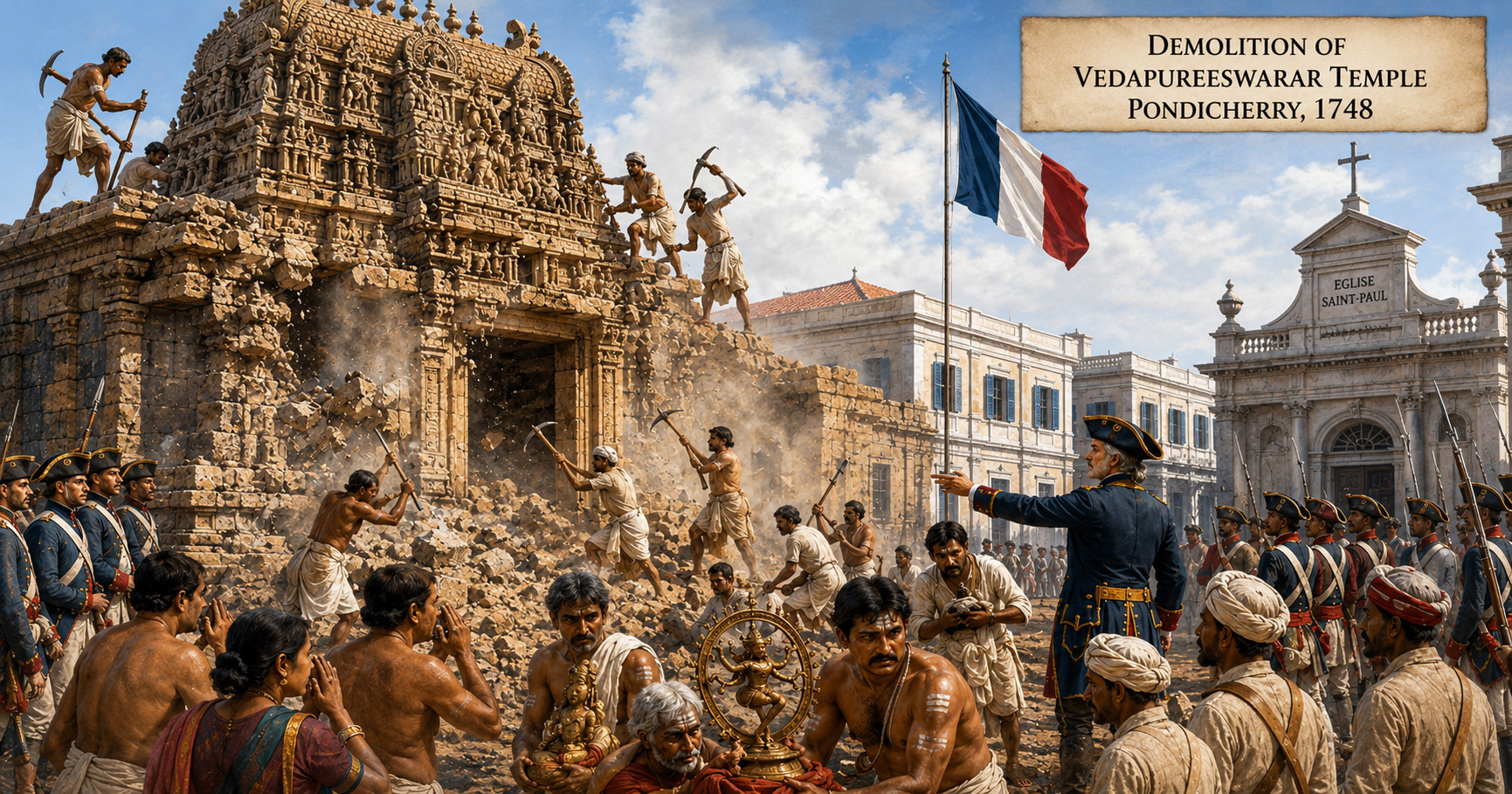
The Demolition of Vedapureeswarar Shiva Temple in Pondicherry Under French Rule | This image is AI-generated
When people speak of colonialism in India, the British Empire usually dominates the conversation. Yet, on India's southeastern coast, another colonial power left behind a painful chapter of religious persecution and cultural destruction. In the French-controlled town of Pondicherry, one of the most sacred temples of the region, the Vedapureeswarar Temple dedicated to Lord Shiva, was brought down in 1748. Its destruction became a symbol of the struggle between colonial ambitions and the determination of local communities to preserve their faith.
For centuries, the Vedapureeswarar Temple had stood as an important center of worship for the people of Pondicherry. Dedicated to Lord Shiva, it was not merely a religious structure but a focal point of social and cultural life. However, the arrival of French colonial rule gradually changed the atmosphere of the town. As Pondicherry developed into the capital of French India, tensions began to emerge between the colonial administration, Christian missionary groups, and the local Hindu population. The temple occupied a prominent position near the French headquarters in Pondicherry, and some missionaries viewed its continued presence as incompatible with their vision of a Christian colonial city.
The situation reached a turning point in 1748. At the time, the British and French were engaged in a wider struggle for dominance in India as part of global European conflicts. During the British siege of Pondicherry (August–October 1748), French authorities decided to demolish the temple, reportedly because churches stood on the same street and the temple's presence was seen as incompatible with the Christian colonial vision. Amid this atmosphere of uncertainty and war, French authorities decided to act against the Vedapureeswarar Temple.
On September 8, 1748, Governor-General Joseph François Dupleix, a man determined to expand French influence, ordered the temple’s demolition. French troops moved against the temple, and one of Pondicherry's most revered religious sites was systematically demolished. Walls were torn down, sacred structures were destroyed, and a centuries-old center of worship was reduced to rubble. For the Hindu residents of Pondicherry, the event was devastating. Ananda Ranga Pillai, a prominent merchant and administrator who lived in Pondicherry during this period, was an eyewitness to the incident. In his diary, he wrote, on September 8, “...200 soldiers, 60 or 70 troopers, and Sepoys were stationed at St. Paul’s Church. M Gerbault (the Engineer), the priests with diggers, masons, coolies and others, 200 in all, with spades, pickaxes and whatever is needed to demolish walls, began to pull down the southern wall of the Vedapuri Iswaran temple and the outhouses…”
Before the temple could be completely desecrated, devotees rushed to save what they could. Sacred idols and religious objects were secretly removed from the temple premises and taken to safer locations. Several of these idols were sheltered in nearby temples, including the Varadharaja Perumal Temple. Local traditions also remember Ananda Ranga Pillai as one of the individuals who played a role in helping preserve these sacred images from destruction.
The demolition sent shockwaves through the Hindu population of Pondicherry. For many families, it became a painful reminder of the vulnerability of their traditions under colonial rule. Stories of the temple's fall were passed down through generations, ensuring that the memory of what had happened would not be forgotten.
But the story of the Vedapureeswarar Temple did not end with destruction. In the decades that followed, community leaders, merchants, and ordinary worshippers worked together to restore what had been lost. Funds were collected, support was mobilized, and plans were made to rebuild the sacred shrine. Finally, in 1788, forty years after the demolition, a new Vedapureeswarar Temple rose in Pondicherry. The reconstruction was led by Dewan Kandappa Mudaliar and supported by the local Hindu community. What colonial power had sought to erase was rebuilt through collective determination and devotion.