How India's First Tricolour Hoisting in 1906 in Calcutta Inspired Madam Bhikaji Cama's 1907 Historic Flag Hoisting in Germany
On August 7, 1906, thousands gathered at Parsi Bagan Square in Calcutta despite heavy monsoon rains. Then history was made. For the first time, an Indian tricolour, not the British Union Jack, rose above an Indian crowd.

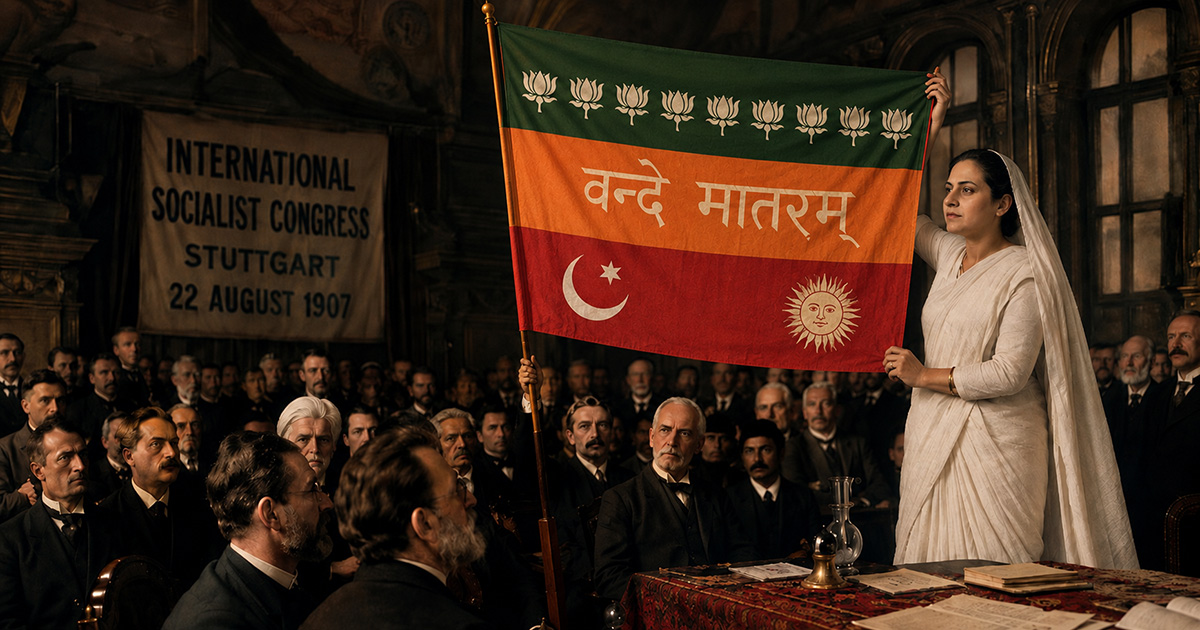
Madam Bhikaji Cama hoists the Indian flag in Germany in 1907 | This image is AI-generated
Imagine witnessing India's national flag being unfurled not in India, but in Germany, forty years before India became independent. On August 22, 1907, a packed hall in Stuttgart fell silent as a revolutionary Parsi woman stepped onto the stage, raising a tricolour high and declaring that, "Behold, the flag of independent India is born! It has been made sacred by the blood of young Indians who sacrificed their lives for it." Madam Bhikaji Cama | Image Source: The Better India
Their answer came on August 7, 1906, when thousands gathered at Parsi Bagan Square in Calcutta despite heavy monsoon rains. Then history was made. For the first time, an Indian tricolour, not the British Union Jack, rose above an Indian crowd. Designed by Sachindra Prasad Bose and Sukumar Mitra, it featured green, yellow and red horizontal stripes, eight lotus flowers representing India's provinces, the words "Vande Mataram," and the symbols of the sun and crescent moon as a message of unity. As the flag climbed, thousands roared, "Vande Mataram!" Then the Britishers began arresting nationalists, and even the slogan "Vande Mataram" became a target and got banned. But while they could suppress the movement, they couldn't stop the idea.
That idea soon travelled across Europe. In Paris, revolutionary Hemchandra Kanungo met Madam Bhikaji Cama, and together they adapted the Calcutta tricolour. While preserving its spirit and the central "Vande Mataram" in the middle band, they modified the color scheme to green at the top, saffron in the middle, where Bande Mataram' was written in Hindi, and red at the bottom. The top green band retained the eight lotuses representing the provinces of British India, while the bottom red band featured a sun on the hoist side and a crescent moon on the fly side. Some sites also note that Madam Bhikaji’s flag was very similar to the first flag except that the top strip had only one lotus but seven stars denoting the Saptarishi. Nonetheless, with this newly adapted flag, they waited for the right moment to present India's cause before the world.
That moment arrived on 22 August 1907, at the International Socialist Congress in Stuttgart. Before more than a thousand delegates from across the world, Madam Cama delivered a powerful speech exposing how British rule had drained India's wealth while millions suffered in poverty. Her words left the audience stunned: "The cause of such poverty is that thirty-five million pounds sterling are taken out of that land every year. It goes to England to make that wealthy country more and more wealthy. While in Hindustan, owing to this poverty, we die by half a million every month. Hindustan means one-fifth of the human race whose very lifeblood is sucked by England." Madam Bhikaji Cama at Stuttgart | Image Source: Utsavpedia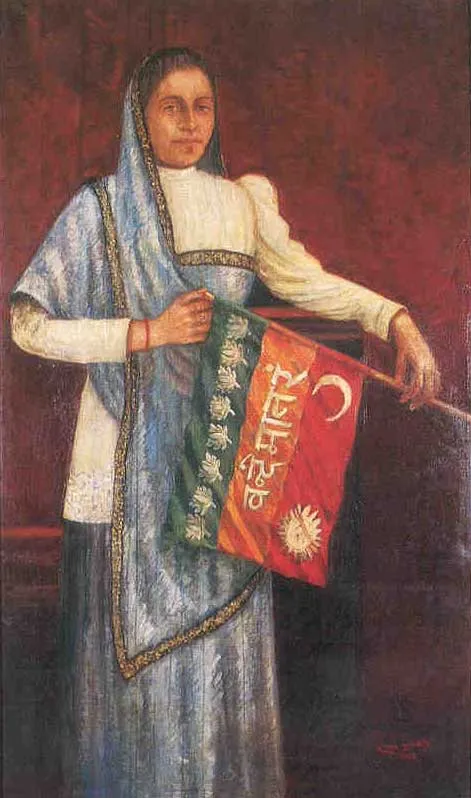
Then, at the height of her speech, she unfolded the tricolour and the hall erupted in applause. For the first time, India's struggle for independence was presented before the world beneath an Indian flag. Forty years later, the Tricolour rose above the Red Fort in an Independent India. But its journey had begun decades earlier on an international stage where Madam Bhikaji Cama boldly proclaimed that India would one day be free.